From 99-0, TeamFB7 is looking back on the greatest players in NFL history to don each jersey number. No ties allowed, tough decisions will be made — next is No. 77 and Jim Parker.
The Baltimore Colts of the mid-1950s all the way through the 1960s were one of the great teams of their time.
Loaded with talent and a revolutionary offense, they won NFL championships in 1958 and 1959 in the pre-Super Bowl era, again in 1968 (before subsequently losing Super Bowl III) and then won Super Bowl V to cap the 1970 season and really the end of their run.
Those Colts teams featured eight future Pro Football Hall of Famers, including several already spotlighted in this series with more to come, in quarterback Johnny Unitas, wide receiver Raymond Berry, running back Lenny Moore, offensive lineman Jim Parker, tight end John Mackey, defensive end Gino Marchetti, defensive tackle Art Donovan and linebacker Ted Hendricks near the end, plus HOF head coaches Weeb Ewbank followed by Don Shula.
And those Hall of Fame accolades weren’t merely the product of greatness by association but truly a wealth of individual legends forming a historic collective.
Each played a pivotal role in making the Baltimore Colts one of the most iconic teams of that time.
Jim Parker Helped Transform The Baltimore Colts
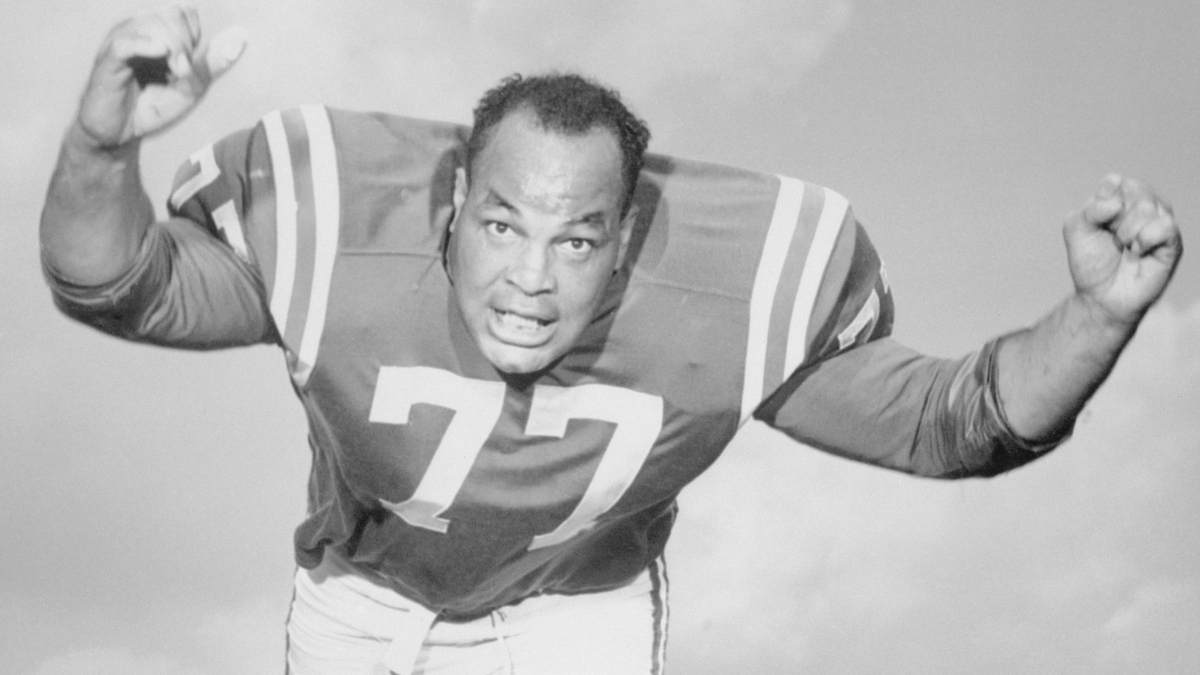
One of the most essential pieces to that puzzle was Parker, the No. 8 overall pick in the 1957 NFL Draft who immediately asserted himself as one of the best left tackles in the league before later finishing his career at guard.
“The turning point, really, in our offense and our team’s ability to compete in the Western Division of those days was the addition of Jim Parker at left tackle,” Berry said on NFL Network’s 10-part 2010 series ranking the 100 greatest players of all-time. “He brought the ability to open holes in the running game. [And] for John Unitas to ever get hit from the blindside, I don’t know that it ever even happened.”
Given Unitas’ legendary status, the offensive stats and touchdowns piled up by Berry, Moore and Mackey, the towering stature of Marchetti as one of the most feared defensive ends in the game and the outsized personality of Donovan, it would be fair to wonder if the more reserved Parker was overshadowed or underrated on those Colts teams.
But no, he was simply too good for that to be the case.
One Of The All-Time Greatest NFL Offensive Linemen
Historically listed at 6-foot-3, 273 pounds and seeming even larger than that on the field, Parker entered the league as a polished and fierce run blocker from his time as an All-American at Ohio State, where as a two-way player he helped the Buckeyes to an undefeated national championship season as a sophomore in 1954.
In Baltimore, with Unitas leading the NFL in passing attempts in four of his first five full seasons, Parker quickly showed elite proficiency as a pass blocker as well.
The NFL Network “Top 100: NFL’s Greatest Players” series pulled an old interview with Parker, who died in 2005, talking about how he approached the position.
“Sometimes I would pretend I was a freight train running over a pedestrian. On pass blocking, I would pretend I was a mountain, and that the other guy, he had to get around this mountain — and it was impossible,” he said.
In that same series, Hall of Fame Los Angeles Rams defensive tackle Merlin Olsen said, “Parker was like putting an apartment house in the line — the man was so huge. When I first saw Jim Parker play, I was amazed because he had great quickness, good feet, good balance and also this incredible size and strength. I think perhaps the most difficult thing for me to deal with as a defensive lineman was someone who had this huge bulk who still had enough mobility to move around.”
That combination of intimidating size and elite skill sets in both pass protection and run blocking quickly made Parker the standard setter for offensive line play at the time. Starting with his second NFL season in 1958, he was named to the Pro Bowl and voted first-team All-Pro eight straight years, including three at left guard.
Credit Ewbank, the Colts’ head coach at the time, for setting him on that path as Parker initially preferred to play defense in the NFL.
“Weeb said he had the three greatest linebackers in the game, and at defensive end, I saw they had Gino Marchetti. So that left me with tackle,” Parker once said, as recounted by The Athletic a few years ago.
And a most fortuitous outcome it was.
The NFL Legacy of Jim Parker
Parker would be the first full-time offensive lineman inducted into the Pro Football Hall of Fame in 1973.
Named to the NFL’s 1950s All-Decade Team, 75th Anniversary Team and 100th Anniversary Team, he was listed No. 24 on The Sporting News’ 1999 ranking of the top 100 players in NFL history, he landed at No. 32 on that NFL Network-produced “Top 100: NFL’s Greatest Players” in 2010 (second among offensive linemen behind only Anthony Muñoz and second behind Unitas from those Colts teams), and in 2021 Parker was No. 42 on The Athletic’s attempt at a top 100 list (fourth among offensive linemen behind Muñoz, John Hannah and Forrest Gregg).
On the NFL Network series, Berry contended that Parker’s dominance was even more impressive in the context of the era in which he played.
“You must understand that in the modern day game, what the offensive linemen are allowed to do under the rules [with their hands], in Jim Parker’s day it would be holding,” Berry said. “He had basically to keep his hands in like this, and we tried to get that ball out of their in 2.5 seconds. If Jim Parker could have done that extension of the arms and grasping and circling, I mean Unitas would have had 6 seconds to throw.”
A serious knee injury ended Parker’s career prematurely at 33 years old. While he was already contemplating retirement, he came back for an 11th season in 1967 with the Colts positioned to contend for a championship. The injury happened early that season and persisted, and with two games still remaining, Parker humbly announced his retirement so that the Colts could add another player who might help them down the stretch.
It was a noble if unceremonious ending to a legendary career.
But his place in NFL history was well-secured by then, and the Colts wasted no time retiring Parker’s No. 77.
He is, indeed, the greatest NFL player to ever wear it.
Deserving honorable mention as all-time great No. 77s are:
Hall of Fame OT Willie Roaf: 11 Pro Bowls, 4 first-team All-Pros, 5 second-team All-Pros in 13 seasons from 1993-2005 with the New Orleans Saints and Kansas City Chiefs.
Hall of Fame two-way early NFL star Red Grange: “The Galloping Ghost” was a two-time first-team All-Pro and two-time NFL champion with the Chicago Bears over eight seasons between 1925-34
OT Jim Tyrer: 9 Pro Bowls, 6 first-team All-Pros, 2 second-team All-Pros, 3 AFL championships, 1 Super Bowl championship in 14 seasons from 1961-74 mostly with the Kansas City Chiefs.
Greatest NFL Players By Number
99 | 98 | 97 | 96 | 95 | 94 | 93 | 92 | 91 | 90 | 89 | 88 | 87 | 86 | 85 | 84 | 83 | 82 | 81 | 80 | 79 | 78