

From 99-0, TeamFB7 is looking back on the greatest players in NFL history to don each jersey number. No ties allowed, tough decisions will be made — next is No. 79 and Roosevelt “Rosey” Brown.
When it comes to all-time NFL draft steals, everyone knows about quarterback Tom Brady falling to the New England Patriots in the 6th round and 199th overall pick in 2000 before going on to become the greatest player in league history.
Or the San Francisco 49ers finding a franchise quarterback in Brock Purdy with literally the last pick (No. 262) in the 2022 draft.
But somewhere on that list also needs to be Roosevelt “Rosey” Brown.
The NFL draft was interminably long back in the 1950s — 30 rounds and 360 picks — and many players selected never ended up playing for the team that picked them. Some went back to college and joined the team the following year. Some just went and got real jobs instead because the money was better that way.
There was no scouting combine. Heck, there was very little scouting, period.
Longtime football executive Gil Brandt, who got his start with the Los Angeles Rams in 1955 and most notably served as the vice president of player personnel for the Dallas Cowboys from 1960-88, reflected on the chaos of those early drafts in a column for NFL.com a while back.
“Most teams would come into the draft with football magazines or newspapers, like the Billings Gazette, which would, for example, have college all-star teams listed in them. The other thing most teams would bring was a whole roll of quarters. When someone needed, say, a tackle, they might go out to the lobby, pick up a payphone, call a school and say, ‘Hey, we need a tackle; you got anybody good?'” Brandt recalled.
An NFL Career That Almost Didn’t Happen For Rosey Brown
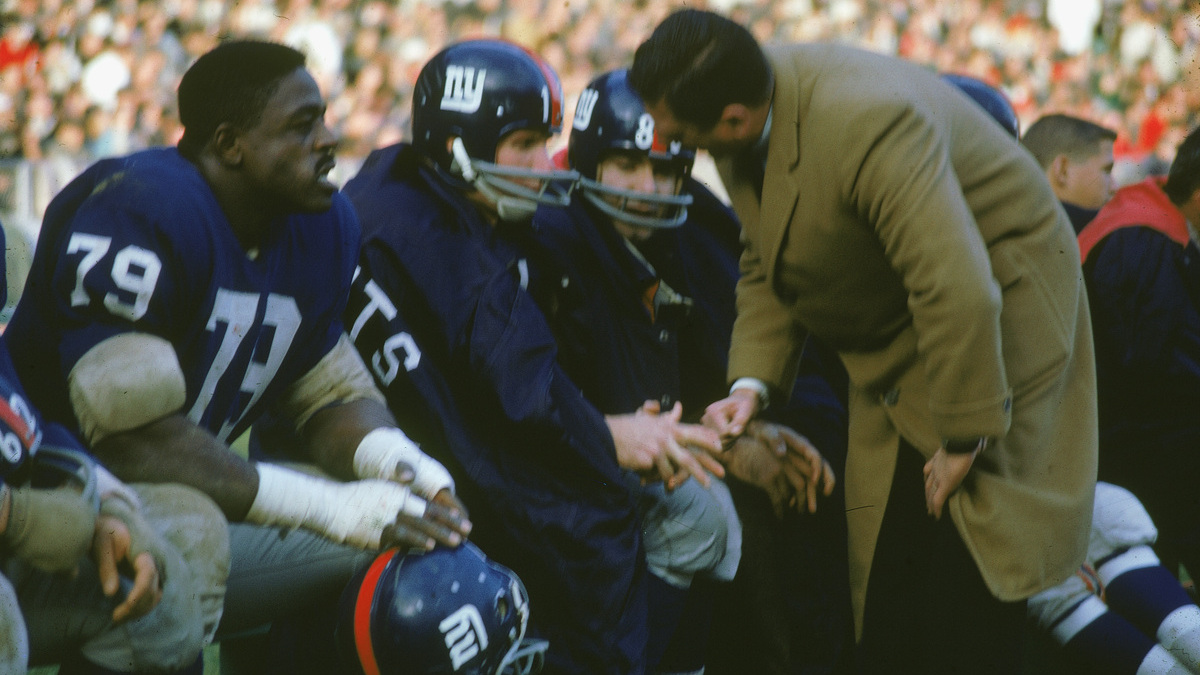
Well, apparently more teams should have been calling the staff at little Morgan State University in Baltimore during the 1953 NFL Draft as a future Hall of Fame left tackle tumbled all the way to the 27th round before the New York Giants selected the exceptionally athletic 6-foot-3, 255-pound Brown with the 321st overall pick.
As the story goes, the Giants chose him based on seeing his name on the Pittsburgh Courier’s All-American Team.
Brown became an immediate starter as a rookie for the Giants. By his third season, he made his first of nine Pro Bowl appearances, and by his third season he was recognized as one of the best tackles in the league, earning the first of his six first-team All-Pro honors (along with two second-team All-Pro nods).
Brown played a key role in the Giants winning the 1956 NFL Championship, helping clear the way for halfback Frank Gifford, who was one of the biggest stars in the league at the time.
“I wouldn’t be in the Hall of Fame if it weren’t for him,” Gifford said, as recounted in the New York Times’ obituary for Brown in 2004. “… The longest run of my career was on a pitchout against Washington. Rosey made a block at the line of scrimmage, I cut it up, and then I’m running downfield and I look up and I see No. 79 in front of me and he wiped out another guy.”
Brown missed only four games over his 13-year NFL career — all with New York — and remained stout to the end, making the Pro Bowl in each of his final two seasons.
“Probably the best offensive lineman … maybe the best ever,” Gifford once said. “I wouldn’t want to have a foot race with him — he was really fast and very athletic. I mean, he could have played any position. He could have played halfback probably, too. He was extraordinary and a wonderful, wonderful person.”
Talk about a draft steal …
The Cultural Signifcance Of Brown’s Success In The NFL
But there was more to Brown being so undervalued in the draft than that. In the early 1950s, NFL teams were unfortunately still slowly adjusting to embracing Black players — especially in evaluating draft prospects from HBCU’s (Historically Black Colleges and Universities) like Morgan State.
It was just a handful of years earlier in 1946 that the Los Angeles Rams effectively broke the modern-era color barrier in signing Kenny Washington and Woody Strode. Fittingly, they had been teammates at UCLA with Jackie Robinson, who would of course break Major League Baseball’s color barrier the next year in 1947. But Washington was 28 years old when he signed with the Rams and Strode was 32 — well past their college days before their NFL opportunity finally came.
Future Hall of Fame defensive back Emlen Tunnell became the first Black player for the Giants in 1948 and was assigned as Brown’s roommate on the road when he joined the team.
“Rosey Brown used to tell me stories about when they used to go on the road a lot of the hotels would not let African-Americans in there,” longtime Giants executive Chris Mara said in a documentary the team produced on Brown. “And my dad [Giants co-owner Wellington Mara] had to kind of step up and say, ‘Well then you’re not letting any of us in because we’re not staying.'”
Brown’s wife Linda reiterated that story as well in the documentary.
Brown was so beloved by the Giants that when he announced his retirement as a player just before the 1966 season, the team immediately named him its assistant offensive line coach. As a player, coach and scout, he spent more than 50 years with the team.
Brown was inducted into the Pro Football Hall of Fame in 1975, named to the NFL’s 75th Anniversary Team in 1994 and later as one of seven offensive tackles named to the NFL’s 100th Anniversary Team in 2019.
Deserving honorable mention among the all-time great No. 79s are:
Fellow Hall of Fame offensive tackle Bob St. Clair, who made five Pro Bowls and earned five second-team All-Pro honors from 1953-63 with the San Francisco 49ers.
Five-time Pro Bowl defensive tackle Ray Childress, who earned four second-team All-Pro and one first-team All-Pro honors from 1985-95 with the Houston Oilers (before finishing with three games for the Dallas Cowboys in 1996).
Greatest NFL Players By Number
99 | 98 | 97 | 96 | 95 | 94 | 93 | 92 | 91 | 90 | 89 | 88 | 87 | 86 | 85 | 84 | 83 | 82 | 81 | 80
Editor's Pick
 10 Dark Horse Candidates For 2026 NFL MVP