From 99-0, TeamFB7 is looking back on the greatest players in NFL history to don each jersey number. No ties allowed, tough decisions will be made — next is No. 76 and Lou Groza.
Lou Groza will surely be the only kicker spotlighted in this series.
But that’s because Groza was so much more than just a kicker.
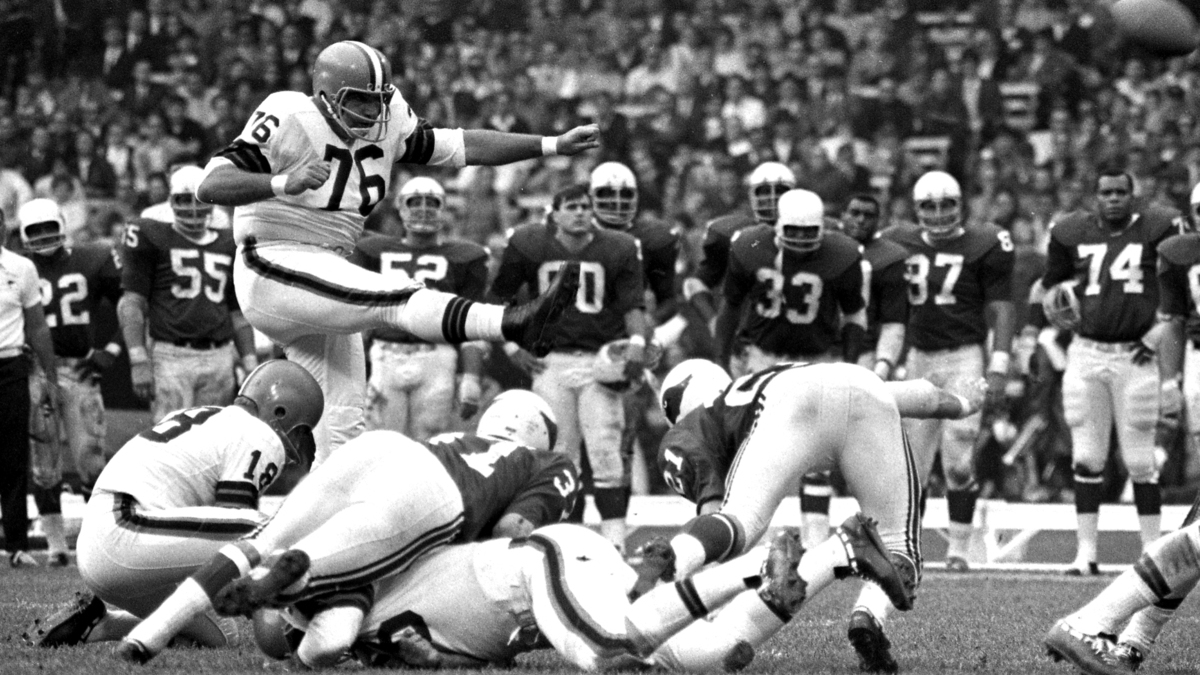
He was a pioneer of placekicking — the first next-level talent at the craft who ultimately changed the way that component of football was viewed entirely. After all, consider how good one has to be at such a discipline to be nicknamed simply “The Toe.”
But the 6-foot-3, 240-pound Groza was also the Cleveland Browns’ full-time starting left tackle for 12 seasons from 1948-59 (after playing part-time on the offensive line his first two seasons).
More than that, he was considered one of the very best offensive tackles in the league during his prime, making nine Pro Bowls in a 10-year span while earning first-team All-Pro honors four times and second-team All-Pro twice — all purely for his work at left tackle. The Pro Bowl and All-Pro teams didn’t yet recognize kickers as a specialized position at that time.
So while he may be remembered best in NFL lore as “The Toe,” Groza always made clear he viewed himself as an offensive tackle first and foremost.
During a 1998 interview available on YouTube, recorded a little more than two years before Groza died, he countered a question asked to him by clarifying: “I went in the Hall of Fame as a tackle.”
“Being selected to the Hall of Fame, I can remember the first year I didn’t make it when I was eligible, and the reason for it is some guy, a young reporter from some newspaper — they never told me who he was — he said he didn’t think that just a kicker should be able to get in the Hall of Fame. Of course, he didn’t realize I played tackle,” Groza said. “That’s how I went in the Hall of Fame was as a tackle rather than a kicker.”
Lou Groza Was A Game-Changing Talent At Kicker
But if he had been only a kicker, Groza would still hold a meaningful place in NFL lore.
Using the long-bygone straight-on kicking style, he led the NFL in made field goals in four of the Browns’ first five years in the league after the team was absorbed from the folded All-America Football Conference (AAFC) into the NFL in 1950.
The best way to state Groza’s impact on professional football at the time is by looking at how little emphasis was placed on kicking in the immediate years before his emergence.
The NFL leaders in made field goals in the five years prior to 1950 finished with 7 (out of 13 attempts), 9 (out of 17), a three-way tie at 7 (out of 10, 16 and 16), 8 (out of 12) and a two-way tie at 9 (out of 16 and 18).
(There were some mildly higher totals in the AAFC in those years, including Groza’s own 13 field goals in 1946).
Groza himself had been an inconsistent kicker his first four seasons with the Browns, but starting in 1950 as the team moved to the NFL he became Cleveland’s special weapon, especially from longer distances at which other teams would be hesitant to attempt field goals.
1950: He went 13 of 19 on field goals in 10 games, leading the NFL in attempts, makes and percentage and breaking a 24-year-old NFL record for made field goals. His 16-yard field goal with 28 seconds left gave the Browns a 30-28 victory over the Los Angeles Rams in the NFL championship game.
1951: He made just 10 of a league-high 23 attempts in 12 games, an outlier for “The Toe” in terms of success rate. The Browns lost an NFL championship rematch with the Rams, but Groza made a 52-yard field goal that stood as a championship game record for 42 years.
1952: He made 19 of 33 field goals in 12 games to lead the league in both categories.
1953: In a career year, Groza made 23 of 26 field goals in 12 games to lead the league in attempts, makes and percentage as his 88.5% mark stood as a record for 28 years. He went 3 of 4 on field goals in the Browns’ 17-16 NFL championship game loss to the Detroit Lions, including two fourth quarter field goals (one from 43 yards) to give the team a 16-10 lead at the time.
1954: Groza followed that up by going 16 of 24 on field goals in 12 games to lead the league in makes and percentage.
That season, Groza was named NFL MVP by The Sporting News — one of two media outlets naming MVPs at the time, before the Associated Press MVP became the standard-bearer.
In addition to being a first-team All-Pro/Pro Bowl left tackle, Groza had been instrumental in two of the Browns’ wins during their 9-3 regular-season — accounting for all the points in a pivotal 6-0 win over the Philadelphia Eagles, who finished second in the Eastern Conference standings, and then 10 points in a 16-7 win over the New York Giants. The Browns won their second NFL championship that season with a 56-10 win over the defending champion Detroit Lions.
And on he went from there …
NFL Legacy For Lou Groza
In all, Groza led the NFL in made field goals five times (and the AAFC once) and field goal percentage five times. Including his AAFC years, he made 264 of 481 field goal attempts (54.9%) and 810 of 833 extra point attempts (97.2%).
After sitting out the 1960 season due to a back injury, Groza returned for seven more seasons as purely a kicker, playing until he was 43 years old.
He retired in 1967, after 21 seasons and 4 NFL championships with the Browns, as the NFL’s all-time leader in field goals, extra points and scoring. Including his four AAFC seasons, he set the professional football career scoring record at 1,608 points (including one receiving touchdown), which was later surpassed in 1971 by the Oakland Raiders’ George Blanda.
But Groza’s real legacy as a kicker is that his success — and the Browns’ confidence in using him often and everywhere — influenced other teams to put greater priority on the position.
“In my day, kicking was just part of something that you did,” Groza said. “And of course, we used it so proficiently they started hiring guys just to kick, and of course, they expanded the size of the squad. When we started in ’46, we had 33 men on the team.”
Since 1992, the Lou Groza Award has been given each year to the top placekicker in college football.
For his impact on shaping the use of the kicking game in football, and with respect to his separate accolades as a left tackle, Groza is our pick as the NFL’s greatest No. 76 — a number he wore from 1952-67 after initially donning No. 46.
But it wasn’t an easy call, especially over Hall of Fame offensive tackle Orlando Pace, who made 7 Pro Bowls, earned 3 first-team All-Pro and 1 second-team All-Pro honors and won a Super Bowl with the “Greatest Show On Turf” St. Louis Rams over a 13-year career from 1997-2009.
Other honorable mentions at No. 76 include fellow Hall of Famers:
OG Steve Hutchinson: 7 Pro Bowls, 5 first-team and 2 second-team All-Pro honors with the Seahawks and Vikings (and later Titans) in a 12-year career from 2001-12.
DT Steve McMichael: 95 sacks, 2 Pro Bowls, 2 first-team and 2 second-team All-Pro honors and a Super Bowl championship in 15 seasons from 1980-84, mostly with the Bears.
OG/OT Lou Creekmur: 8 straight Pro Bowls, 6 first-team and 1 second-team All-Pro honors and 3 NFL championships with the Detroit Lions over 10 seasons from 1950-59.
OT Bob Brown: 6 Pro Bowls, 5 first-team and 3 second-team All-Pro honors from 1964-73 with the Eagles, Rams and Raiders.
Greatest NFL Players By Number
99 | 98 | 97 | 96 | 95 | 94 | 93 | 92 | 91 | 90 | 89 | 88 | 87 | 86 | 85 | 84 | 83 | 82 | 81 | 80 | 79 | 78 | 77