From 99-0, TeamFB7 is looking back on the greatest players in NFL history to don each jersey number. No ties allowed, tough decisions will be made — next is No. 82 and Raymond Berry.
Like most of the early NFL stars, the impact of Raymond Berry on the game can no longer be told through statistics.
At one time, it could have been.
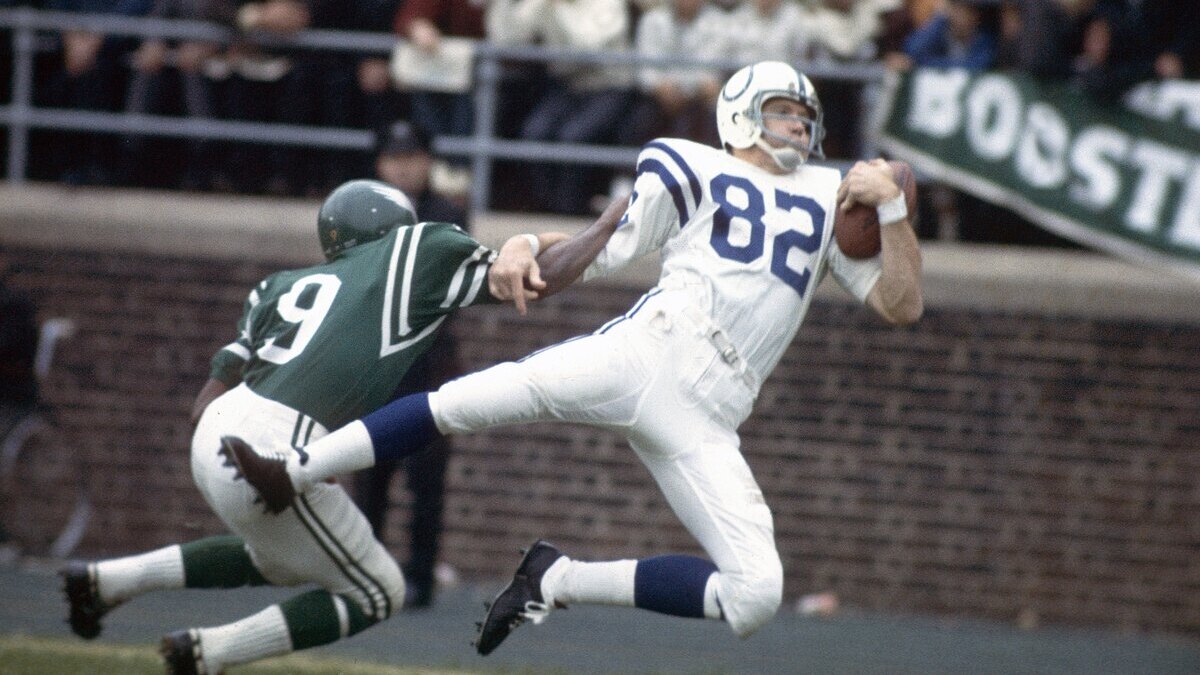
When Berry retired after the 1967 season, after 13 years with the Baltimore Colts, he was the NFL’s all-time leader in receptions (631) and receiving yards (9,275).
Ironically, it’s due in part to the prolific passing tandem he formed with Hall of Fame quarterback Johnny Unitas that those numbers are now so overshadowed.
Berry and Unitas took passing offense to another level for the league in the 1950s-60s, accelerating the evolution of the sport.
And ultimately, that’s a legacy far more profound than mere stats.
A 20th-round draft pick in 1954 out of SMU, it certainly wasn’t expected at the time that the unassuming 6-foot-2, 185-pound Berry would leave such a mark on the game. In fact, as a “future choice” in the draft, Berry returned to SMU for his final season before joining the Colts in 1955.
He caught just 13 passes for 205 yards as a rookie, still giving no hint as to what was to come.
Raymond Berry And Johnny Unitas Formed A Legendary Pairing
Unitas started his NFL career even more inauspiciously, meanwhile. A ninth-round pick in 1955 out of Louisville, he was released by the Pittsburgh Steelers before the season and got a job working construction while playing semi-pro football on the weekends.
The next year he tried out for the Colts, got signed and took over as the team’s starting quarterback the following season in 1957.
Berry had already started to emerge the previous season with 37 catches for 601 yards, but in pairing up with “The Golden Arm” Unitas he became a star in the league.
In their first season together in 1957, Berry had 47 catches for an NFL-leading 800 yards and 6 touchdowns.
Berry would then lead the league in receptions each of the next three seasons with 56, 66 and 74, lead in receiving touchdowns in two of those seasons and twice more lead all receivers in yards.
That included perhaps his finest year of all in 1960 when he had 74 receptions for a career-high 1,298 yards and 10 TDs back when the NFL regular season was just 12 games. No other player in the league had more than 972 receiving yards that season, meaning Berry averaged 27.2 yards per game more than any other receiver.
That was the second-most receiving yards in a season in NFL history at that point behind only Elroy “Crazylegs” Hirsch’s 1,495 in 1951.
Berry played in six Pro Bowls and earned three first-team All-Pro and two second-team All-Pro honors while helping the Colts to two NFL championships in the pre-Super Bowl era.
The Career-Defining Performance For Raymond Berry
One of those was the 1958 NFL Championship Game, which is remembered as “The Greatest Game Ever Played” — a 23-17 overtime win by the Colts over the New York Giants at Yankee Stadium.
Berry had 12 catches for 178 yards and a TD, including 3 consecutive receptions for 62 yards at the end of regulation to set up the Colts’ game-tying field goal. He then had 2 catches for 33 yards on the game-winning drive in overtime.
The 12 receptions remained an NFL championship game record until the Denver Broncos’ Demaryius Thomas caught 13 passes in Super Bowl XLVIII after the 2013 season.
When NFL Films produced “The Top 100: NFL’s Greatest Players” in 2010, as determined by a panel of former and current players, coaches, league executives and media, Berry ranked No. 36.
From lightly regarded 20th-round draft pick to arguably the best receiver in the NFL, Berry was one of the league’s great success stories of the time.
“I suppose Raymond Berry was the hero to everybody who wasn’t very athletic,” acclaimed sportswriter Frank Deford said.
A Legendary Work Ethic
Berry was said to have legs of uneven length, a bad back for which he sometimes wore a brace and poor eyesight. But what he lacked in size, raw speed or other natural physical traits, he made up for with elite route-running, the most reliable hands in the game at the time and a relentless will to be greater than the sum of his skills.
“Intangibles, I now realize, are just as much a gift as strength, speed and all that,” Berry told NFL Films. “I just loved to play the game and I loved to play it right. It really ticked me off to not have a top performance, so I was set on [the] goal all the time of looking for ways to get better.”
Berry said he identified there to be 18 different kinds of catches he’d possibly need to make in a game, so he worked on all 18 every day in practice, perfecting the craft he made look so natural and easy on game days.
Practice Makes Perfect
“I hated to drop a football,” he said. “It’s what motivated me. … Every day, every week, I just drilled and drilled and drilled on making the catches that I did not know when they were going to come up in a game, I just knew they were [coming] sometime or another.”
Hall of Fame Colts coach Weeb Ewbank once said, per the Los Angeles Times, “One of his drills was to throw nothing but bad balls to him. I used to have to run John [Unitas] off — ‘John, you’ve had enough throwing today’ — and he’d say, ‘Yeah, talk to that guy out there.’”
“He combined his dogged determination to succeed with the keen football mind that perfected the scientific approach to the art of pass receiving that was far ahead of his time,” Ewbank said, as recounted by the Pro Football Hall of Fame.
Putting The Career Of Raymond Berry In Perspective
The evolution of the passing game in modern football, in which Unitas and Berry played an instrumental role, has buried their totals on the all-time lists. Once the NFL’s career leader in receptions and receiving yards, Berry ranks just 83rd in receptions now and 68th in receiving yards.
But he did it back when the NFL played 12- and later 14-game seasons and when the game was simply played differently. There hadn’t been a single 3,000-yard passing season in NFL history until Unitas did it in 1960. For comparison, 21 quarterbacks (or every one that played at least 15 games) hit that mark last season.
So Berry’s legacy may be overshadowed a bit today, but in his time he shined as bright as anyone to play the position.
“I think you always have to measure people in any sport by the era that they played,” Deford said. “You don’t put Babe Ruth in the context of today’s game. You say, ‘How good was he at that time?’ And at that time, Berry was the best.”
Berry was inducted into the Pro Football Hall of Fame in 1973. After his retirement, he spent more than two decades in the NFL as a coach, including six seasons as head coach of the New England Patriots, leading the team to a Super Bowl appearance in the 1985 season (losing to the Chicago Bears).
He lived to be 93 years old, dying this past May, which brought about a fresh wave of remembrances for his impact on the sport.
Other Great No. 82s
As for being the greatest No. 82 in NFL history, that’s a feat in its own right as the number has been worn by several memorable legends and stars.
Honorable mentions include Hall of Fame Browns tight end Ozzie Newsome (one of the best to ever play the position), future HOF Cowboys tight end Jason Witten (4th all-time with 1,228 career receptions, 22nd with 13,046 receiving yards, 11 Pro Bowls), HOF Steelers wide receiver John Stallworth (3 Pro Bowls, 4-time Super Bowl champion) and former Jaguars WR Jimmy Smith (5 Pro Bowls, 862 receptions for 12,287 yards).
Greatest NFL Players By Number
99 | 98 | 97 | 96 | 95 | 94 | 93 | 92 | 91 | 90 | 89 | 88 | 87 | 86 | 85 | 84 | 83