From 99-0, TeamFB7 is looking back on the greatest players in NFL history to don each jersey number. No ties allowed, tough decisions will be made — next is No. 81 and Terrell Owens.
Much like with the greatest peer of his era Randy Moss, it’s not a bold take to say that Terrell Owens’ NFL career should have been even greater — or could have been, at least.
Despite both ranking on the very short list statistically among wide receivers all-time.
Owens is third in NFL history with 15,934 career receiving yards, behind only Jerry Rice and Larry Fitzgerald and a spot ahead of Moss. He also ranks third all-time with 153 receiving touchdowns behind Rice and Moss, and he’s ninth on the career receptions list with 1,078.
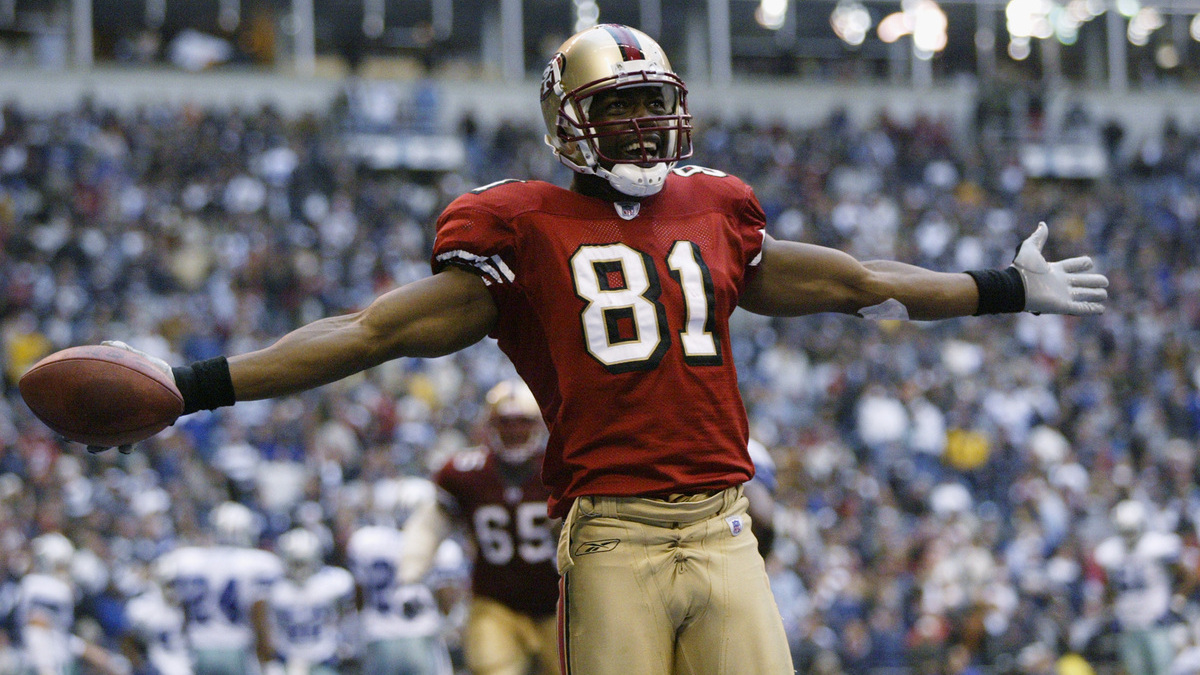
From a pure statistical perspective, that qualifies as one of the greatest NFL careers on record — at any position, for that matter.
So how could Owens’ legacy still feel so conflicted and his potential shortchanged?
Where to begin …
In the peak era of diva wide receivers, Owens was in a class of his own.
And thus, unfortunately, the buzz he created far too often came more from what he said and did off the field rather than his brilliance on it.
As deftly as he eluded defensive backs throughout his career, “T.O.” simply couldn’t ever get out of his own way.
Terrell Owens’ Complicated 49ers Career
Owens should have gone down as a San Francisco 49ers legend, one of the greatest talents to play for one of the league’s most storied franchises and a celebrated success story as a late third-round draft pick (89th overall) out of Chattanooga in 1996.
In fact, the narrative arc was set up perfectly.
Owens’ first five years in San Francisco overlapped with the end of Rice’s illustrious career there (before he moved on to the Raiders and later Seahawks). It should have been a historical bridge and passing of the torch from one franchise icon to the next, from the greatest wide receiver in NFL history and one small-school-star-turned-Hall-of-Famer (Rice played at Mississippi Valley State) to another legend taking a similar track.
Instead, after asserting himself as one of the best emerging wideouts in the game, Owens forced his exit from San Francisco and burned the bridge on his way out of town.
After averaging 97 catches, 1,388 yards and 14 touchdowns at his apex from 2000-02, Owens’ production dropped ever so slightly in 2003 to a still elite 80-1,102-9 line, but the 49ers dropped to 7-9 and missed the playoffs and simmering friction throughout the season had strained Owen’s relationship with the team.
As SFGate.com concisely summarized at the time, “Owens was disgruntled when the 49ers didn’t extend his contract before last year. What followed was a season marked by sideline tirades, a blow up with quarterback Jeff Garcia and several dropped passes.”
Owens had an option in his contract to void the rest of his time with the 49ers and become a free agent, but his agent didn’t file the necessary paperwork in time. That led to a grievance against the NFL, a failed attempt by the 49ers to trade him to the Ravens (which Owens and the NFL Players Association contested) and Owens meanwhile operating as if he was a free agent and negotiating a deal with the Eagles, all eventually leading to a settlement among all the parties involved that cleared his way to land in Philadelphia.
Still, he would not go quietly. Owens publicly questioned 49ers quarterback Jeff Garcia’s sexuality in an interview with Playboy magazine that summer.
This would all set the precedent and ultimately the expectation for an inevitable sour ending with his subsequent teams.
Terrell Owens Went From Super Bowl Sizzle To Fizzle In Philly
That would happen quickly in Philadelphia, but initially at least Owens was everything the Eagles hoped he would be in that 2004 season as they finally reached the Super Bowl (after three straight NFC championship game losses).
On the field, Owens remained one of the best receivers in the league, posting 77 receptions for 1,200 yards and 14 touchdowns in 14 games before sustaining a fractured fibula and badly sprained ankle against the rival Cowboys. Owens required surgery but incredibly returned to play in Super Bowl XXXIX against the New England Patriots.
Even more incredibly, he caught 9 passes for 122 yards in that game as the Eagles came up just short in a 24-21 loss.
Again, Owens’ performance (and toughness) should have been an exclamation point on his NFL legacy — but he just couldn’t let his play speak for itself.
Owens infamously called out Eagles quarterback Donovan McNabb that April, questioning the QB’s physical condition late in the game as the offense attempted a desperate drive in the final minute down 3 points. McNabb ultimately ended the comeback hopes with an interception (his second of the fourth quarter and third of the game), but he also threw for 357 yards and 3 TDs, including a 30-yard touchdown pass to cap a 79-yard drive minutes earlier to put Philadelphia within a field goal.
“I played every snap they allowed me to play,” Owens told ESPN.com a couple months later. “I wasn’t even running until, like, two weeks before the game. But I made sure I was in the best shape possible. I wasn’t the guy who got tired in the Super Bowl.”
That public shot at his QB would go down as a stain on both players’ careers, ultimately.
It was followed by a contract holdout through offseason team activities and Owens later getting sent home from training camp after a blowup with coach Andy Reid, leading to the viral and surreal scene of the receiver doing sit-ups in his driveway in front of TV cameras and reporters.
Owens somehow overcame that to play in seven games for the Eagles in 2005 (productive as ever with 47 catches for 763 yards and 6 TDs) before it all imploded.
There was a physical altercation in the locker room between Owens and former teammate/recently retired team ambassador Hugh Douglas. Then an interview the next day with Graham Bensinger in which Owens answered a question by saying he agreed with commentary (from former NFL star Micheal Irvin) that the Eagles would be undefeated if Packers QB Brett Favre and not McNabb was leading the offense.
Again, you can’t make this up …
Owens was suspended by the team and ultimately deactivated for the rest of the season. Despite a belated public apology to McNabb, the organization, fans, etc., and an appeal for reinstatement, the Eagles didn’t budge and released him the following March.
Same Story, Different City
The next flameout would come in Dallas, which signed Owens to a three-year, $25-million contract.
And of course, his time there began with the tease that it might be different this time …
Owens endeared himself to Cowboys fans when he refused to miss any games after breaking his finger in Week 2 of the 2006 season vs. Washington, having a plate screwed into his finger and catching 5 passes for 88 yards the next week vs. the Titans. Late in the season it was revealed that Owens injured a tendon on that same finger and was recommended to have season-ending surgery, but he again kept playing while finishing with 85 catches for 1,180 yards and an NFL-leading 13 receiving TDs as the Cowboys backed into the playoffs at 9-7.
Owens was even better in 2007 with 81 catches for 1,355 yards (his most in six years) and 15 TDs (the second-best total of his career) in 15 games for a 13-3 Dallas team — all while turning 34 years old late in that season. He was leading the NFL in receiving yards and second in TDs when a high-ankle sprain kept him out of the final game, but he returned for the Cowboys’ divisional round playoff matchup with the Giants, catching 4 passes for 49 yards and a TD in a 21-17 loss.
That was the day he went viral again with his tearful “That’s my quarterback” postgame defense of QB Tony Romo.
And yet, a year later the Cowboys would release Owens despite another 1,000-yard season and 10 TDs, with ESPN’s Ed Werder reporting at the time that team owner Jerry Jones made the move “following the advice of many, many people” after a season in which the outspoken star reportedly clashed with tight end Jason Witten, offensive coordinator Jason Garrett and Romo.
An Unceremonious End To A Hall of Fame Career
Owens bounced to the Buffalo Bills in 2009 and the Cincinnati Bengals in 2010, still showing at 37 years old he could make an impact with 72 catches for 983 yards and 9 TDs in 14 games that final season.
The Bengals nonetheless decided not to re-sign him after he tore his meniscus in his left knee late that season.
Owens then tore his ACL during the offseason, but he was determined to continue his NFL career and staged a showcase for interested teams in late October at a Los Angeles-area high school. No NFL teams showed up for it. (It was televised on ESPN and NFL Network, however).
It’s quite the commentary that perhaps sums up the duality of “T.O.” best — that one of the most productive players in NFL history, with the numbers to back it up the previous season even while turning 37 years old, couldn’t get a single team to even send a representative to evaluate him.
Or that he then played eight games for the Indoor Football League’s (not to be confused with the more highly regarded Arena Football League at the time) Allen (Texas) Wranglers.
Or that the Wranglers then released him unceremoniously and terminated Owens’ ownership stake in the team for violating his contract, citing his refusal to play in two road games critical to the team’s playoff hopes and failing to appear for a scheduled appearance at a local children’s hospital.
“It is impossible to maintain a player when even our fans notice and comment on a player’s lack of effort both on and off the field,” Wranglers co-owner Jon Frankel said at the time, per ESPN. “It’s disappointing and unfortunate, but [he] could no longer be tolerated by the Wrangler organization.”
Cowboys Hall of Fame receiver Drew Pearson went on ESPN Radio in Dallas that week and delivered a fitting epitaph to Owens’ NFL career, saying, “There is no question Terrell could still play in the NFL. But it’s not what happens between the lines with Terrell, unfortunately. It’s how he handles things outside the lines.”
Same as it always was.
The final flickers of his NFL career came in that summer of 2012 when the Seahawks briefly signed him, evaluated him through two preseason games and then released him.
Making Sense Of Terrell Owens’ NFL Legacy
To recap, the three primary teams Owens played for in his career were happy to see him go, ditto a publicity-seeking Indoor Football League team that could only tolerate having a future Hall of Famer on the roster for eight games, even though his stats remained strong to the end.
And yet, for the unceremonious and rather abrupt ending to his career, and all the what-if’s along the way, Owens simply has to be included on any list of the greatest wide receivers of all-time — even if it took him three years on the Pro Football Hall of Fame ballot to gain election.
He didn’t win a Super Bowl ring, but he certainly did his part in his lone appearance on that stage with the Eagles.
He made six Pro Bowls, earned five first-team All-Pro honors, led the NFL in receiving touchdowns three times, had nine 1,000-yard seasons (and two others with 983 and 936 yards) and remained continually productive on the field despite all the distractions and drama he brought upon himself and his teams.
Owens, of course, isn’t the only diva star receiver who wore out their welcome in the NFL. Moss wasn’t far behind him on that scale, and Antonio Brown may have taken it to new heights this decade.
Still, it’s unfortunate that he’ll be remembered for that part of his complicated career as much as for being an all-time great talent.
A Bunch Of Hall of Famers Wore 81, But Terrell Owens Was Best
As for being the greatest No. 81 in NFL history, that’s no small statement.
Honorable mentions also considered here include these fellow Hall of Fame wide receivers:
Calvin Johnson: 731 receptions for 11,619 yards and 83 TDs in nine seasons with the Detroit Lions from 2007-15, including an NFL-record 1,964 yards in 16 games in 2012. Ultimately, Johnson’s career — even with its astounding apex — was just too short too beat out Owens.
Tim Brown: 1,094 receptions for 14,934 yards — 7th-most all-time in both categories — and 100 TDs in 17 seasons from 1988-2004 (all-but one with the Raiders). Despite nine Pro Bowl selections, Brown earned only one second-team All-Pro honor.
Art Monk: 940 receptions for 12,721 yards and 68 TDs in 16 seasons from 1980-95 (all but two with Washington), winning three Super Bowl championships with Washington.
As well as …
Hall of Fame Vikings DE Carl Eller: 133.5 sacks unofficially (tied for 19th all-time) in 16 seasons from 1964-79 (all but one with Minnesota), earning five first-team All-Pro and one second-team All-Pro honors.
Hall of Fame DB Dick “Night Train” Lane: 68 career interceptions in 14 seasons from 1952-65 for the Los Angeles Rams, Chicago Cardinals and Detroit Lions
Hall of Fame DE Doug Atkins: Eight Pro Bowls, one first-team All-Pro and six second-team All-Pro honors in 17 seasons from 1953-69, before sacks were even tracked unofficially (Pro Football Reference credits him with 94.5 unofficial sacks over just his final 10 seasons). Won two NFL Championships with the Cleveland Browns and Chicago Bears.
Hall of Fame DE Andy Robustelli: Seven Pro Bowls, six first-team All-Pro and four first-team All-Pro honors, two-time NFL champion in 14 seasons from 1951-64 with the Rams and Giants. Pro Football Reference credits him with 52.5 sacks over just his final four seasons (the earliest such records have been accounted for). He wore No. 81 during his Giants tenure from 1956-64.
Hall of Fame TE Jackie Smith: 480 receptions for 7,918 yards and 40 TDs in 16 seasons from 1963-78 (all but one with the St. Louis Cardinals), earning 5 Pro Bowls.
Hall of Fame LB George Connor: Four first-team All-Pro and two second-team All-Pro honors in eight seasons from 1948-55 for the Chicago Bears, wearing No. 81 in half of those seasons.
WR Torry Holt: 920 receptions for 13,382 yards (17th all-time) and 74 TDs in 11 seasons from 1999-2009, including starring for the “Greatest Show On Turf” Rams’ Super Bowl title team. He wore 81 for the final eight of his 11 seasons.
WR Anquan Boldin: 1,076 receptions for 13,779 yards and 82 TDs in 14 seasons from 2003-16 for the Cardinals, Ravens, 49ers and Lions.
Greatest NFL Players By Number
99 | 98 | 97 | 96 | 95 | 94 | 93 | 92 | 91 | 90 | 89 | 88 | 87 | 86 | 85 | 84 | 83 | 82