Week 2 is arguably the most important week of the NFL preseason because it’s the closest thing many roster-bubble players get to a final exam.
By this point, coaches have seen players through training camp, joint practices and the preseason opener. Thus, Week 2 of the preseason is where they want to see whether that practice-field progress translates into game situations. It also frequently provides meaningful snaps before teams become increasingly protective of important players approaching the regular season.
For young quarterbacks, late-round picks and undrafted players, this is especially important. They’re not simply compiling statistics: they’re trying to change the depth chart. Coaches are evaluating processing speed, protection calls, ball security, route discipline, tackling, special-teams value and how players respond when something breaks down.
That’s why performances like Joe Milton‘s 179 yards and 2 touchdowns on 13 attempts, Jack Strand‘s 212 yards, Athan Kaliakmanis‘ 11-of-14 passing and Tanner McKee‘s 2-touchdown game carry weight. They occurred when roster decisions are becoming increasingly urgent.
The biggest difference is timing: Week 1 creates an impression; Week 2 can confirm it. And with the regular season approaching, there are fewer opportunities remaining to erase a bad one.
For many players near the bottom of an NFL roster, Week 2 isn’t really an exhibition game as much as it’s an audition that can determine whether they’re employed in September.
Standout Performances from Week 2 of the NFL Preseason
Based on production, efficiency, explosiveness and how much the performance could change the player’s roster/depth-chart outlook, here were the top 10 performances from this week across the NFL:
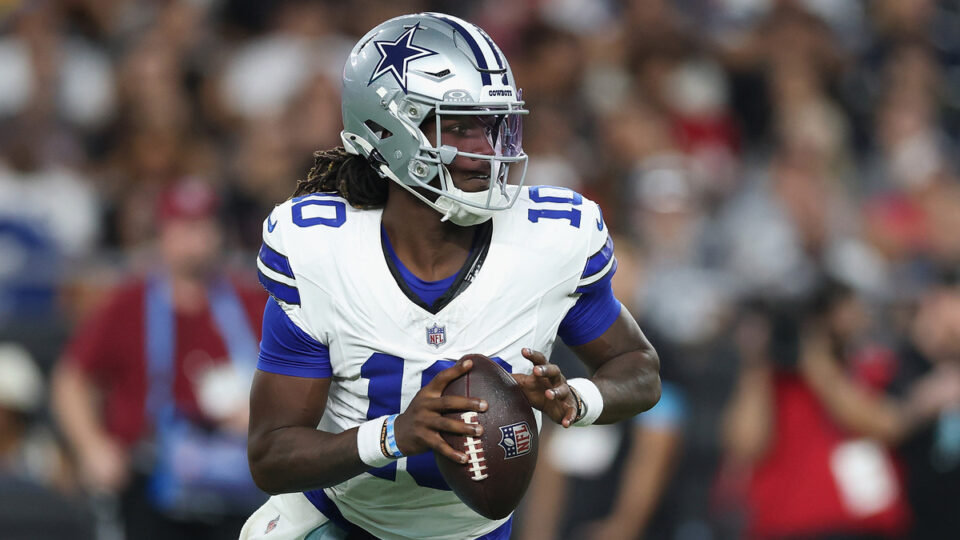
Joe Milton, QB, Dallas Cowboys
(9-of-13 passing, 179 yards, 2 TDs, 151.4 rating)
The best combination of efficiency and explosiveness. Milton averaged 13.77 yards per attempt, completed 69.2% and produced 2 touchdowns on only 13 throws. His enormous arm has never been questioned. Showing accuracy and command is what makes this performance significant. More importantly, Milton generated 179 yards on just 9 completions, demonstrating that his vertical ability can translate into actual production rather than simply highlight-reel throws. For a quarterback fighting to establish himself as a dependable NFL option, combining big-play creation with efficient decision-making is critical. Performances like this force coaches to reconsider the depth-chart ceiling.
.@Qbjayy7 to @CamdenBrown7 for a HUGE gain❗️
📺: #DALvsAZ on CBS11
📲: Stream on NFL+ https://t.co/7pAfvQ9tid pic.twitter.com/vj4VZ0O8Wo— Dallas Cowboys (@dallascowboys) August 23, 2026
Jack Strand, QB, Atlanta Falcons
(12-of-17 passing, 212 yards, 1 TD, 132.5 rating)
This might have been the biggest true breakout considering expectations. Strand averaged 12.47 yards per attempt, topped 200 yards on just 17 throws and showed he could push the football vertically. For an unheralded quarterback trying to establish himself, that’s powerful preseason tape. More importantly, Strand turned limited opportunities into explosive production, exactly what coaches want from a developmental quarterback. He showed decisiveness, efficiency and the willingness to attack downfield rather than simply protect the football. Performances like this can completely change a player’s standing, earning additional practice reps and potentially forcing his way into a legitimate roster conversation.
Athan Kaliakmanis, QB, Washington Commanders
(11-of-14 passing, 162 yards, 114.9 rating)
Maybe the most impressive pure efficiency performance: 78.6% completions and 11.57 yards per attempt. Kaliakmanis didn’t need a touchdown to stand out because he consistently moved the offense while showing accuracy, decisiveness and command. For a young quarterback fighting for developmental reps and organizational trust, efficiency matters enormously. He avoided wasted throws, generated chunk yardage and demonstrated he could operate the offense without forcing plays. With roster evaluations intensifying, that type of controlled performance can significantly improve a quarterback’s standing with coaches.
Tanner McKee, QB, Philadelphia Eagles
(16-of-22 passes, 173 yards, 2 TDs, 125.8 rating)
McKee strengthened the argument that he’s more than a developmental quarterback. He completed 72.7% of his passes, threw 2 touchdowns and protected the football, while averaging 7.86 yards per attempt. His combination of size, pocket presence and accuracy continues to translate against NFL reserves. More importantly, McKee looked in complete command, processing quickly and finishing drives instead of simply compiling preseason yardage. For a quarterback trying to prove he can be trusted as a legitimate NFL backup, this was meaningful tape. Another efficient, mistake-free performance strengthens Philadelphia’s confidence that its offense can remain functional if the Jalen Hurts goes down at any point.
Kyle Allen, QB, Buffalo Bills
(10-of-12 passes, 128 yards, 1 TD, 138.89 rating)
Nearly flawless efficiency. Kyle Allen completed 83.3%, averaged 10.67 yards per attempt and produced a touchdown. The veteran experience matters against preseason defenses, but he couldn’t have done much more with his opportunity. What made the performance especially valuable was his command of the offense and ability to consistently stay ahead of the chains. For a veteran competing for a backup job, preseason football is about proving reliability. Allen showed he can distribute efficiently, avoid wasted possessions and keep an NFL offense functioning smoothly.
Tommy DeVito, QB, New England Patriots
(8-of-15 passes, 151 yards, 1 TD; 44 rushing yards)
The passing percentage wasn’t great, but Tommy DeVito generated 195 total yards on just 18 passing/rushing opportunities. His 44 rushing yards mattered because they show another way he can keep an offense functioning when protection breaks down. More importantly, he created explosive production despite limited opportunities, averaging more than 10 yards every time he passed or ran. That versatility strengthens his value in a backup-quarterback competition. DeVito showed he doesn’t need perfect circumstances to manufacture offense, extending plays with his legs while still attacking defenses downfield when opportunities develop.
.@tommydevito007 goes DEEP to @k_mmoneyyyy 😤
📺: WBZ pic.twitter.com/1cEo0iuTBT
— New England Patriots (@Patriots) August 23, 2026
Joe Fagnano, QB, Baltimore Ravens
(15-of-20 passes, 123 yards, 1 TD, 106.87 rating)
Joe Fagnano‘s 75% completion rate jumps out. He wasn’t producing Milton-like explosives, but he looked comfortable running the offense and continued making a legitimate argument for a roster spot. What mattered most was his consistency and command when every preseason snap carries evaluation weight. Fagnano showed he could process quickly, deliver catchable footballs and keep the offense on schedule. For a quarterback battling for survival on the depth chart, avoiding negative plays while repeatedly completing passes is exactly how trust is earned.
Sincere McCormick, RB, San Francisco 49ers
(53 yards on 6 carries, 1 TD)
Don’t dismiss this because of the tiny sample. Sincere McCormick averaged 8.8 yards per carry, ripped off a 37-yarder and scored. For a running back fighting for touches, explosive runs are precisely what can force coaches to reevaluate the depth chart. More importantly, McCormick demonstrated the burst and big-play ability teams desperately want from their rotational backs. Turning 6 carries into 53 yards means he maximized virtually every opportunity. In a crowded backfield, one explosive preseason performance can change the conversation, especially when a runner shows he can create yardage beyond what is blocked.
Big rush ✅
TD rush ✅📺: ESPN & KPIX pic.twitter.com/eXZK2YzK5J
— San Francisco 49ers (@49ers) August 21, 2026
Shane Buechele, QB, Buffalo Bills
(5-of-10 passes, 111 yards, TD, 123.33 rating)
The completion percentage lowers his ranking, but 11.1 yards per completion is enormous. Shane Buechele generated chunk plays and a touchdown (which went for 71 yards) despite getting only 10 attempts, exactly the kind of high-impact production a reserve QB needs. The limited workload actually makes the production more meaningful because Buechele had little margin for wasted opportunities. He showed he could enter, immediately push the football downfield and generate points. For a quarterback battling for a roster spot, demonstrating explosive passing ability and maximizing limited snaps can make a lasting impression on a coaching staff.
Shane Buechele ➡️ Ja’Mori Maclin for a 71-yd touchdown!
Tune into CBS pic.twitter.com/n1QbelEma2
— Buffalo Bills (@BuffaloBills) August 22, 2026
Quentin Skinner, WR, New York Jets
(4 receptions, 47 yards, 1 TD)
Quentin Skinner made his limited opportunities count. His 31-yard reception demonstrated downfield ability, while turning 4 catches into a touchdown is significant for a receiver whose preseason priority is creating memorable plays on limited snaps. His 47 receiving yards also meant nearly 12 yards per catch, showing he wasn’t simply accumulating underneath receptions. Skinner created field-flipping production and finished a drive with points. For a receiver battling through a crowded depth chart, proving he can stretch coverage and capitalize when targeted is exactly how preseason snaps become roster-making opportunities.
W.G. Ramirez is a veteran sports writer from Las Vegas and a Staff Writer at TeamFB7.com. Follow him on X at @WillieGRamirez.