From 99-0, TeamFB7 is looking back on the greatest players in NFL history to don each jersey number. No ties allowed, tough decisions will be made — next is No. 78 and Anthony Muñoz.
This was by far the toughest decision yet in the countdown.
Tougher than No. 99 with Aaron Donald over J.J. Watt. Tougher than No. 88 with Tony Gonzalez over fellow Hall of Famers Marvin Harrison and Alan Page. Tougher than No. 87 with Travis Kelce over Rob Gronkowski.
There might not even be a right answer here when debating the greatest No. 78 in NFL history and weighing the cases of offensive tackle Anthony Muñoz and defensive end Bruce Smith — two Hall of Famers of contrasting disciplines who were among the absolute best to ever play their respective position.
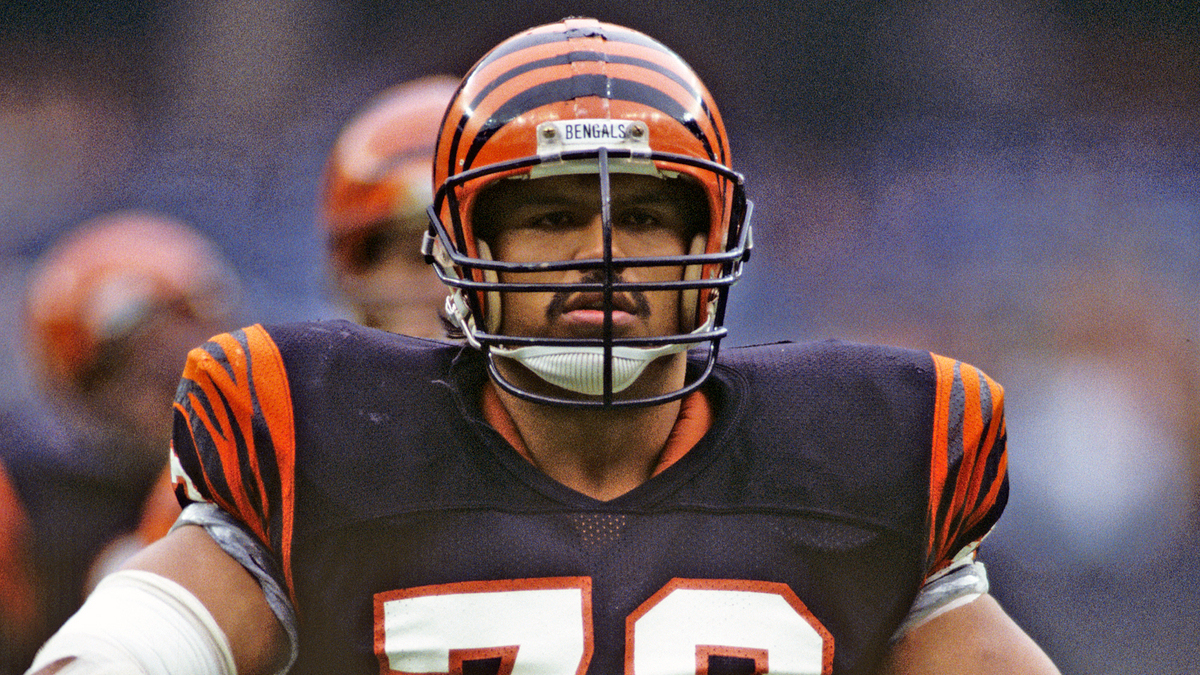
Debating Anthony Muñoz vs. Bruce Smith
On one side …
It’s pretty much a consensus opinion among NFL historians, analysts and peers alike that Muñoz is the greatest offensive tackle in NFL history, which is as compelling an argument as can be made in such a debate — to be the best ever at anything.
In 2022, ESPN polled 50 “experts, reporters and analysts” to identify the “GOAT” at each position. Muñoz garnered 27 of the votes at offensive tackle with no other candidate receiving more than 10 (Jonathan Ogden).
Back in 2010, when NFL Network produced its 10-part series “The Top 100: NFL’s Greatest Players” with current and former players, coaches, league executives and media contributing to the rankings, Muñoz was No. 12 overall and the only offensive tackle in the top 30.
On the other side, though …
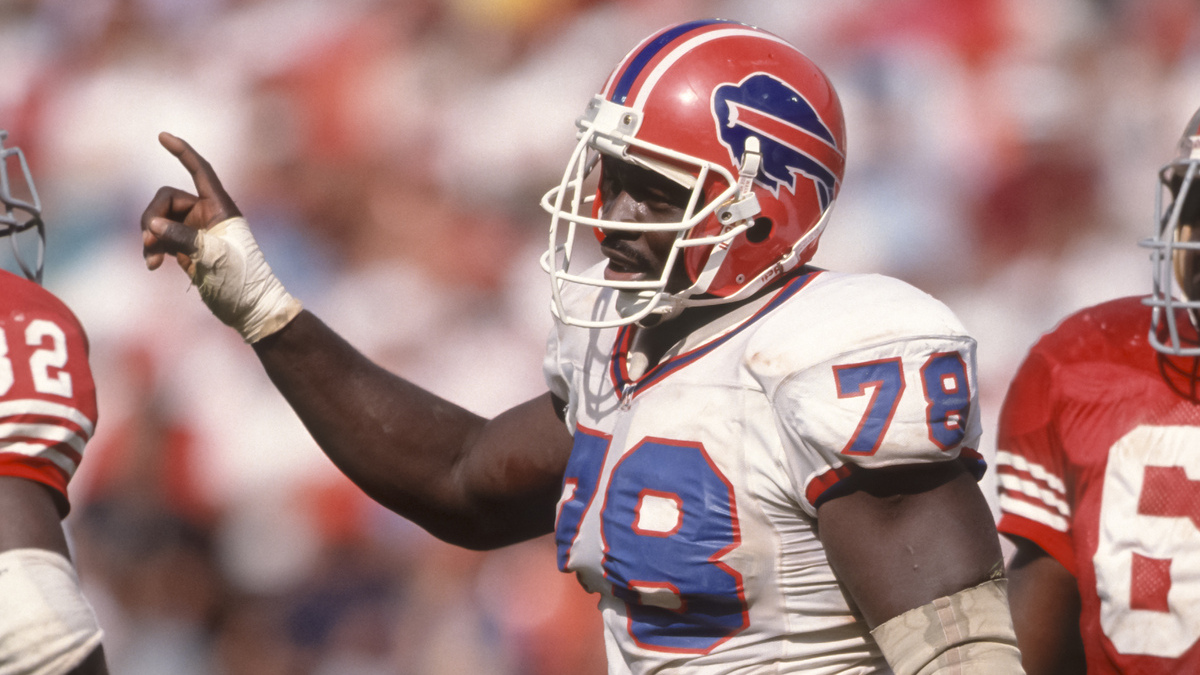
Smith remains the NFL’s career sacks leader (200) more than two decades after he retired. That feat is even more impressive when considering the 6-foot-4, 260-pound Smith played most of his career in a 3-4 defense, which is generally less conducive for defensive ends rushing the passer (and more designed for the outside linebackers to feast while rushing around the edge), though Smith often lined up wider than a standard 3-4 DE.
“It’s like when you’re diving off the Olympic platform,” Smith told The Athletic a few years ago. “There should be something into the equation for degree of difficulty.”
By any measure, he was an incredible force at the position while also excelling as a run stuffer who twice had over 100 solo tackles in a season and 1,224 total tackles for his career.
“You can look at his sacks, but it’s bigger than that,” former Miami Dolphins seven-time Pro Bowl left tackle Richmond Webb told The Athletic. “Those pass-rush specialists get to rest on first and sometimes second down and come in fresh. This guy didn’t leave the field until it was time to punt. He was out there for 10 or 12 plays straight. That’s what is so rare.”
Muñoz made 11 straight Pro Bowls (all but his first and final seasons) and earned nine first-team All-Pro and two second-team All-Pro honors. That’s a record for first-team selections among left tackles and tied for the second-most at any position. He was also named NFL Offensive Lineman of the Year three times and NFL Players Association Lineman of the Year in four seasons.
Smith, meanwhile, made 11 Pro Bowls in a 12-year span in the middle of his 19-year career (with the lone exception due to injury), earned eight first-team All-Pro and three second-team All-Pro honors and was twice named NFL Defensive Player of the Year. He finished top 5 in DPOY voting an incredible eight times, including two runner-up finishes.
That’s about as comparable as any two career resumes can get.
And the parallels continue …
Smith And Muñoz Elevated Their Teams To New Heights
Muñoz helped jumpstart the Cincinnati Bengals to one of the best eras in their history.
The No. 3 overall pick in the 1980 NFL Draft out of USC, Muñoz helped the Bengals go from three straight losing seasons to 12-4 and the franchise’s first Super Bowl appearance in his second year. Cincinnati remained up and down throughout the decade — despite a consistently great offense — before again finishing 12-4 in 1988 and reaching the Super Bowl for a second time.
During that stretch, Muñoz keyed the pass protection for two NFL MVPs in quarterbacks Ken Anderson (1981) and Boomer Esiason (1988).
Listed at 6-foot-6, 278 pounds, Muñoz’s excellence was due in equal parts to his menacing physicality and his elite athleticism for his size. A two-sport athlete at USC, Muñoz once thought he’d end up playing Major League Baseball.
“Greatest athlete over 250 pounds that there ever was,” Dave Lapham, an offensive guard for the Bengals from 1974-83, once said.
Beyond his physical talents, Muñoz wasn’t only the Bengals’ best player during those years but also one of the team’s most respected leaders. More broadly, it could be said he was one of the most respected players in the NFL.
“I don’t think it’s a coincidence the [Bengals’ first] two Super Bowl teams he was the left tackle because when your best players are your best people and your best workers, you have a chance to raise the whole ship,” Lapham told The Athletic. “When your best players are malcontents and don’t work, you don’t have a shot. There’s not a better example of your best player being your best person than Anthony Muñoz.”
Incredibly, he did all of that after having three knee surgeries in college at USC and missing most of his senior season. He then played in all but three games over his first 12 NFL seasons — at an elite level from start to finish.
“He was so consistently proficient for his entire career. The day he retired I didn’t see any difference in the way he played offensive tackle, which is extraordinary,” said Bob Trumpy, a Bengals tight end in the 1970s and later a noted NFL broadcaster, as part of the NFL Network “Top 100” series.
Smith’s Impact On The Bills
At the same time, Smith was helping the Buffalo Bills to the greatest era in their existence.
The No. 1 overall pick in the 1985 NFL Draft out of Virginia Tech, Smith was a catalyst to the Bills’ emergence from a 2-14 record his rookie year (and the year prior) to 4-12 (with rookie QB Jim Kelly joining the cause and elevating the offense), then 7-8, a 12-4 breakout and AFC championship game loss and two years later the start of four straight Super Bowl appearances (and losses).
Smith won the first of his Defensive Player of the Year award that first Super Bowl season, 1990, when he notched a career-high 19 sacks with 101 tackles and a league-leading 5 forced fumbles. He had a sack and a safety in the Bills’ gut-wrenching 20-19 Super Bowl XXV loss to the New York Giants that ended in Scott Norwood’s missed 47-yard field goal in the final seconds.
Smith had 11.5 sacks in his first 15 postseason games and 14.5 postseason sacks in 20 games overall for his career.
A model of consistency, Smith had a record 13 seasons with double-digit sacks during a 15-year span, with one of the exceptions being the 1991 season when a knee injury limited him to 5 games. He’d go on to play until he was 40 years old, spending his last four seasons with Washington while chasing down Reggie White’s career sacks record, passing the mark in his final season with his final 5 sacks in 2003.
Most would consider Reggie White the greatest defensive end in NFL history and Lawrence Taylor the greatest edge rusher overall, but Smith is certainly near the top of the list.
Settling On The Greatest No. 78 In NFL History …
So how to decide who was the greater overall player between Muñoz and Smith? One widely considered the greatest offensive tackle in NFL history and the other arguably the greatest 3-4 defensive end.
It’s an almost impossible decision.
One that shouldn’t come down to one opinion.
So for the first time in this series, we’re letting outside perspective be the swaying factor only because of the volume of insight and analysis it engulfs.
We earlier referenced NFL Network’s “The Top 100: NFL’s Greatest Players” from 2010 and it’s as authoritative and useful a reference point as there is in this case.
As noted, Muñoz was No. 12 with the next offensive lineman on the list coming in at No. 24 (New England Patriots guard John Hannah) and the next offensive tackle at No. 32 (the Baltimore Colts’ Jim Parker).
Smith landed at No. 31, with fellow DEs White (7) and Deacon Jones (15) ahead of him (plus Taylor at No. 3 if lumping all edge rushers together).
The Athletic more recently attempted its own top 100 ranking in 2021, slotting Muñoz at 12 and Smith at 20.
On the other hand, Pro Football Reference created a metric called “Approximate Value,” which we should note we’ve often disagreed with or went against in this series so far. But for what it’s worth, that list ranks Smith 9th and Muñoz 25th, although it is a cumulative statistic (like WAR in baseball) skewed by Smith’s 19 seasons to Muñoz’s 13.
And that is very much part of the crux of the debate too.
Smith being the NFL’s career sacks leader resonates in an impactful way, but is it worth considering …
White set the mark at 198 sacks in 15 seasons and Jones unofficially tallied 173.5 in 14 seasons from 1961-74 (as tracked by Pro Football Reference, as sacks weren’t an official stat back then) while Smith had 171 sacks through his first 15 seasons before hanging on to chase down White’s record with diminishing production his final years.
Muñoz remained close to his elite peak until the end of his 13-year career, earning Pro Bowl and second-team All-Pro honors in his penultimate season before being limited to eight games by injury the next year and then retiring.
Meanwhile, CBSSports.com came out with its own fresh ranking of the NFL’s top 100 players just this week and encountered the same dilemma as our task here in choosing the greatest No. 78 of all-time.
That list ranked Muñoz 19th and Smith 20th.
Doesn’t that just sum up this whole endeavor perfectly?
Because we pledged to avoid any ties in this series and make the hard decisions, we’re choosing Muñoz as the greatest No. 78 in NFL history because his entire career was played at near-peak performance and he is near universally regarded as the greatest player ever at one of the most important and impactful positions in the sport.
But ultimately, there’s probably no right answer in this debate … or wrong answer … or there’s only right answers … or only wrong ones in choosing either over the other.
Greatest NFL Players By Number
99 | 98 | 97 | 96 | 95 | 94 | 93 | 92 | 91 | 90 | 89 | 88 | 87 | 86 | 85 | 84 | 83 | 82 | 81 | 80