Each day leading up to the 2026 NFL Draft — April 23-25 — TeamFB7 will break down a different team’s biggest draft need and the best selection to address it. Granted, teams will most often use their first-round pick on the best available player/value and not necessarily always their biggest need, so this isn’t going to compile together into a mock draft in the end. It’s more a breakdown of how each team could best address its most paramount priority if it chooses.
There’s no need to belabor what went wrong for the Minnesota Vikings in 2025.
It can be succinctly summed up by saying they made an absurd, illogical and ill-fated decision to turn a 14-win playoff team over to untested (and ultimately overmatched) second-year quarterback J.J. McCarthy with minimal reliable contingencies.
The ghost of broken-down Carson Wentz? Undrafted rookie Max Brosmer? Sheesh.
All while letting Sam Darnold walk after a career year and go win a Super Bowl with the Seattle Seahawks.
Former Vikings general manager Kwesi Adofo-Mensah paid the price for that decision — and, really, the root problem of using the No. 10 overall pick in the 2024 NFL Draft on McCarthy, who was more of a “game manager” than dynamic college passer while at Michigan.
But Adofo-Mensah might not have been fired immediately for the McCarthy blunder if not for Vikings fans and ownership having to watch Darnold hoist the Lombardi Trophy for the Seahawks when Minnesota easily could have prioritized keeping him after his strong 2024 campaign.
Just a calamity of preventable missteps.
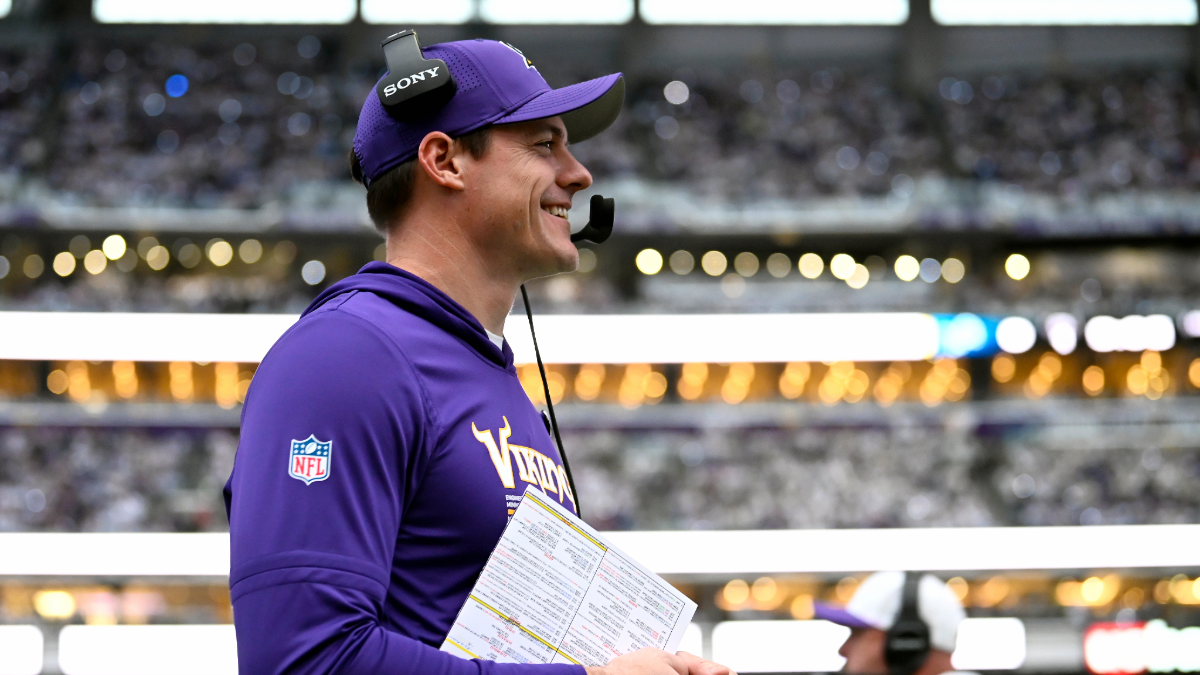
It’s truly impressive that Vikings coach Kevin O’Connell was able to get that team to a 9-8 finish — and keep the locker room together enough to win the final five games in a row — with an offense that ranked 28th in the NFL at 275.0 yards per game and 26th in scoring (20.2 points per game).
And that’s why there’s hope for Minnesota in 2026.
The Vikings have one of the better coaches in the league, they still have a lot of the infrastructure from that 14-win team in 2024, and they at least admitted their folly and signed quarterback Kyler Murray while making a full pivot away from the wreckage of 2025.
Vikings Make Most Impactful Move Of NFL’s Offseason
Murray, the former No. 1 overall pick in the draft who was released by the Arizona Cardinals last month after seven seasons, may not be a perfect NFL quarterback, but we couldn’t have liked this move more. (Or been more critical of the Cardinals’ decision, as we broke down here.)
Murray was absolutely the best available option for any team looking to upgrade the position but also landed in the perhaps the best spot to foster and maximize his potential.
If O’Connell could nurse this team to a winning record with McCarthy and Brosmer turning in some of the worst QB play the league has seen in the last decade, just think what he can do with a dynamic, strong-armed, dual-threat QB playing with peak motivation to prove the Cardinals made a mistake.
The Vikings signing Murray was the single most impactful move of the NFL offseason — especially considering Minnesota got him for the veteran’s minimum with Arizona paying most all of his $36.8-million contract.
They were a 14-win Super Bowl contender just two years ago with Darnold. They can be that again with Murray.
That said, the Vikings’ roster isn’t yet complete, and how they manage the draft this coming week will be key as they hold the No. 18 overall pick.
Minnesota is still working with an interim general manager in Rob Brzezinski, who has been with the organization since 1999, and O’Connell will surely have a good bit of influence on the team’s draft decisions (deservedly so).
In addition to No. 18, the Vikings also hold the following picks: 2nd round (49th overall), 3rd (82nd), 3rd (97th), 5th (163rd), 6th (196th), 7th (234th), 7th (235th) and 7th (244th).
As we have in this draft series, we’ll focus on how the Vikings can best address their biggest need with that first-round selection.
What Is Vikings’ Biggest Need In 2026 NFL Draft?
Minnesota has a few ways it could go at the top of this draft.
Let’s start on offense.
Cross off quarterback, obviously. If Murray has a big season on his one-year deal, both sides will be motivated to work out a long-term extension.
The Vikings would be wise to draft a Day 2 running back as 31-year-old Aaron Jones is on the decline after posting a career-low 4.2 yards per carry in 2025 (548 rushing yards and 2 TDs in 12 games), and both he and Jordan Mason (758 rushing yards and 4 TDs on 4.8 YPC) are free agents after the season.
But the position won’t be a consideration at No. 18 overall. (Arkansas’ Mike Washington Jr. looks like a great fit at No. 49 if he’s available, though).
Tight end is interesting. The Vikings restructured productive veteran T.J. Hockenson’s contract last month to void the final year of the original deal and make him a free agent after this season.
It was one of several moves the team made to get under the salary cap and doesn’t necessarily mean Hockenson won’t be in Minnesota beyond 2026 if he has a big season. His numbers were down last year (51 catches for 438 yards and 3 TDs on a career-low 8.6 yards per reception), but he’s only turning 29 this year and, again, he was catching passes from Wentz (in the best-case scenario), McCarthy and Brosmer.
(Well, nobody was really catching many passes from Brosmer — he literally threw for 51 yards in one of his two starts — but we promised not to belabor the point, so moving on …)
That said, if Oregon star tight end Kenyon Sadiq were to drop to No. 18, the Vikings would have to give strong consideration to that move.
We recommended him earlier in this series to the Buccaneers at No. 15 (with the potential that the Ravens at No. 14 could also be a fit), but if Sadiq is on the board he starts to look like a major value at this point of the first round. (More on him in a minute).
Meanwhile, wide receiver is another need, but it doesn’t have to be addressed in the first round. The Vikings have one of the NFL’s top wideouts in four-time All-Pro Justin Jefferson and a solid No. 2 in former first-round pick Jordan Addison (175-2,396-22 in 46 games over three seasons). They just have no depth. Former No. 3 WR Jalen Nailor signed with the Raiders as a free agent, leaving Tai Felton (3 catches as a rookie last year) next in line.
Minnesota could take a wide receiver in the first round, but we actually like the depth of prospects at the position on Day 2 of the draft.
And wrapping up the offensive side on the line, the Vikings lose just one starter in four-time Pro Bowl center Ryan Kelly, who retired last month after being limited to eight games in 2025 by multiple concussions. Blake Brandel (converted from guard last season) and Michael Jurgens filled in and are both back in 2026. Minnesota could look to draft a center, but that wouldn’t be until at least Day 2.
Vikings’ Defensive Needs In 2026 NFL Draft
On the defensive side, there is really one clear need to consider in the first round of this draft.
While the wait for QB Aaron Rodgers’ decision in Pittsburgh is the predominant retire-or-return storyline in the NFL, the Vikings are navigating their own wait-and-see uncertainty with 37-year-old, six-time Pro Bowl safety Harrison Smith.
(The Vikings actually released Smith with a post-June 1 designation, but it was just a procedural move and the team has made clear it would welcome him back for another sesaon).
It sure seemed like the potential future Hall of Famer was ready to retire after last season, with this moment near the end of the final game seeming like a telling sign.
But Smith has yet to actually announce a decision on his future, leaving open the possibility he may actually choose to return for one more season.
Either way, that shouldn’t stop Minnesota from finding his successor (if not immediate replacement). The current top of the depth chart at safety for the Vikings is three-year starter and six-year veteran Josh Metellus (ranked 79th out of 98 qualifying safeties last season by PFF) and Theo Jackson (who made 8 starts in 2025 but has mostly been a reserve in his four-year career).
And it just so happens there is an obvious fit to address the position at No. 18. (More on that in a minute).
That’s really the only defensive position the team should be considering with that pick, though.
The Vikings are solid at cornerback. Byron Murphy (11 total interceptions, 34 passes defended and solid tackle numbers over the last three seasons, though he received a meager 58.5 PFF grade in 2025) and Isaiah Rodgers (73.8 PFF grade, ranked 17th of 114 CBs; 66 tackles, 1 INT, 4 PDs, 2 forced fumbles in 2025) are returning starters, while the team signed former Steelers reserve/part-time starter James Pierre in an underrated move.
Pierre’s 86.8 PFF grade on 377 snaps ranked 2nd among qualifying CBs. He was the biggest free agent investment (money-wise) for the cap-strapped Vikings on a 2-year, $8.5-million deal.
At linebacker, leading tacklers Blake Cashman (144 tackles, 4 tackles for loss, 2 sacks) and Eric Wilson (115 tackles, 17 TFLs, 6.5 sacks, 4 FFs) return to lead the middle of the defense.
On the edges, the Vikings return their sack leaders Dallas Turner (8 sacks, 11 TFL, 66 tackles, 4 forced fumbles) and Andrew Van Ginkel (7 sacks, 11 TFLs, 54 tackles, 10 pass deflections and an INT in 12 games) along with veteran Jonathan Greenard, who had just 3 sacks in 12 games last year before season-ending shoulder surgery but posted 24.5 sacks and 33 TFLs over the previous two seasons.
The Vikings are one of the few teams in this draft that don’t need to at least consider an edge rusher in the early rounds.
And on the interior of the defensive line, Minnesota lost veteran defensive tackle Jonathan Allen (68 tackles, 7 TFLs, 3.5 sacks) as he signed a 2-year, $25-million deal with the Bengals, but the Vikings are still strong at the top of the depth chart. Jalen Redmond had 62 tackles, 12 TFLs and 6 sacks while ranking 22nd out of 134 DTs per PFF, while young DTs Levi Drake Rodriguez and Tyrion Ingram-Dawkins are still developing but got good experience last year.
The Vikings could look to add a defensive tackle later in the draft.
To summarize, the only three positions Minnesota should be considering with the No. 18 overall pick are, in this order: safety, wide receiver and tight end.
Who Should Minnesota Vikings Select In First Round Of 2026 NFL Draft?
We’ll make this quick.
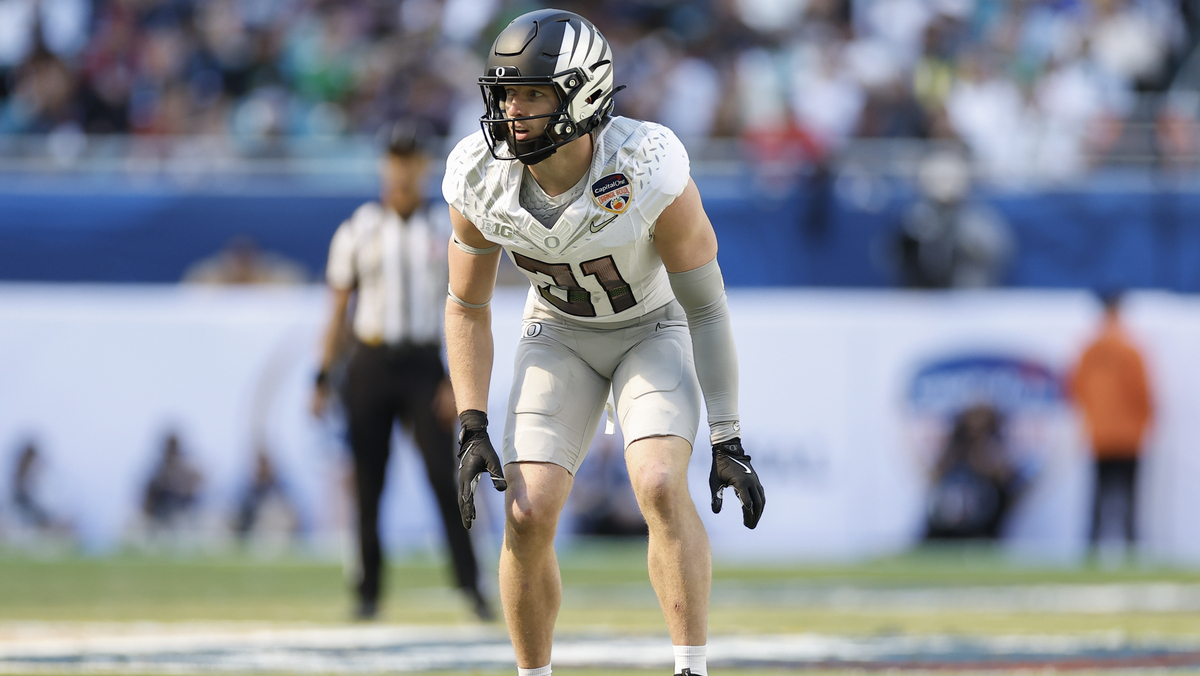
A lot of notable mock drafts — including ESPN’s Mel Kiper Jr. — have the Vikings taking Oregon safety Dillon Thieneman at No. 18, and for good reason. That’s our recommendation as well.
Whether Smith retires or returns for one more season, Minnesota needs to find his replacement as he’s been the lynchpin of that defense for most of his 14-year career with the team, with more than 1,100 tackles, 51 TFLs and 39 INTs. It’s not a spot the Vikings want to have to patch together with Band-Aids — they need a compelling succession plan and Thieneman fits the bill.
After back-to-back 100-tackle seasons at Purdue (and 6 INTs as freshman in 2023), the 6-foot, 201-pound Thieneman transferred to Oregon last year and stepped in seamlessly to a prominent role on one of the best defenses in college football. He led all Big Ten defensive backs with 92 tackles and had 2 interceptions in helping the Ducks to the College Football Playoff semifinals.
Thieneman then ran a 4.35-second 40-yard dash at the NFL Scouting Combine that was fourth-best among safeties and posted the second-best vertical jump of that group (41 inches).
It’s highly unlikely Thieneman is drafted before the Vikings get their shot at No. 18.
If he is gone already, though, the team should pivot to addressing the need for another playmaker in the passing game and take Sadiq if he is somehow still on the board (he shouldn’t be) or one of the second-tier of wide receivers (Texas A&M’s KC Concepcion would be an ideal fit in the slot while also offering top-end upside as a return specialist; Washington’s Denzel Boston or Indiana’s Omar Cooper Jr. would be solid additions as well).
Either way, Minnesota can’t go wrong. If it doesn’t land Thieneman, though, it will need to prioritize a safety in the second round rather than going for a running back/wide receiver.