Notre Dame star Jeremiyah Love is widely regarded as the latest “generational” talent at running back and expected to have a strong shot at landing in the top 5 of the 2026 NFL Draft in a handful of days.
Noted draft analysts like ESPN’s Mel Kiper Jr., The Ringer’s Todd McShay, NFL.com’s Daniel Jeremiah, ESPN’s Peter Schrager, ESPN’s Matt Miller, NFL.com’s Bucky Brooks and so on all project Love to land with the Tennessee Titans with the No. 4 overall pick Thursday. McShay actually has Love ranked the No. 1 overall prospect in the draft at any position.
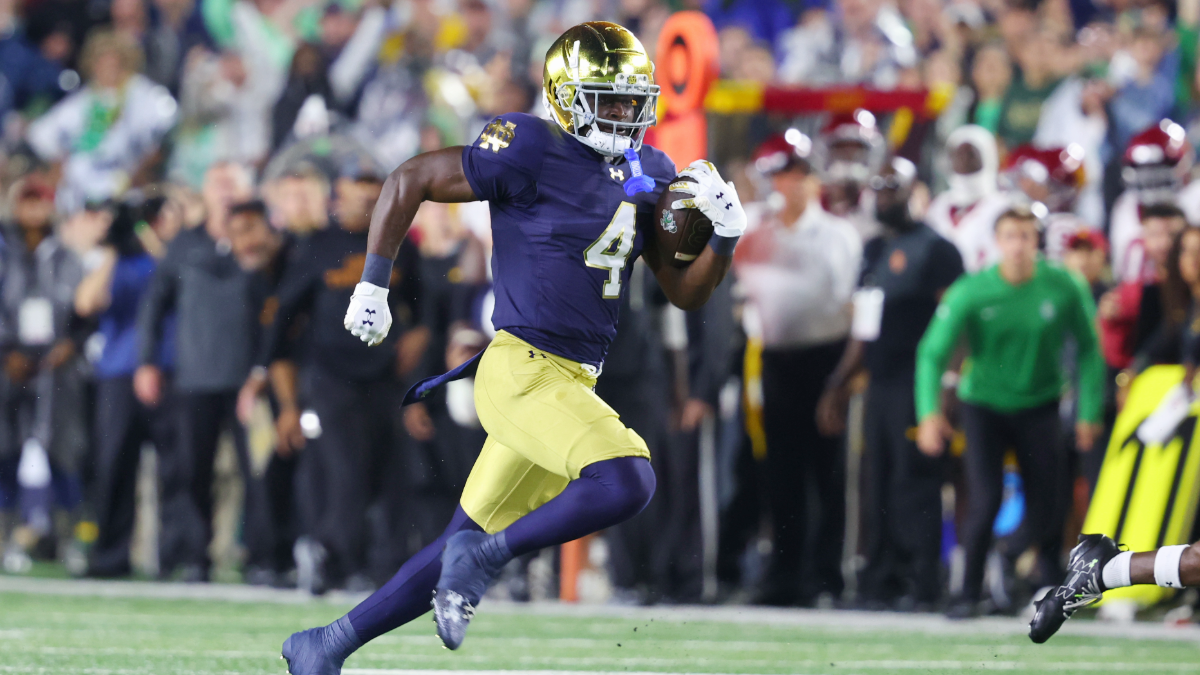
As part of our team-by-team NFL draft preview series, we opined that the Titans had bigger needs to address with the infrastructure of their roster and that a top 5 running back was a luxury for teams with far fewer holes. But that doesn’t mean they agree.
If those projections bear out Thursday, Love would become the first running back drafted in the top 5 since Saquon Barkley went No. 2 to the New York Giants in 2018. (Ashton Jeanty just missed as he was drafted No. 6 overall by the Las Vegas Raiders last year).
There have only been six RBs drafted in the top 5 picks in the last 20 years.
It doesn’t happen often for obvious reasons.
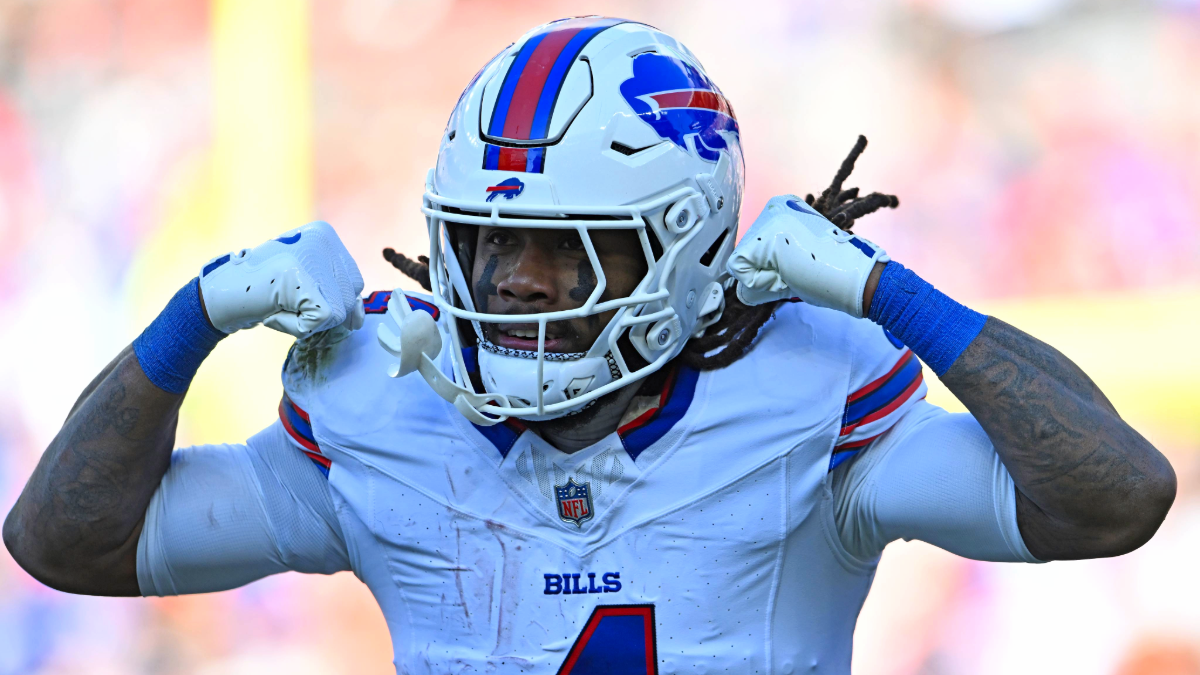
Most Of The NFL’s Best Running Backs Were Not First-Round Picks
First, running back is the single easiest position at which to find immediate-impact, high-upside value on Day 2 or even Day 3 of the draft.
Case in point, five of the NFL’s top six rushing leaders last season were not first-round picks — James Cook (2nd round, 63rd overall), Derrick Henry (2nd round, 45th), Jonathan Taylor (2nd round, 41st), De’Von Achane (3rd round, 84th) and Kyren Williams (5th round, 164th).
We could stretch the point further and say 13 of the top 20 rushers last season were not Day 1 picks. Or that five of them weren’t even Day 2 picks — Williams, Tony Pollard (4th round, 128th), Rico Dowdle (undrafted), Chase Brown (5th round, 163rd) and Jaylen Warren (undrafted).
Or we could flip it and say only 5 of the top 20 rushers in the NFL last season were taken higher than pick No. 24.
That’s one reason to support the argument that a top-5 running back is a luxury the Titans (at the very beginning of a substantial rebuild) can’t quite afford. The chance of landing an impact rusher on Day 2 of the draft is infinitely higher than the chance of finding an immediate-impact edge rusher (like they really need), but what do we know?
The second reason why so few running backs land in the top 5 of the NFL draft is because the hit rate on those picks has been really discouraging.
Complete List Of Running Backs Drafted Top 5 In Last 20 Years
2018, Saquon Barkley, No. 2 to the New York Giants
2017, Leonard Fournette, No. 4 to the Jacksonville Jaguars
2016, Ezekiel Elliott, No. 4 to the Dallas Cowboys
2012, Trent Richardson, No. 3 to the Cleveland Browns
2008, Darren McFadden, No. 4 to the Raiders
2006, Reggie Bush, No. 2 to the New Orleans Saints
Let’s break down that list, shall we? Of those 6 …
– 1 won a Super Bowl with the team that drafted them (Bush) … while Fournette and Barkley won Super Bowls with their second teams.
– 1 won NFL Offensive Rookie of the Year (Barkley)
– 1 won NFL Offensive Player of the Year (Barkley, but with the Eagles not the Giants)
– 2 received first- or second-team All-Pro honors (Elliott twice, Barkley once)
– 2 led the NFL in rushing (Elliott twice, Barkley once)
– They collectively produced 15 1,000-yard seasons between them (Barkley 5, Elliott 4, Bush 2, McFadden 2, Fournette 2) for an average of 2.5 each. Does that sound like a good return on investment?
Now, to be transparent, we could have that group and those numbers looking a little differently by going back a handful more years and including Hall of Famer LaDanian Tomlinson (No. 5 overall in 2001, 8 1,000-yard seasons, two-time NFL rushing leader, MVP), Jamal Lewis (No. 5 in 2000, 7 1,000-yard seasons, NFL rushing leader with 2,066 yards in 2003, Super Bowl champion, NFL Offensive Player of the Year) and Hall of Famer Edgerrin James (No. 4 in 1999, 7 1,000-yard seasons, two-time NFL rushing leader, Super Bowl champion).
But to do that we’d also have to rope in the bizarre 2005 draft class that saw running backs Ronnie Brown, Cedric Benson and Cadillac Williams go 2-4-5 in the draft and combine for one single Pro Bowl nod and five 1,000-yard seasons between them.
The Results Are Hard To Ignore On Drafting RBs In Top 5
Anyways, arguably five of the six running backs to go top 5 in the draft the last 20 years proved to be regrettable picks for one reason or another.
– Richardson, of course, goes down as one of the all-time draft busts, lasting just three years in the NFL while reaching even 575 rushing yards in just one of those seasons.
– McFadden had one 1,000-yard season in seven years with the Raiders (and another later with the Cowboys) and averaged 606.7 rushing yards/season for the team as it failed to post a winning record in that time and averaged 5 wins a year.
– Fournette rushed for 1,040 yards and 9 TDs in 13 games as a rookie, helping the Jaguars make a surprise run to the AFC championship game, but they went 5-11 and 6-10 the next two years. He played in just 36 games in three seasons for the team before being released when Jacksonville was unable to trade him and ready to move a different direction. Surely, the Jags would like that one back.
– Bush had been the most exciting player in college football during his time at USC and was actually widely expected to be the No. 1 overall pick, before falling to the Saints at No. 2. They had to feel fortunate in the moment, but Bush never fully delivered on expectations in the NFL. He wasn’t a bust, but he never established himself as a true No. 1 RB with the Saints, peaking at 581 rushing yards in his second of five seasons there. His impact as a pass-catcher also diminished after he had 88 catches for 742 yards as a rookie, as he never got to 450 again for the team. He did have 4 punt return TDs, including 3 in 2008. But he never made a Pro Bowl or earned any such honors, and in the Saints’ Super Bowl season in 2009, he contributed just 390 rushing yards and 335 receiving yards albeit with 8 total TDs. (He had 25 yards rushing and 38 receiving in the Super Bowl).
Bush lasted six more seasons in the NFL and actually had his three best rushing seasons with the Dolphins (1,086 yards and 986 yards) and Lions (1,006 yards). But certainly, in hindsight, New Orleans could have gotten more value out of the No. 2 overall pick by going any other number of directions — that’s just a fact.
Giants And Saquon Barkley A Relevant Reference Point For Titans In This Draft
– And even Barkley probably proved to be the wrong selection for the Giants at No. 2 overall — through really no fault of his own. Like the Titans are now, the Giants were coming off a dismal season (3-13) and simply had more pressing needs than a RB that high in the draft to run behind a bad offensive line. Barkley delivered 1,307 rushing yards, 91 catches for 721 yards and totaled 15 TDs to win NFL Offensive Rookie of the Year, but New York still went 5-11. And then 4-12, 6-10, 4-13, 9-7-1 and 6-11.
Barkley missed most of the 2020 season with a torn ACL and was limited in 2021, but he was generally excellent in his three full seasons with the Giants.
Only then did they ironically decide it didn’t make sense for them to pay top dollar for a running back when the roster had so many other needs that they let Barkley become a free agent, he signed with the division rival Eagles and immediately had a career year with 2,005 rushing yards and 15 total TDs to win NFL Offensive Player of the Year honors on the way to a Super Bowl championship.
So that is a prime example that even when the player proves worthy of being drafted so highly, like Barkley did, it still doesn’t mean it was worth allocating that kind of draft capital to a running back over a more keystone position of greater talent scarcity (like offensive tackle, edge rusher, cornerback, even top-end wide receiver).
Perhaps the only top 5 running back pick of the last 20 years that delivered as expected was Elliott, believe it or not.
He led the league in rushing as a rookie in 2016 with 1,631 yards and 15 TDs (plus 363 yards and a TD receiving) for a 13-3 Cowboys team that was already well-built along the offensive line and set up to truly benefit from adding another dynamic offensive weapon it could maximize. Elliott rushed for 125 yards in the divisional round playoff loss to the Packers and did everything he could for Dallas that season.
He also led the NFL in rushing in 2018 with 1,434 yards and 6 TDs with a career-high 567 yards and 3 TDs receiving for a 10-6 Cowboys team that again lost in the divisional round.
Overall, Elliott averaged 1,180 rushing yards over seven seasons and totaled 80 TDs before moving on to the Patriots for a year and back to Dallas for one final season in a smaller role. It’s hard to say the Cowboys could have realistically hoped for more out of Elliott with that pick.
And it still didn’t get them to a conference championship game.
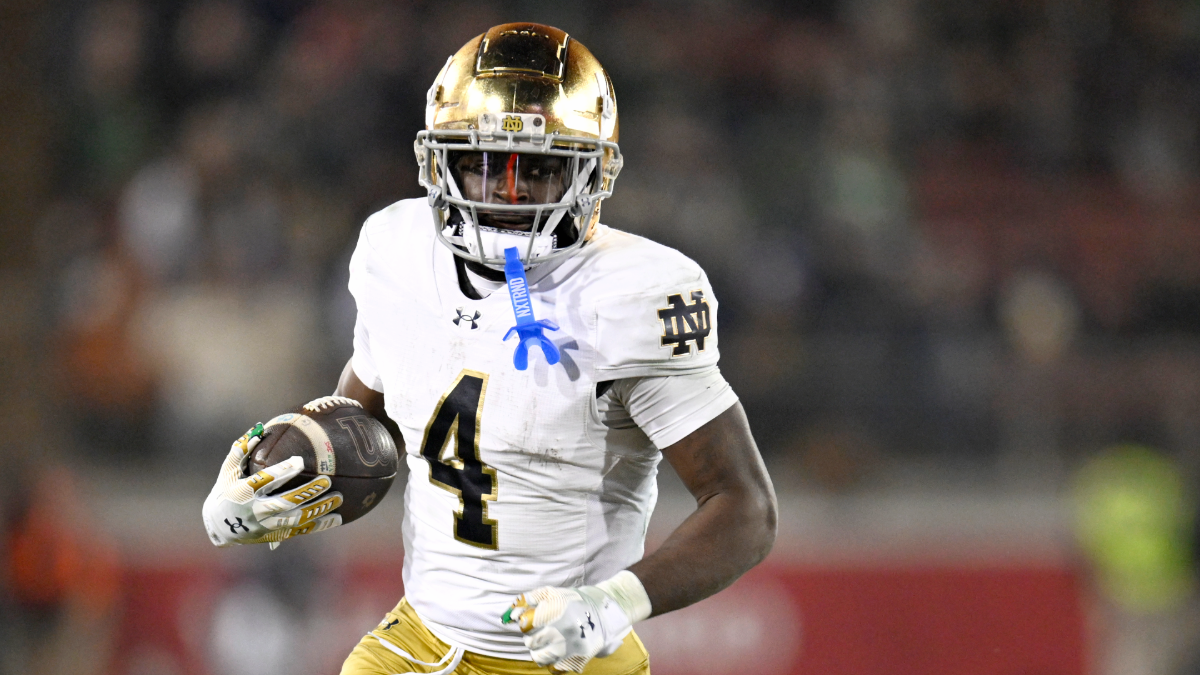
The Case For Jeremiyah Love As a Top 5 Pick
We’ve gotten this far into the column and barely talked about the focus of it, so let’s do that.
There is almost no doubt that Love will indeed be an excellent running back in the NFL. None of the data outlined above, or the dots connected or points made were to suggest anything else.
Love rushed for 1,372 yards and 18 TDs while adding 280 yards and 3 TDs receiving over 12 games last season for Notre Dame. He averaged an elite 6.9 yards per carry for the second straight season. That was the best rate of any Power Four RB with at least 100 carries in 2025 (Love had 199).
He’s 6-foot, 212 pounds, uber athletic in every way and ran a blazing 4.36-second 40-yard dash that was second-best among RBs at the NFL Scouting Combine this year.
He has no red flags on or off the field. He projects as a top-tier three-down back in the NFL if he stays healthy — and lands in a good situation.
In other words, he is definitely not Trent Richardson, who was a plump 5-foot-9 and 228 pounds coming out of Alabama and ran anywhere from a 4.4-4.58 40 time at his Pro Day with no consensus ever settled upon.
Love is as safe a running back pick as there is — like Bijan Robinson, who went No. 8 overall to the Falcons three years ago as a can’t-miss prospect and has delivered on expectations so far.
…
Or like Barkley.
That brings us full-circle to our point here.
The Titans don’t have to evaluate if Love is cut out to be a top-tier NFL running back. They have to evaluate if they are set up to maximize his potential and have it actually matter — and not get undermined by a team with so many other needs, as we outlined in depth here.
When the Giants drafted Barkley, they had a bad offensive line as evidenced by QB Eli Manning being sacked 47 times in that following 2018 season (sixth-most in the NFL). They then had one of the most limited passing attacks in the league from there on, trading top wide receiver Odell Beckham Jr. after that season and transitioning at QB to Daniel Jones.
All the while, Barkley worked at a disadvantage game after game, did his part when healthy but ultimately couldn’t carry a team with too many issues at too many other spots.
Similarly, look at the Raiders last year in drafting Jeanty No. 6 overall. They had arguably the worst offensive line in the NFL, ranking dead last in rushing in 2024 and somehow finished even worse with Jeanty at a dismal 77.5 yards per game, all while QB Geno Smith tied for the league lead in sacks taken at 55.
Why not address the offensive line, sign a cheap veteran running back or try to hit on one in the middle of the draft, and then come back to spend premium capital on a RB when the offense is truly ready to feature one?
Which brings us back to Tennessee at No. 4 …
The Titans have a lackluster offensive line as well. As evidenced by QB Cam Ward tying Smith for the league lead in taking 55 sacks last season. Or that they ranked 29th in the NFL in rushing (93.5 YPG) — also 29th in passing.
Tennessee has changed out the coaching staff, signed a new center and greatly overpaid for wide receiver Wan’dale Robinson (in our humble opinion). It remains totally undetermined if Ward is going to be a good NFL quarterback — he wasn’t set up to succeed in any way last year.
We’re not saying it can’t work out — just that a running back is rarely the missing ingredient to a championship recipe unless it’s the final one.
Like Jahmyr Gibbs for the Lions at No. 12 in the 2023 draft, or Robinson should have been for the Falcons if they didn’t mess up the QB situation, or like Love might have been for the Chiefs if they had any confidence he’d fall to No. 9 and didn’t splurge on free agent Kenneth Walker III instead.
The Titans aren’t Love’s only shot at landing in the top 5, though. If they do go a different direction, the Giants are sitting next at No. 5.
At the beginning of another rebuild, with second-year QB Jaxson Dart, new head coach John Harbaugh and a razor-thin cast of offensive playmakers outside of young WR Malik Nabers working back from major knee surgery. (Albeit with an improving offensive line that seems in better shape than when they tried this with Barkley.)
Do the Giants dare attempt to anchor another rebuild around a can’t-miss running back prospect who is just too good to pass up at the top of the draft even with greater needs pretty much all over the field? Wouldn’t that be something …