Remaining NFL free agents like Jauan Jennings, Tyreek Hill, Stefon Diggs, Bobby Wagner and Joey Bosa will eventually find homes for the 2026 season, and we see some obvious fits for those and other unsigned veteran players.
With the NFL draft in the rearview, teams have a fresh picture of their remaining roster needs and a dwindling pool of free agents from which to plug those holes.
Some moved quickly after the draft to lock in priority targets, highlighted by the Baltimore Ravens signing soon-to-be 40-year-old edge rusher Calais Campbell this week.
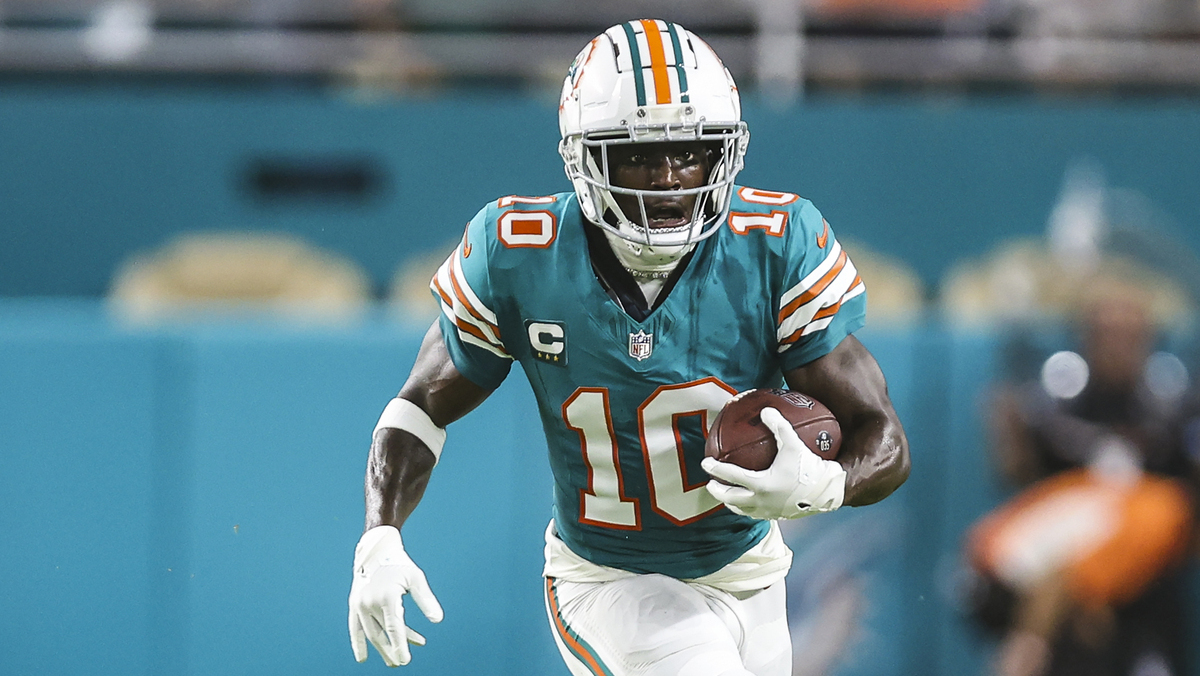
But a lot of notable names remain available, and a good bit of them will end up making significant impacts this season — for some team.
Here are 10 ideal fits of remaining free agents who address priority needs for teams.
Best Fits For Top Remaining NFL Free Agents
WR Tyreek Hill — Kansas City Chiefs
The Chiefs addressed other needs in the draft while taking a flier on Cincinnati wide receiver Cyrus Allen in the fifth round, but the fact remains their wide receiver depth chart is underwhelming.
Rashee Rice has had his moments, but injuries and off-field issues have limited him to 12 games total over the last two seasons. Meanwhile, Xavier Worthy simply hasn’t delivered as expected as a 2024 first-round pick with 101 catches for 1,170 yards and 7 TDs combined his first two seasons.
Tyquan Thornton had a career-best season in 2025, catching 19 passes for 438 yards and 3 TDs on an impressive 23.1 yards per catch in his first year with the team. But he’s a complementary piece at best.
Per Spotrac.com, Kansas City has a little under $7 million in salary cap space, not accounting for potential future cap-saving moves. That’s not much, but they can probably make this work.
Hill is going to have to first show that he’s still got some speed once he fully recovers from the devastating knee injury that ended his 2025 season and Miami Dolphins tenure, but assuming he’s able to do that, he remains a very intriguing option for any WR-needy team.
And what would be a better fit than returning to the franchise where he had his greatest success?
From 2016-21, Hill had 479 catches for 6,630 yards and 56 touchdowns playing with the Chiefs and QB Patrick Mahomes. He was part of a Super Bowl championship team, and quite honestly, Kansas City’s passing attack has been missing him ever since he got traded to Miami.
He’ll probably never be the same elite talent again after dislocating his left knee and tearing his ACL and other ligaments, especially now at 32 years old, but it also seems plenty possible he’s still an above-average playmaker.
It makes sense for Hill to pursue a one-year deal and try to prove himself for a bigger contract in 2027 and beyond, and in betting on himself it would be wise to go to a team where he has such familiarity already and that will get the most out of him.
This pairing just makes too much sense if the Chiefs can make it work financially.
WR Jauan Jennings — Indianapolis Colts
Jennings overplayed his hand in free agency and priced himself out of the market, wanting to be paid as a No. 1 wide receiver when he only fell into that role for the San Francisco 49ers by default and then delivered modest production (55-643-9 in 15 games last season).
Jennings is a No. 2 WR, which is what the Colts badly need after breaking the bank to keep Alec Pierce while then giving Michael Pittman Jr. away to the Pittsburgh Steelers to save salary cap space.
Beyond Pierce, the Colts have Josh Downs, signed free agent Nick Westbrook-Ikhine to a cheap one-year deal and added Oklahoma WR Deion Burks in the seventh round of the draft. Downs is solid, but he’s primarily a slot receiver, so there’s room to add/upgrade on the outside. More to the point, there’s pressing need to do so.
The Colts expect to compete for a playoff spot in 2026 and have more than $27 million in salary cap space available still, per Spotrac.
If his asking price comes down — it’s going to have to ultimately — then Jennings makes a lot of sense for Indianapolis.
The wide receiver recently wrapped up a visit with the Minnesota Vikings but left without a deal. The Vikings make some sense too, but the Colts should feel more desperate to reel in one of the top remaining free agent wide receivers.
OT Taylor Decker — Chicago Bears
We’re not reinventing the wheel here — there is a lot of buzz about Decker as a logical fit for the Bears.
Because, well, he’s an obviously logical fit for the Bears.
The veteran left tackle was released by the Detroit Lions when he declined to take a pay cut to help the team free up cap space. Decker made a Pro Bowl in 2024 and has started 140 games over 10 seasons since being the No. 16 overall pick in the 2016 NFL Draft.
He’s the best offensive tackle still on the market.
Left tackle was a bit of a mess last season for the Bears. Braxton Jones, a fifth-round draft pick in 2022, started the first four games before being replaced by undrafted rookie Theo Benedet, who started the next six. Then in Week 12, 2025 second-round pick Ozzy Trapilo claimed the job.
It looked like the Bears had found their answer in Trapilo, but he tore his patellar tendon in the team’s wildcard playoff game and general manager Ryan Poles said in February the injury will keep the young linemen out “most of the year.”
The Bears had other needs in the draft — including drafting Iowa center Logan Jones in the second round following Pro Bowl C Drew Dalman’s unexpected retirement — and did not take an offensive tackle.
So, they can either roll with the combo of Jones and Benedet … or sign a proven left tackle who played for Bears coach Ben Johnson when he was the offensive coordinator in Detroit.
Chicago doesn’t have a lot of salary cap space, with Spotrac calculating it at about $11.5 million, and Decker was set to make $18.2 million this season on his old contract with the Lions. The Bears could try to free up some extra cap space if needed, but it’s a smart fit for both sides ultimately.
It seemed retirement was at least a consideration for Decker after last season before he asserted his desire to play in 2026, so a one-year deal could be appealing to both sides. The Bears shore up QB Caleb Williams’ blind-side protection, also boost their thin OT depth overall by having Jones and Benedet available as needed on either side, and Decker gets to play for a contender. Win-win.
OG Kevin Zeitler — San Francisco 49ers
Last season, PFF ranked Zeitler 13th out of 81 qualifying offensive guards with a 74.5 overall grade as he played on a one-year contract with the Tennessee Titans. But the Titans let him become a free agent, and now he’s the top remaining offensive guard on the market.
The 49ers are among the teams with the biggest need for an experience guard.
They let former starting left guard Aaron Banks go as a free agent last year, as he signed a massive contract with the Green Bay Packers. They then let his replacement Spencer Burford go in free agency this year (to the Las Vegas Raiders).
Burford and 2025 seventh-round pick Connor Colby split the position last year, but PFF graded Colby 79th out of 81 offensive guards in pass protection over his 451 snaps.
The 49ers also have Robert Jones, who signed a cheap one-year deal after missing all of last season with a neck injury, but he was a full-time starter in only one of his four healthy NFL seasons (with the Miami Dolphins).
The team then used a fourth-round draft pick on Washington’s Carver Willis, who was a left tackle in college but could potentially work at guard.
None of those options are ideal in 2026 for a team with Super Bowl ambitions, though.
The 49ers have ample salary cap space to work with and should use it to bolster their weakest spot on the offensive side.
WR Stefon Diggs — Baltimore Ravens
The Ravens addressed their needs at wide receiver in rounds 3 and 4 with USC’s Ja’Kobi Lane and Indiana’s Elijah Sarratt, and while we are sky-high on the value and long-term upside of both of those picks, there’s no guarantee that both will be ready to step into major roles immediately as rookies.
Baltimore has a star WR1 in Zay Flowers, but the drop-off is steep after that with Rashod Bateman and Devontez Walker.
The Ravens are a legit Super Bowl contender and should make sure QB Lamar Jackson has the weapons he needs.
Diggs, who was released after one season with the New England Patriots despite totaling 85 catches for 1,013 yards and 4 TDs, is better suited as a WR2 at this point of his career, and that’s all the Ravens need him to be.
Baltimore has just under $24 million in salary cap space, per Spotrac. Diggs has been making over $20 million a year for a while now, but that’s not going to happen anywhere in 2026, so there should be a more modest middle ground to reach with Diggs on a one-year deal.
Also, he’s from Maryland and went to the University of Maryland, so the appeal of returning to his roots may be further enticement for Diggs in Baltimore.
LB Bobby Wagner — Cincinnati Bengals
The Bengals didn’t have a first-round pick in the draft after trading it to the New York Giants for defensive tackle Dexter Lawrence, and with their second-round pick they prioritized their need at edge rusher over their equally pressing need at linebacker.
The Bengals didn’t draft a linebacker period, for that matter, despite getting disappointing production from rookies Demetrius Knight Jr. (a second-round pick in 2025) and Barrett Carter (a fourth-round selection). That was a big reason Cincinnati had one of the NFL’s worst defenses overall.
Wagner will be 36 years old this season, but the 10-time Pro Bowl and six-time All-Pro selection is still playing at a high level. He had 162 tackles, 8 tackles for loss, 4.5 sacks and 2 interceptions for the Washington Commanders last season.
Washington opted to get younger on defense and let Wagner become a free agent while drafting LB Sonny Styles No. 7 overall.
There will be other suitors for Wagner, but he would be an ideal stabilizing presence in the middle of a Cincinnati defense that badly needs such leadership. The Bengals’ elite offense makes them a playoff team if the defense can even be league average.
EDGE Cameron Jordan — New Orleans Saints
Jordan has spent his entire 15-year career with the Saints and wants to keep playing heading into his age-37 season, but the two sides have yet to come to an agreement.
They should.
Jordan flourished in his first season in defensive coordinator Brandon Staley’s system, notching 10.5 sacks — his most since 2021 — in a resurgence after having just 6 sacks combined the previous two years.
And there remains mutual interest between Jordan and the Saints.
New Orleans could have benefitted from prioritizing edge rusher in the draft. Not only did the Saints not use an early-round pick on the position but they didn’t take one at all.
They return Chase Young (10 sacks last season) and Carl Granderson (6 sacks) and signed former Patriots EDGE Anfernee Jennings (7.5 sacks in five seasons) after the draft for depth, but that’s a thin unit overall.
The Saints should also value having Jordan play out his whole career for the franchise.
EDGE Jadeveon Clowney — Minnesota Vikings
The Vikings chose to prioritize interior defensive line over their needs on the edge in the draft, taking Florida DT Caleb Banks at No. 18 and coming back in the third round with Iowa State DT Domonique Orange.
Not only did the Vikings not draft an edge rusher but they traded away Jonathan Greenard (12 sacks in 2024 before a drop-off last year) to the Philadelphia Eagles during the draft.
That leaves Andrew Van Ginkel (7 sacks in 12 games in 2025) and Dallas Turner (8 sacks) atop a thin depth chart.
Clowney, who has 66.5 sacks in 12 seasons since being the No. 1 overall pick in 2014, showed he’s still playing at a productive level while posting 41 tackles, 12 tackles for loss and 8.5 sacks for the Dallas Cowboys last season.
WR Deebo Samuel — Los Angeles Rams
The Rams had one prime need entering the draft — a receiver to complement Puka Nacua and Davante Adams, and ideally one who can work in the slot.
They had the chance to take the perfect fit for that need with the No. 13 pick in USC WR Makai Lemon.
They chose not to do that, instead questionably drafting potential future QB Ty Simpson. (The Rams took Miami WR CJ Daniels in the sixth round).
Thus, they should be in the market for a free agent wide receiver with Jordan Whittington the next most-established WR on the depth chart.
Samuel isn’t what he was at his peak with the 49ers when he was hybrid weapon who once had 1,405 receiving yards and 365 rushing yards in the same season, but he’s still productive — finishing his lone season in Washington with 72 catches for 727 yards and 5 TDs
The Rams would just need him to be a third receiver assuming Nacua and Adams can stay healthy, and Samuel has ample experience working out of the slot.
EDGE Joey Bosa — San Francisco 49ers
Bosa has had four double-digit sack seasons and totaled 77 overall in 10 years with five Pro Bowl selections, but his production has been in decline as he posted 5 sacks each of the last two seasons.
But he’s a useful rotational edge rusher still, and he also had 5 forced fumbles for the Buffalo Bills last season.
Joining forces with his brother Nick Bosa in San Francisco should be an obvious appeal, but the 49ers also need a veteran pass rusher so it’s more than just a compelling storyline.
Nick Bosa is recovering from a torn ACL sustained in Week 3 of last season, and while he should be ready for the start of the 2026 season the team may want to ease him back. Meanwhile, 2025 first-round pick Mykel Williams is a little further behind in his recovery after tearing his ACL in Week 9.
The rest of the depth chart at that spot — Keion White, Sam Okuayinonu and new third-round draft pick Romello Height — is full of complementary pieces.
Joey Bosa would be an upgrade over every one of those players except his brother.