The first round of the 2026 NFL Draft went off script early and never fully recovered.
But that’s why it’s the compelling spectacle it is.
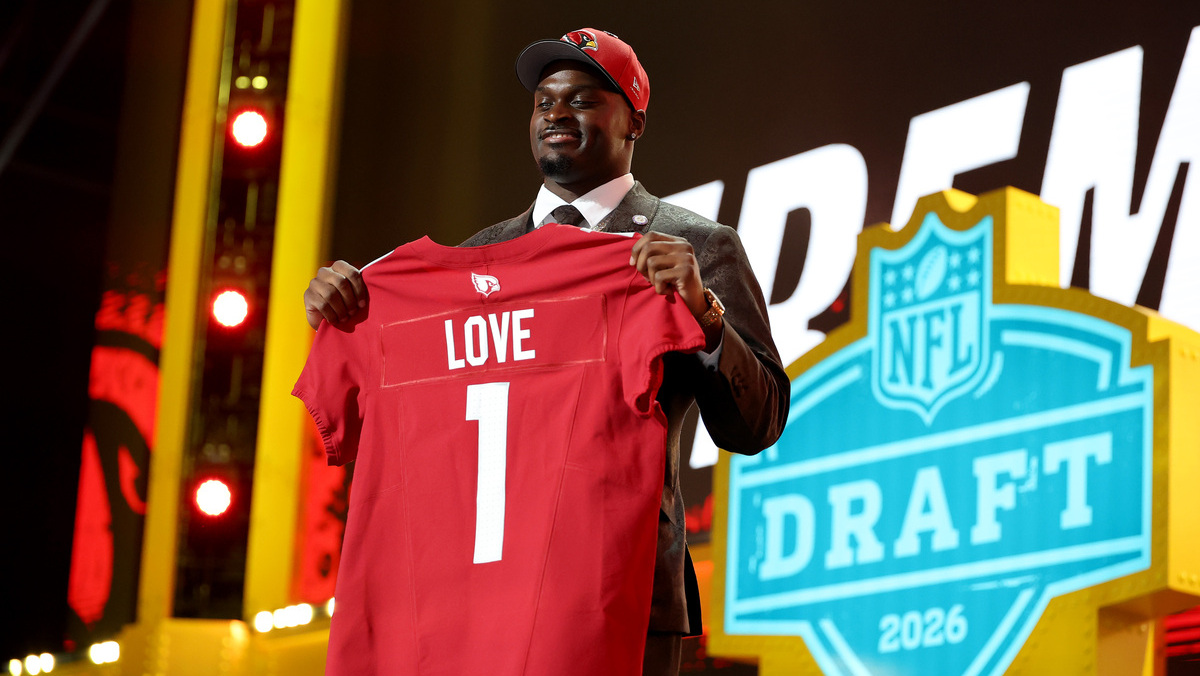
For all the weeks of debate over whether the Tennessee Titans at No. 4 (or maybe the New York Giants at No. 5) would make Notre Dame’s Jeremiyah Love the first running back drafted in the top 5 since Saquon Barkley in 2018, think again!
It was the Arizona Cardinals jumping the gun at No. 3 to take a running back when they badly need to rebuild their diminishing defense, don’t have a long-term plan at quarterback and already invested in two well-compensated veteran running backs for 2026. But sure, despite ample examples to the contrary the last 20 years, a running back is going to fix everything there.
The Cardinals were one-upped just minutes later, though, when the Titans, perhaps panicked after Love came off the board, reached way too early to take Ohio State wide receiver Carnell Tate, who was not even the best wideout on his own college team. That’s harsh (but true). Tate is a fine prospect and merited going in the top half of the first round for sure, but we’re not talking Ja’Marr Chase or Calvin Johnson levels of transcendent talent here — No. 4!
After they already splurged (overpaid) in free agency on WR Wan’Dale Robinson … while needing help on both sides of the line of scrimmage and elsewhere on defense … and while passing on Buckeyes linebacker Arvell Reese, who could have been a Day 1 difference-maker for that defense. Wild.
And thus the tone for the draft was set as eight trades and more chaos ensued.
But nothing compared to watching Los Angeles Rams coach Sean McVay try to toe the line and pretend like he wasn’t fuming mad that the team wasted its first-round pick on a questionable quarterback for the future when it really needed a wide receiver for the present to complete a roster built to win a Super Bowl this year.
Revisiting The Top Takeaways From Day 1 Of The 2026 NFL Draft
Before we spoil any more of the plot, let’s break Day 1 down from all angles — the good, the bad and the Ossenfort.
JUMP TO: No. 1 | No. 2 | No. 3 | No. 4 | No. 5 | No. 6 | No. 7 | No. 8 | No. 9 | No. 10
1. Did The New York Jets Win Day 1 Of The NFL Draft?
Trust us, we’re as stunned to write it as you are to read it.
But not only did the Jets manage not to totally blow this, they actually maximized the first round, hitting on both of their own picks and trading back into the end of the round for another shrewd move.
The Jets badly needed an impact edge rusher and didn’t overthink it by taking Texas Tech star David Bailey at No. 2. (They could have also taken Ohio State LB/EDGE Arvell Reese and considered that a win too, but we like the Bailey pick.)
It figured they might go wide receiver at No. 16 as they had a barren WR depth chart behind Garrett Wilson and were the worst passing offense in the NFL last year (which had a lot to do with the QBs, of course). But the Jets smartly — again, it doesn’t sound right to us either — saw a fortuitous value opportunity with Oregon tight end Kenyon Sadiq still on the draft board.
The consensus top prospect at the position, who led the Ducks in receptions (51) and receiving touchdowns (8) on their way to the College Football Playoff semifinals, will immediately elevate the Jets’ offense in his own way.
But New York also remained mindful that it still had to address the razor-thin WR depth chart without letting too many of the best options come off the board, and so it traded back into the first round and took Indiana’s Omar Cooper Jr. (69-937-13 for the national champs), giving up only the No. 179 pick to the 49ers to move up from No. 33 to No. 30.
We’re not totally sold on Cooper as a future No. 1 WR, but he should absolutely be a productive No. 2 with Wilson — which the Jets didn’t have before Thursday night.
After solid work in free agency, an incredible start to the draft, more work still to do this week and then three first-round picks in 2027, the Jets’ rebuild is well on its way.
2. Sean McVay Was All Of Us …
What. Were. The. Rams. Thinking?!
No team in the league is more all-in on 2026 than the Los Angeles Rams, not knowing how much longer 38-year-old reigning NFL MVP QB Matthew Stafford will keep playing and wanting to seize this championship window while it lasts.
So Rams general manager Les Snead had one of the easiest decisions in the draft Thursday night — or so it seemed.
The one thing the Rams needed to complete their roster puzzle was another dynamic receiver, either as a complement to Puka Nacua and Davante Adams or insurance against Nacua’s mounting off-field transgressions or Adams’ health at 33 years old and after missing three games last season.
And the absolute perfect fit fell into their laps at No. 13 as expected in USC’s Makai Lemon, who is from Los Angeles, starred in college down the road with the Trojans and could fit into the slot with Nacua and Adams on the outside to take arguably the NFL’s best offense to an even higher level and maximize Stafford’s remaining year(s).
Done and done, send the pick in, right?
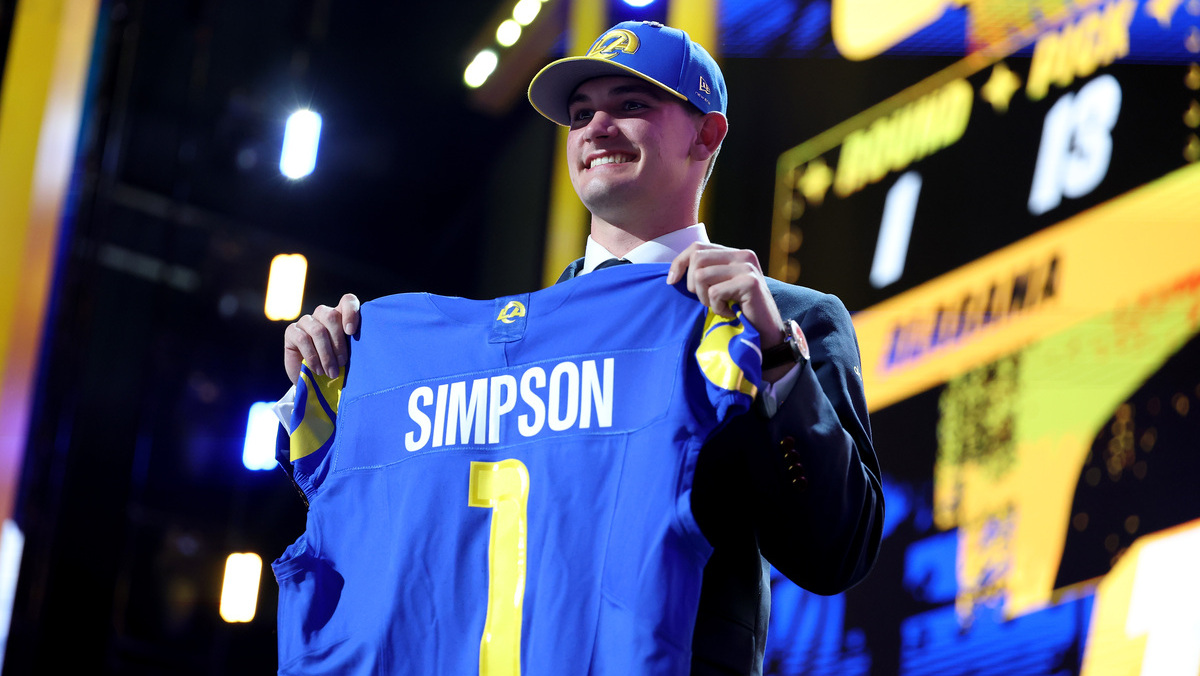
Nope, Snead tried to be the smartest guy in the room and ended up the dunce of the draft by taking Alabama quarterback Ty Simpson — to plan for the future with a team otherwise built to seize the present.
That’s not even getting into the whole matter of whether Simpson is actually going to be a good NFL QB. Analysts were so split on whether he even warranted being drafted in the first round, let alone at No. 13!
Who’s to say Stafford won’t play two or three more years?
Well, Rams coach Sean McVay sure seemed to share in the confusion of the pick.
McVay wouldn’t even commit to Simpson as the team’s backup QB in 2026.
The reaction from John Lynch, GM of the rival San Francisco 49ers made the whole matter even more interesting.
“Ty Simpson’s a good football player. There was a lot made as to where he would go and what teams would do. It probably surprised everybody. But one thing I’ve learned over the years is that with the quarterbacks, people will do those type of things. They certainly did, so we’ll see,” he said.
Indeed, we will …
3. A RB At No. 3? Really, Monti?!
We broke down in-depth why there had only been six running backs drafted in the top 5 picks over the last 20 years, and how ultimately five of those six cases ended up with the team likely regretting the decision.
Especially teams at the early stages of a rebuild, which the Cardinals are with no clear plan at quarterback after cutting Kyler Murray and planning to patch it together with Jacoby Brissett again in 2026. We drew the parallel to the Giants taking Barkley at No. 2 in 2018 — Barkley was unquestionably an elite talent at RB and delivered as expected when healthy. But it made nary a difference for a Giants team so lacking in so many other areas.
Precisely.
Arizona had three primary needs. It had lost its most productive linebacker in Akeem Davis-Gaither to the Colts, leaving Cody Simon, Mack Wilson and newly signed Jack Gibbens (formerly of the Patriots) as a serviceable but unspectacular trio. It also badly needed an edge rusher to pair with Josh Sweat.
The Cardinals could have taken Reese and used him in either spot (or like the Giants plan to, a little of everything).
A right tackle would have been the third priority.
The Cardinals brought back veteran running back James Conner on a one-year deal and gave free agent Tyler Allgeier a 2-year, $12.25-million deal. Why do that if planning to break the bank for a rookie running back?
Oh, Monti …
To be clear, none of this is to doubt Love’s ability to be a dynamic NFL running back — at all. He sure seems to be the real deal. It’s just a shame he didn’t land with a team better equipped to maximize that.
4. Trying To See Tennessee’s Perspective At No. 4
Devoid of context, taking Tate at No. 4 just seems bonkers, and we still don’t like the pick for the Titans.
Tate played second-fiddle to Jeremiah Smith in Ohio State’s passing attack the last two years and peaked this year as a junior with 51 catches for 879 yards and 9 touchdowns despite missing three games due to injury. His 17.2 yards per reception is the stat that stands out most, as he really flexed as a field-stretcher and downfield threat in 2025.
The stat that concerns us is that he was held under 50 yards receiving in five of his nine games vs. Power Four opponents last season.
Again, there’s absolutely justification for top-5 WRs — but they should be week-after-week dominant playmakers in college.
But we’re going to try to see it from their standpoint.
What the Titans needed most, they really weren’t in position to fix. They need to upgrade their offensive line, after QB Cam Ward tied for the NFL lead with 55 sacks taken as a rookie, but left tackle Dan Moore Jr. signed a four-year, $82-million contract a year ago with $50 million guaranteed and right tackle JC Latham was the No. 7 overall pick in the 2024 draft and entering the third year of his four-year rookie contact. They’re kind of stuck with those two, and it was too early in the draft to take an offensive guard without trading back.
Taking Reese would have made a ton of sense for the defense new head coach Robert Saleh wants to build, but he would know best of all how he feels about the pieces he has in place after some free agent upgrades.
So the next-best way to help Ward become the franchise QB they’re banking he can be is, indeed, to give him better targets in the passing game.
With Tate, veteran Calvin Ridley and free agent addition Robinson to operate in the slot, that is absolutely a dramatically better group of playmakers than Ward had a year ago.
We’ll see how it works out …
5. Teams That Benefitted Most As The Draft Board Unfolded
New York Giants
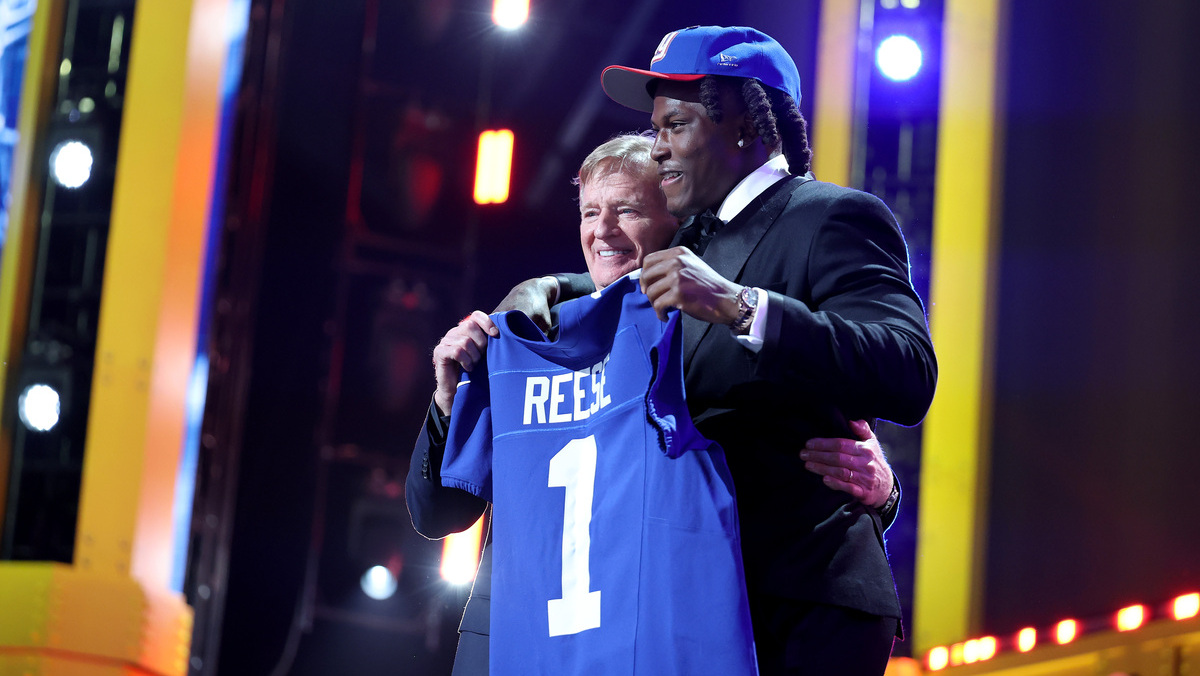
We thought the Giants would have been in great shape if they took Ohio State linebacker Sonny Styles at No. 5, but that’s because we didn’t think there was any chance fellow Buckeyes LB Arvell Reese would still be on the board by then.
As noted, leave it to the Cardinals and Titans to botch that, leaving the Giants with the easiest of decisions at No. 5.
There was question as to whether Reese would settle in as an off-ball linebacker or edge rusher in the NFL, most analysts felt he was more naturally suited to play in the middle of the defense and that’s what he’ll do for the Giants, while still being able to put his hybrid blend of skills to work if the coaching staff is creative.
Washington Commanders
The domino effect then benefitted the Commanders greatly. They used this offseason to invest significantly in getting younger and faster on defense, but they had left the linebacker position unaddressed while letting aging leading tackler Bobby Wagner become a free agent.
The clear best-case scenario for the Commanders at No. 7 was to hope Styles fell to them.
But if Reese isn’t on the board for the Giants, they likely take Styles instead and Washington has to adjust its draft plan. Instead, it all worked out ideally for Dan Quinn and his defense.
Tampa Bay Buccaneers
The Bucs’ clear priority need was at edge rusher, but drafting 15th it was questionable whether Rueben Bain Jr. would still be on the board or if the team would have to consider reaching to the next tier of EDGE prospects.
We thought surely he’d be long gone by that point, but Tampa Bay got its man.
6. Most Surprising Picks Outside The Cardinals, Titans And Rams
These were the other picks that surprised us most, and that’s not a bad thing in all cases.
New York Giants take OT Francis Mauigoa at No. 10
Using the extra first-round pick acquired from the Bengals in trading DT Dexter Lawrence, the Giants surprised a bit in taking one of the top offensive tackles in the draft. We thought they’d either snatch up safety Caleb Downs and double-down on the defensive upgrades, or get young QB Jaxson Dart another top-end WR to pair with Malik Nabers.
The reason the Mauigoa pick was a surprise was because the Giants have one of the better left tackles in the NFL locked up on a long-term deal in Andrew Thomas and just re-signed right tackle Jermaine Eluemunor for 3 years and $39 million.
But the Giants plan is to start Mauigoa off at right guard (which was the weak spot of the line), and honestly, we love the move. It also gives them the flexibility of having another high-level tackle if injury strikes on either end.
Minnesota Vikings take DT Caleb Banks at No. 18
This one was a more confusing stunner.
Many projected Oregon safety Dillon Thieneman to the Vikings as the logical successor to longtime stalwart Harrison Smith. Not just because it was an obvious need/fit, but because Thieneman was the consensus No. 2 safety in the draft and a nice value at that point in the first round
Instead, the Vikings took Florida’s Caleb Banks as the first defensive tackle selected when almost no prominent draft analyst had him as the top DT prospect. For instance, ESPN’s Mel Kiper Jr. projected Banks going at pick … No. 62. The Ringer’s Todd McShay had Banks ranked as his No. 53 overall prospect and the fourth-best DT.
The 6-foot-6, 327-pound Banks was also limited to three games as a fifth-year senior at Florida due to a significant fracture in his left foot, which gave some teams concern for a player his size.
Minnesota surely could have traded back (like so many teams in the back half of the round did) and still gotten Banks later.
This was a strange pick.
7. Most Underrated Move Of Day 1
Houston Texans GM Nick Caserio is one of the best in the business — so good, in fact, that his roster really had no obvious needs entering this draft.
That meant the Texans could pool some of their draft assets to move up and find a target upgrade somewhere on the depth chart.
That’s exactly what they did, but only needing to do so a couple spots, flipping the No. 28 pick for the Bills’ No. 26 pick and taking Georgia Tech offensive guard Keylan Rutledge.
The Texans had no need for a guard as they just gave right guard Ed Ingram a lucrative extension and signed free agent Wyatt Teller to play left guard.
But what they did need is an upgrade at center, and Rutledge is on board with making the move to that position.
Houston has a passable starter in Jake Andrews in place so if Rutledge needs a year to learn the position before taking over, the Texans have that luxury as well. Just a terrific, savvy pick for a loaded roster that should be in Super Bowl contention in the coming years.
8. Wildest Moment For Any Draft Prospect On Day 1
The aforementioned Lemon, the star WR and Biletnikoff Award winner from USC, was on the phone with the Pittsburgh Steelers telling him they were going to take him with pick No. 21 when the Philadelphia Eagles traded up to pick No. 20 and snagged him instead.
Speaking of the best GMs in the game, Howie Roseman strikes again!
The Eagles traded the 23rd pick along with picks 114 and 137 to move up and get their guy.
With the team widely expected to trade disgruntled star WR A.J. Brown after June 1, the Eagles landed another high-upside running mate for DeVonta Smith.
A terrific pick, but an even more impressive maneuver to realize they needed to trade up and beat the Steelers to the selection.
Rough night for the Steelers, meanwhile. They had reportedly been hoping to land Penn State guard Olaivavega Ioane to replace lynchpin left guard Isaac Seumalo, who signed with the Cardinals, but the rivals Ravens snatched Ioane at pick No. 14. Then the Eagles dashed their backup plan.
Pittsburgh eventually took Arizona State offensive tackle Max Iheanachor at No. 21. It was an interesting pick as Iheanachor, who didn’t start playing football until junior college, was considered of the more raw OT prospects, and the main reason for the Steelers to pivot to OT in the draft is the concern over left tackle Broderick Jones, who reportedly had a setback in recovering from a neck injury and may not be ready for the start of the season.
Iheanachor was a right tackle for the Sun Devils and may need more development at the NFL level than some of the other offensive tackles on the board. But, it’s not a bad pick — his upside is very intriguing and he may well lock down one side of the line for the Steelers for the next decade.
It’s just surely not how they saw their night unfolding.
9. Best Value Picks In First Round
LB Arvell Reese to the Giants at No. 5: As noted, we though he’d surely be off the board at picks 2-4.
S Caleb Downs to the Cowboys at No. 11: This is about in the range he was projected to go, but it’s great value for the Cowboys, who needed to add difference-makers to their underwhelming defense, plain and simple. That’s what the two-time All-American Downs is, and Dallas didn’t take any chances trading with the Dolphins to move up from pick 12 to 11 to get him.
EDGE Rueben Bain Jr. to the Buccaneers at No. 15: It’s likely that in a few years he looks like one of the steals of this draft.
OT Monroe Freeling to the Carolina Panthers at No. 19: Some draft analysts argued that Freeling was a top 2-3 prospect at the position. Instead, he’s the fifth OT selected. The reason for pause was that he only started one year at Georgia. But his tape was excellent and he’s arguably the most athletic tackle in the draft at 6-foot-7, 315 pounds. He’s also local from the Carolinas so this is a great fit on multiple levels.
WR Makai Lemon to the Philadelphia Eagles at No. 20: Already covered, but Lemon should not have been on the board at No. 20. He’s built in the mold of Amon-Ra St. Brown and Puka Nacua and will be an impact NFL receiver.
S Dillon Thieneman to the Chicago Bears at No. 25: The Vikings passing on Thieneman was the Bears’ gain as he now slots in next to high-priced free agent safety Coby Bryant, formerly of the Super Bowl champion Seahawks, as part of Chicago’s rebuilt defense.
DT Peter Woods to the Kansas City Chiefs at No. 29: The Clemson star had a case to be the top DT taken in this draft. Instead, the Chiefs get a Day 1 impact player to plug next to star Chris Jones at the front of their defense.
10. Well done, Cleveland Browns
Let’s end this list the way we started it, giving rare praise to one of the NFL’s perennially-bumbling franchises.
But hats off to embattled Browns GM Andrew Berry in this case.
Cleveland had two picks in the first round, trading down from No. 6 to No. 9 (picking up an extra third- and fifth-round pick from the Chiefs) and still got their guy in Utah offensive tackle Spencer Fano.
That completes the Browns’ offensive priority of remaking their offensive line.
They already signed former Chargers left guard Zion Johnson (3 years, $49.5 million) and former Packers center Elgton Jenkins (2 years, $24 million), traded a fifth-round pick to the Texans for right tackle Tytus Howard and re-signed right guard Teven Jenkins (1 year, $4 million).
But left tackle Dawand Jones’ unreliability (and inconsistency) through his first three seasons — being limited to 11, 10 and 3 games due to injuries — left one big question up front, and the Browns have now addressed that too.
Fano also has the potential to move inside to guard if needed. A great pick for the Browns’ situation.
But they badly needed a wide receiver too, with Jerry Jeudy sitting atop one of the worst WR depth charts in the NFL. And at No. 24, the Browns were able to check that box in a big way as well, drafting Texas A&M’s KC Concepcion, who can work all over the field and also make an impact in the return game (2 punt return TDs last season).