A new crop of talented freshmen arises every season across college football, and this is our list of the 10 top standouts so far during 2026.
College football is a sport that rewards experience, but every season, a handful of freshmen arrive ready to challenge that idea. Some enter with five-star recruiting reputations and enormous expectations. Others arrive with little national attention and force everyone to learn their names.
The 2026 season has already produced both stories. Oregon State wide receiver Jesse Legree has turned into one of the most explosive players in the country. USC’s young talent has also made its presence felt, and several freshmen on defense are proving that their contributions deserve recognition beyond the highlight reel.
Rather than ranking players based on recruiting hype, this list focuses on what they have actually brought to the field: game-changing ability, consistency, opportunities earned, and the potential to become indispensable to their teams.
Ranking The Top 10 College Football Freshmen In 2026
Here are the top 10 freshmen in college football throughout the midway point of the season.
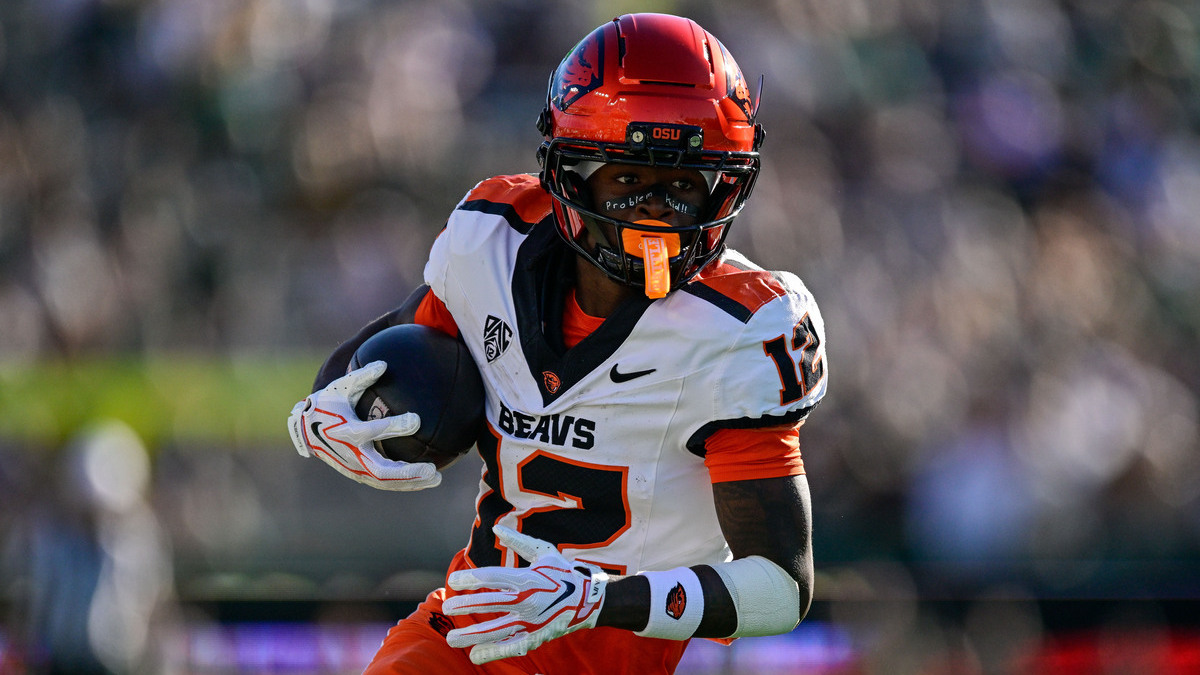
1. Jesse Legree, WR, Oregon State
Some freshmen need an entire season to adjust to college football. Jesse Legree appears to have skipped that step.
The Oregon State wide receiver has emerged as one of the most productive young players in the country, delivering the kind of numbers normally associated with established stars. Through six games, Legree had accumulated 38 receptions for 932 yards and 12 touchdowns, including six consecutive games with at least 100 receiving yards.
His 191-yard, 3-touchdown performance against San Diego State on Oct. 10 continued a remarkable run of production. Legree has demonstrated that his success is not dependent on one favorable matchup or a single explosive performance.
What makes his season especially compelling is the distance between expectations and results. A three-star recruit who received limited Power Four interest before arriving at Oregon State, Legree has become a player opposing defenses must prioritize.
The question is no longer whether Legree belongs among the best freshmen. It is how much longer defenses can keep him from taking over games.
Sustained production, explosive playmaking, and an ability to change the outcome of games give Legree one of the strongest Heisman cases, even as a freshman.
2. Deuce Geralds, DT, LSU
Freshman standouts are often identified by touchdowns, long runs, and spectacular catches. Deuce Geralds offers a reminder that some of the most important plays happen before a quarterback can even release the football.
The LSU defensive tackle has made an immediate impression by disrupting opposing offenses from the interior defensive line. Through the first six games, Geralds had recorded 5 sacks, including a 2-sack performance in LSU’s victory over Texas A&M.
Interior defensive linemen rarely receive the same attention as edge rushers, but their ability to collapse the pocket can fundamentally change an offense’s approach. A quarterback who cannot step into a throw has fewer options, and running backs have less room when defensive linemen penetrate the backfield.
Geralds has shown that he can create those problems without waiting for a favorable matchup. His early production has established him as one of the more impactful young defenders in the SEC. On an LSU team that has Princewill Umanmielen leading the charge, it can be difficult to stand out. However, Geralds has done so.
There is still plenty of football left, and maintaining that level of disruption against increasingly familiar opponents will be a challenge. Nevertheless, Geralds has already demonstrated that his impact is not simply theoretical potential.
Five sacks from a freshman defensive tackle represent the kind of production that can change an entire defensive unit’s outlook.
3. Jamal Rule, RB, Nebraska
Jamal Rule‘s early succeess provides a useful lesson in evaluating running backs: Carries alone do not tell the whole story.
The Nebraska freshman rushed for 386 yards and 5 touchdowns through his first four appearances, averaging 6.8 yards per carry. He also recorded two 100-yard rushing performances, establishing himself as an explosive option in the Cornhuskers’ backfield.
Rule’s efficiency is particularly notable because young running backs must learn to recognize college-level defensive fronts, anticipate openings, and adjust when the original running lane disappears.
His early numbers suggest that he has handled those responsibilities effectively. Rather than needing a large number of attempts to produce, Rule has consistently turned opportunities into substantial gains.
An injury against Michigan State in late September has created uncertainty surrounding his availability, and that is an important factor in assessing his overall season. His ranking reflects the production he has delivered rather than an assumption about what he might accomplish after returning.
If he is able to regain his form, Nebraska could have a valuable weapon for the second half of the season.
Rule’s combination of rushing efficiency, touchdown production, and explosive potential makes him one of the most effective freshman backs so far.
4. Trent Mosley, WR, USC
USC’s talented freshman class has created several compelling storylines, but Trent Mosley‘s ability to contribute immediately after an injury deserves particular attention.
Mosley opened his college career with consecutive 100-yard receiving performances and 4 touchdowns in his first three games. He also returned a punt for a touchdown against Louisiana, demonstrating that his impact could extend beyond the passing game.
A knee injury then forced him to miss time, interrupting what had been a promising start.
Mosley’s return against Penn State on Oct. 10 was therefore significant. He helped USC earn a 31-23 road victory over the Nittany Lions, immediately reintroducing an explosive element to the offense with 111 receiving yards, including a touchdown.
Injuries can complicate the development of young players, particularly when they disrupt the rhythm needed to adjust to college competition. Mosley’s ability to make an impact upon returning suggests that he can remain an important part of USC’s offensive plans.
His versatility is another reason to watch him. A receiver who can produce through the passing game and on special teams gives a coaching staff additional ways to create advantageous situations.
Mosley’s early scoring production, special-teams ability, and return from injury give him a stronger overall case than a conventional receiving-stat line might suggest.
5. Kayden Dixon-Wyatt, WR, USC
USC’s receiving room is filled with young talent, which makes earning opportunities as a freshman particularly challenging. Kayden Dixon-Wyatt has responded by making the most of his chances. He joins his teammate Trent Mosley on this list as one of the top freshmen in the nation across college football.
Through the opening weeks of the season, Dixon-Wyatt has recorded 27 receptions for 400 yards and 4 touchdowns. He became especially important when Mosley was sidelined, recording 7 catches for 114 yards and a touchdown against Oregon.
That performance illustrated an important distinction between potential and production. Dixon-Wyatt did not simply benefit from being part of a talented recruiting class; he demonstrated that he could deliver when his team needed him.
His ability to contribute in a crowded receiving room also makes his early numbers more impressive. Young receivers often struggle to establish consistent roles while learning a new offense and competing with older players for targets.
Dixon-Wyatt has already shown that he can be a reliable option. The next step is proving that his production can remain consistent as defenses gain more opportunities to study his tendencies.
He has converted increased responsibility into meaningful production and demonstrated that USC’s freshman depth is more than recruiting hype.
6. Legend Glasker, WR, BYU
Not every freshman needs 10 receptions per game to change an offense. Sometimes, one explosive play is enough to alter a defense’s entire approach.
Legend Glasker has made his name through that type of impact at BYU.
Glasker opened his college career with 4 total touchdowns, including three receiving scores and one rushing touchdown. He later recorded 5 catches for 131 yards against Colorado State, including receptions of 61 and 70 yards.
Those plays demonstrate why explosive receivers can be so valuable. A defense may execute its coverage correctly for much of a drive, only to see a single missed assignment or broken tackle produce a major gain.
Glasker’s versatility adds another dimension to his game. His ability to contribute as both a receiver and a runner creates additional possibilities for the Cougars’ offense and forces defenses to account for more than one type of threat.
The challenge for Glasker is sustaining that impact as opponents adjust. Big plays can establish a player’s reputation quickly, but consistency determines whether he becomes a dependable weekly contributor.
Glasker’s early production and ability to generate explosive plays make him one of the more intriguing young offensive weapons in the country.
7. Kenny Darby, WR, Kentucky
Kentucky freshman Kenny Darby has made an immediate impression in the Wildcats’ passing game, showing that he can contribute consistently against SEC competition.
Through six games, Darby recorded 29 receptions for 401 yards and 3 touchdowns. His most productive outing came against South Carolina on Oct. 3, when he caught 12 passes for 96 yards and a touchdown, setting a Kentucky single-game freshman record for receptions. He followed that performance with 4 catches for 79 yards against LSU.
Darby’s value extends beyond one impressive afternoon. His production across six games demonstrates that Kentucky can rely on him as a regular receiving option, even as opposing defenses adjust to his role in the offense.
For a young receiver, earning consistent targets in a major conference is an important step. Darby has already shown that he can handle that responsibility while creating opportunities for the Wildcats to move the ball through the air.
His next challenge will be improving his efficiency and turning more of his receptions into explosive gains. Nevertheless, his early production gives him a strong case for recognition among the top freshmen in college football.
Darby’s 401 receiving yards, 3 touchdowns and record-setting performance against South Carolina reflect consistent contributions throughout the season, rather than a ranking based on one isolated highlight.
8. Carson Clark, WR, San José State
Carson Clark has emerged as a productive young receiver at San José State, giving the Spartans another offensive weapon capable of making an impact throughout a game.
Through six games, Clark recorded 37 receptions for 405 yards and 4 touchdowns. His 67.5 receiving yards per game demonstrate that he has become a regular contributor rather than a receiver who depends on occasional opportunities.
Clark’s production has also developed as the season has progressed. He recorded 8 catches for 81 yards and 2 touchdowns against Cal Poly, followed by 5 catches for 27 yards and another touchdown against Fresno State. Against Wyoming on Oct. 9, he caught 8 passes for 91 yards.
That consistency matters when evaluating freshmen. Big plays can attract attention, but regularly earning targets and producing against different opponents offers a better indication of a player’s role within an offense.
At 5-foot-9, Clark also demonstrates that a receiver does not need prototypical size to become an effective college playmaker. His ability to create opportunities and contribute to the Spartans’ passing attack has made him one of the more productive freshmen at his position.
Clark’s 405 receiving yards and 4 touchdowns through six games give him a strong statistical résumé, particularly for a freshman establishing himself in San José State’s offense. The St. John Bosco (Bellflower, Calif.) alum ranks inside the top 20 nationally in catches.
9. Mark Bowman, TE, USC
Wide receivers have dominated much of the freshman conversation this season, but USC tight end Mark Bowman offers a different perspective on what an effective first year can look like.
Through USC’s first five games, Bowman has recorded 21 receptions for 204 yards and 2 touchdowns. His production is notable for a tight end adjusting to college football while learning to contribute in an offense with several talented receiving options.
Bowman’s early season included 2 touchdown receptions against Louisiana on Sept. 12, highlighting his ability to provide a scoring threat from the tight end position. He also contributed as a receiver against Oregon, finishing with 4 catches for 44 yards.
Tight ends often have responsibilities beyond catching passes, including blocking and helping create opportunities for other players. That makes their contributions more difficult to assess using receiving statistics alone.
Bowman’s early numbers nevertheless show that USC has found a way to involve him in its passing attack. His presence also gives the Trojans another option in situations where a quarterback needs a target over the middle or near the goal line.
Bowman has established himself as a receiving contributor at a position where freshmen can take time to adjust. His 21 catches and 2 touchdowns provide a solid foundation for his first college season. Bowman has missed the last two games with an injury.
10. Elijah Satchell, OLB, NC State
Not every freshman makes his impact through offensive statistics. NC State linebacker Elijah Satchell has provided a compelling defensive case through his ability to pressure opposing quarterbacks.
Through six games, Satchell recorded 3 sacks, along with a forced fumble and a pass breakup. His sack production has helped him stand out among young defenders, particularly at a position where recognizing offensive formations and timing pressure takes experience.
Quarterback pressure can change an offense’s approach even when it does not result in a sack. It can force hurried throws, disrupt the timing of a play and create opportunities for teammates to make stops.
Satchell’s contributions show why freshmen rankings in college football should extend beyond receiving yards and rushing touchdowns. Defensive players can influence games by disrupting the opposing offense and creating difficult situations for the quarterback.
There is still room for development as Satchell gains experience and faces different offensive schemes. Sustaining his pressure production will be important as the season progresses, but his early results give NC State reason to be encouraged about his development.
Three sacks and a forced fumble through six games give Satchell a meaningful defensive résumé and provide balance to a list otherwise led largely by offensive playmakers.
Final Verdict: Which Freshman Has Made the Biggest Impact?
The most exciting part of evaluating freshmen around college football is recognizing that their first season is rarely a finished product. Some players will improve dramatically as they become more comfortable with college football, while others will face the inevitable challenges of a longer schedule and tougher opponents.
For now, Jesse Legree has the strongest case as the most impactful freshman in the country. His receiving production has been remarkably consistent, and his ability to deliver explosive performances week after week makes him difficult to overlook.
The biggest takeaway, however, is that freshman success is not limited to the most highly recruited players or the biggest programs. A productive running back, a disruptive defensive lineman, or a receiver who capitalizes on an opportunity can change a team’s season.
With the second half of the regular season approaching, the rankings remain fluid. The next breakout performance could come from a player already on this list or someone who has not yet received national attention.
That is what makes this freshman class worth watching: the race to become college football’s next superstar is just beginning.