The New Orleans Saints have been in a state of flux ever since the Drew Brees/Sean Payton Era ended.
Payton actually outlasted Brees by a year, “retiring” as head coach after a 9-8 finish in 2021, but the Saints haven’t reached the playoffs since Brees’ final season at quarterback in 2020.
And they haven’t really had a clear transition plan since, which is the ultimate problem.
New Orleans made the almost-always ill-fated decision to cling to continuity at all costs in promoting defensive coordinator Dennis Allen to head coach once Payton stepped down.
Allen, a fine coordinator but failed head coach who went 8-28 leading the Raiders before being fired during his third season, predictably was not suddenly Sean Payton 2.0 just because they had shared a sideline together. Allen went 18-25 with the Saints and was again fired during his third season.
In hiring Kellen Moore, an up-and-coming coach with successful stints as offensive coordinator for the Cowboys, Chargers and Eagles, New Orleans at least initiated a much-needed and long-overdue total reset last year (even if it came with a 6-11 finish.)
QB Miscues Have Stalled New Orleans Saints
Meanwhile, at quarterback, replacing Brees has proven even tougher than expected, in part because of the Saints’ approach — believing for too many seasons that they still had a contending roster otherwise and just needed to Band-Aid over the most important position with underwhelming veteran placeholders.
That almost never works either.
After the Buccaneers gave up on turnover-prone former No. 1 overall pick Jameis Winston, the Saints brought him in to serve as Brees’ backup in his final season. They then named him their starter for 2021. He went 5-2 before tearing his ACL. Winston was actually an understandable gamble and the team was coming off a 12-4 finish in Brees’ final campaign, with Payton still running the show, so this all made enough sense.
Injuries simply undercut Winston in both 2021 (with Trevor Siemian and multi-talented tight end but underqualified QB Taysom Hill left to fill in) and 2022 (with veteran backup Andy Dalton taking over and starting 14 games).
It’s at this point where it may have made sense to consider a true reboot.
But despite a 7-10 finish in 2022, the Saints stuck to the script — or were stuck to the script by lack of an alternate path in the draft. (More on that in a moment.)
So for 2023, bringing this whole failed endeavor full-circle, Allen fell back on his own familiarity as the Saints brought in QB Derek Carr, who had run his course with the Raiders. And Carr delivered the most Carr-like season possible where the stats looked solid enough on paper (3,878 passing yards, 25 TDs and 8 INTs) yet the end result was an underwhelming 9-8 finish.
Carr was beset by injuries the next season, the team lost seven straight games to fall to 2-7 and Allen was dismissed — the second time he was fired mid-season with Carr as his QB. How’s that for familiarity and continuity …
As the Pittsburgh Steelers have experienced since Ben Roethlisberger retired, the worst place an NFL team without a franchise quarterback can find itself is stuck in the purgatory of perennial mediocrity. That not-so-sweet spot of winning just enough games to miss out on the top QB prospects in the draft while also not being good enough to contend in any meaningly way.
That’s where the New Orleans Saints have resided.
(Saints in purgatory, we get the irony.)
Three Major Miscalculations Are To Blame For Saints’ Struggles
So let’s back up again and look at what happened in the draft for New Orleans in this prolonged post-Brees lull.
After picking 28th in the 2021 NFL Draft following Brees’ final season, the Saints held the No. 18 pick in the 2022 draft before a pair of trades. They sent that pick to the Eagles for picks 16 and 19 (while surrendering their 2023 first-rounder among other draft capital changing hands both ways) and subsequently moved that No. 16 pick (and more) to the Commanders to slide up to No. 11 and select WR Chris Olave.
We’re not faulting the Saints in this case (that’ll come soon enough!)
There simply was no franchise quarterback to be taken at that point or any point in a historically weak 2022 QB draft class — where Kenny Pickett was the only QB selected in the first two rounds. Unless, that is, having the clairvoyance to know that seventh-rounder Brock Purdy (Mr. Irrelevant at pick 262) would turn into an NFL star.
With the aforementioned 7-10 finish that year, New Orleans would have had the No. 10 pick in the 2023 NFL Draft had it not sent it to Philadelphia in that draft-day trade a year earlier. But again, it wouldn’t have mattered anyway for finding a franchise QB. Bryce Young (No. 1 overall) and C.J. Stroud (No. 2) are the only QBs from that class still with starting jobs.
(The Saints did start a telling trend that year, though, of hoping to hit on a mid-round QB lottery ticket, taking Jake Haener late in the fourth round.)
By riding the last gasp of Carr to that 9-8 finish in 2023, the Saints were left with the No. 14 overall pick in the 2024 draft (taking OT Taliese Fuaga) and missed out on all the notable quarterbacks. Old pal Payton scooped up Bo Nix for the Broncos two picks earlier as the sixth QB selected.
This is where the finger-pointing starts for the Saints’ front office and how we truly explain why six years after Brees’ retirement the team seems no closer to contention.
Where would the franchise be if coming off a 7-10 finish in 2022 while realizing Winston/Dalton weren’t the answer, that instead of believing Allen just needed to reunite with a past-his-prime Carr to get the franchise over the hump, the Saints had used the 2023 season to initiate an obviously-needed rebuild, traded away expensive assets (like RB Alvin Kamara when he still had value) and found their way into the top of a now-legendary 2024 QB draft?
That was the first franchise-stalling mistake.
The second was doubling-down on Carr after his first season despite seeing that rich pool of QB prospects that included Caleb Williams, Jayden Daniels, Drake Maye, Michael Penix Jr. (the jury is still out), J.J. McCarthy (hey, they can’t all hit) and Bo Nix all within the top 12 picks while the Saints sat at No. 14.
If ever there was a time to mortgage current and future draft capital to trade up in the draft, it would be a rudderless team without any long-term plan at QB in an exceptionally deep QB class.
Four teams found franchise quarterbacks in that first round and changed their trajectory for the better while the Saints … well, they compounded their QB dilemma even further.
The second-worst move behind patching the position together with veteran castoffs that other teams didn’t want is to waste even more time hoping an ill-fated mid-round flier proves all other scouts, general managers and analysts wrong.
New Orleans Saints Now Left Hoping Tyler Shough Is The Answer at QB
Instead of trading up to nab one of the aforementioned top QB prospects in 2024, the Saints drafted Spencer Rattler in the fifth round after he’d lost his starting job at Oklahoma (albeit to Caleb Williams) and then had two serviceable but unspectacular seasons at South Carolina for 8-5 and 5-7 Gamecocks teams.
It would have been a mostly harmless gamble at that part of the draft — even if it was the second year in a row (Haener) the Saints thought they could outsmart the system and hit big on a QB in the middle rounds — if not for what came next.
After having Rattler finish out the 2024 season following Carr’s injury, watching him go 0-6 as a starter (0-7 in games as the team’s primary QB) with just 4 TDs and 5 INTs — pretty much what one would expect of Rattler as an NFL QB — the Saints named him their starting QB entering 2025! Simply incredible.
While yet again trying to hedge their bets with another value QB.
This was the third fateful mistake.
The Saints wasted another chance in the 2025 draft to actually land a true belated long-term, high-upside replacement for Brees, using the No. 9 overall pick last year on offensive tackle Kelvin Banks Jr.
Now, to be clear, Banks had a solid enough first season as the team’s starting left tackle, which is certainly valuable, no question, but later in that first round (No. 25) the Giants selected Jaxson Dart. He was the second quarterback off the board and looks like he may well be New York’s next franchise QB now and a draft steal. Many thought he would go earlier in the first round.
Would the Saints look more intriguing for 2026 with the dynamic dual-threat Dart at QB playing for an exciting offensive-minded head coach in Moore and a veteran free agent at left tackle in place of Banks?
Instead, the Saints once again chose to shop in the value bin, drafting Tyler Shough in the second round at No. 40. Shough didn’t have his first full and productive college season until his seventh year and his third school, turning in a fine final campaign at Louisville (3,195 yards, 23 TDs and 6 INTs) at age 25.
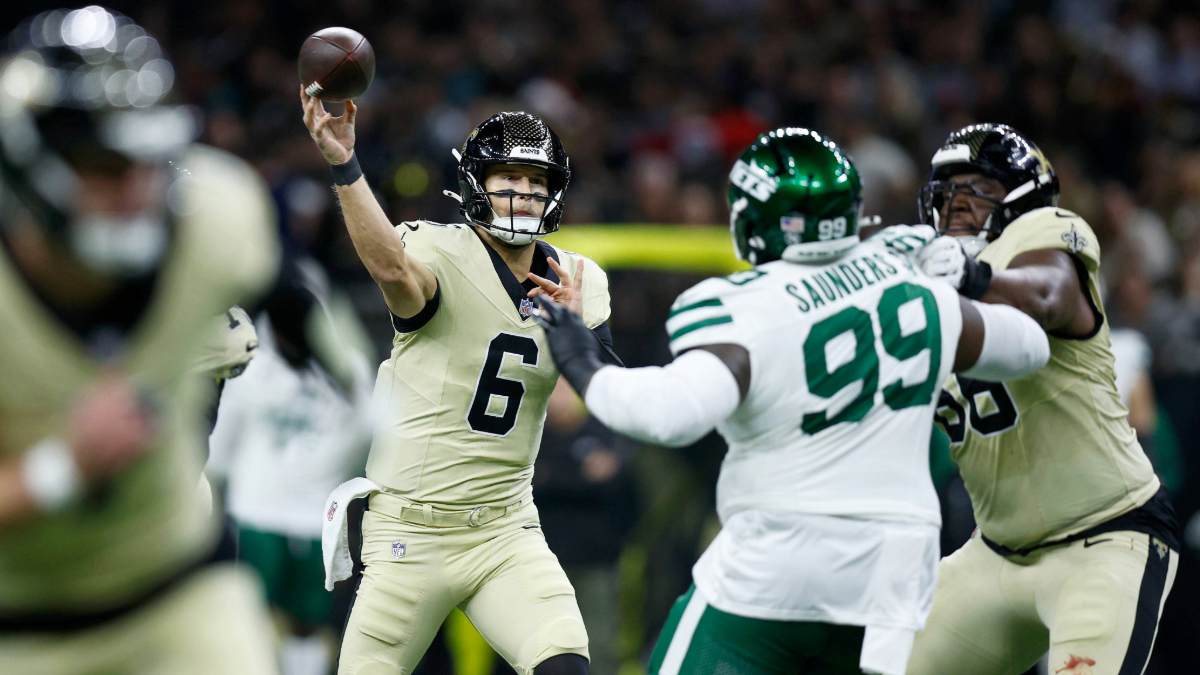
When Rattler not surprisingly failed as the starter, going 1-7 to start last season, Shough took over and went a perfectly mediocre 5-4 with 2,384 passing yards, 10 TDs and 6 INTs (plus 3 rushing TDs). He did lead the Saints to four straight wins late in the season (over the free-falling Buccaneers, erratic Panthers, and lowly Jets and Titans), finished second in NFL Offensive Rookie of the Year voting and is now locked in as the team’s starting quarterback for 2026.
Saints fans have been so desperate for hope at the position that many have fully talked themselves into Shough as the savior.
We’d counter that his late-season burst (against the most favorable stretch of competition) will only continue the cycle and prolong the Saints’ predicament most likely — even if that seems to be a minority opinion for prisoners of the moment.
Are we being harsh here?
Second in the offensive rookie of the year voting!
Yeah, but there’s nothing in Shough’s career profile or arm talent to suggest his peak potential is anything more than … Derek Carr. (See what we did there!)
He’s also not a young talent full of untapped potential — he’s going to be 27 (in September) this season.
That makes him three years older than Drake Maye, a year and a half younger than Tua Tagovailoa (who has already played six NFL seasons, been released in Miami and is now trying to revive his career in Atlanta) and only five years younger than Carr was when he joined the Saints at the tail-end of his career!)
And being a middle-of-the-pack NFL QB — in what seems the best-case scenario for Shough — simply isn’t elevating the Saints back to their former heights.
Unless, he totally surprises …
Shough Or Bust For Saints?
OR …
New Orleans holds the No. 8 pick in the draft this month — but no.
It is again, unfortunately, a historically weak quarterback draft class. Indiana Heisman Trophy-winner Fernando Mendoza will go No. 1 to the Raiders, and then the watch will be on to see if Alabama’s Ty Simpson lands somewhere in the first round or later. He’s become a polarizing draft prospect, but his stock overall has been on the rise since the NFL Scouting Combine last month.
Still, most draft analysts project him to fall out of the first round with ESPN’s Mel Kiper Jr. more bullish and slotting him No. 16 to the Jets.
So he’s not really a fit for the Saints, especially as they seem committed to developing Shough anyway. And that’s the problem with trying to solve the most important position with Day 2 picks — even when it works out it usually comes with a limited ceiling that a team is then trapped under for several years.
We fully acknowledge Shough may prove to be quality second-round pick and even hang around the NFL for the next decade like Gardner Minshew or Davis Mills or Jacoby Brissett — that’s not really the point here.
Unless he’s the next Maye or Williams or Daniels or Matthew Stafford or Patrick Mahomes or Dak Prescott or maybe Nix or, yes, belated-breakout Sam Darnold, etc., where does that get New Orleans? And does anyone truly think Shough becomes a top-12 NFL QB?
That’s really all that matters here.
Saints fans can sell themselves on that working out for the long run — we’ll bet not — or take solace that 2027 projects to be an incredible quarterback draft class with the likes of Texas’ Arch Manning, Miami’s Darian Mensah, Ohio State’s Julian Sayin, Oregon’s Dante Moore, USC’s Jayden Maiava and others.
But if Shough is good but not great, the Saints are back to the worst-case scenario — a little bit better in 2026 but not good enough to actually matter and then stuck on the outside of the QB run at the top of the draft next year.
Maybe if Shough doesn’t assert an undeniable grip on the job, the Saints will have learned their lesson and pay whatever premium it takes to finally find a high-upside answer at the position in 2027. Or maybe they’ll invest five years of frustration into bumping up against Shough’s ceiling before getting to that point. Or maybe they’ll draft John Mateer in the fourth round next spring and hope once more that their lucky numbers hit against the odds.
In the meantime, barring a real conviction and belief in Simpson and maneuvering down from No. 8 or up from No. 42 in this draft (not that we’d recommend it), the post-Brees Era continues status quo.
Even if Saints fans can’t see it yet.