Each day until the kickoff of the 2026 NFL season, TeamFB7 will dive into a team with analysis, critiques, breakout player picks and overall predictions. We’re working backward from our early preseason power rankings with a couple of updates/tweaks based on subsequent developments. The Arizona Cardinals now sit at No. 29.
The Arizona Cardinals have been a confounding team for quite some time now, and it’s unclear if that will change in 2026 despite a fun collection of offensive playmakers.
To put it bluntly, they appear to lack a master plan while seeming to operate on the fly.
First, the Cardinals rightfully moved on from defensive-minded head coach Jonathan Gannon after seeing their defense (let alone the team as a whole) bottom out as one of the NFL’s worst in 2025. Easy decision to make there.
And yet, they chose to retain defensive coordinator Nick Rallis, who was handpicked for the role by Gannon despite minimal NFL experience (working under him in Philadelphia) and was ostensibly in charge of that defensive debacle last season.
(Picture confused/curious emoji here)
We’ll circle back to the defense in a bit, but the biggest moves of the offseason came on the other side of the ball.
The Costly Decision To Move On From QB Kyler Murray
Even in hiring an offensive-minded head coach in former Rams offensive coordinator Mike LaFleur, the Cardinals didn’t think it worthwhile to at least see if he might be able to revive quarterback Kyler Murray’s potential while the team still owed the former No. 1 overall pick a ton of money regardless.
After all, while absolutely a frustrating QB at times, Murray was nonetheless the NFL’s Offensive Rookie of the Year at one point and made two Pro Bowls at the start of his career playing for offensive guru Kliff Kingsbury.
In 2020, he had 4,790 combined passing/rushing yards, 26 passing TDs with 12 INTs and rushed for 11 TDs. He was ahead of that pace passing-wise in 2021 (with less rushing output) in 14 games as the Cardinals went 11-6 and reached the playoffs.
The future was seemingly bright! Murray signed a five-year, $230.5-million extension. Then he tore his ACL late in an already disappointing 2022 season, Kingsbury was fired and replaced with Gannon, Murray got hurt again early last fall and here we are.
It’s not like Murray was an actual bust, though.
He hadn’t yet lived up to expectations overall, sure, but the Cardinals were on the hook for owing him a sizable sum in 2026 regardless, so why not show some faith in your new offensive staff to figure out how to extract value from your highest-paid player?
Instead, Arizona preferred to pay Murray $35.5 million this season to play for the Minnesota Vikings, who pounced at the opportunity to add the dynamic dual-threat QB for the veteran’s minimum as the potential missing piece to a playoff roster.
So, clearly, there was real urgency to get rid of Murray at any cost so the Cardinals could immediately clear the slate and reset with a coveted free agent quarterback or high draft choice, right? … … Right?
Nah, just more of well-traveled 33-year-old journeyman Jacoby Brissett and a flier on divisive third-round draft pick Carson Beck (because there was no clear prized QB prospect to be had in this case).
(Picture shrugging and “neutral face” emojis here.)
Getting into the weeds on NFL salary cap minutiae is not for the faint of heart and really a specialized science best left to the “capologists,” so let’s go only as deep as needed and simplify it as much as possible.
Many NFL analysts indeed saw the Murray release as inevitable and justified because keeping him through March would have triggered another $19.7 million guaranteed for his 2027 contract, with the thinking being if he wasn’t good this year they’d regret still owing him even more in 2027.
But, and hear us out here, what if he did play well under better circumstances (greatly enhanced running game, bolstered offensive line, offensive-minded head coach)?!
Again, this isn’t J.J. McCarthy or Blake Bortles or Mitchell Trubisky. Murray is flawed and inconsistent but also talented, and at his best he’s a productive, entertaining quarterback who has 121 career TD passes to 60 INTs and a lengthy highlight reel of plays like this that few QBs in the league can make.
It’s just hard to see how eating $35.5 million (plus much more than that in dead salary cap space, but we won’t get into that) now is any better than eating $19.7 million a year from now, while in the meantime at least seeing if a fresh start under a new head coach brought over from the league’s highest-scoring team could maybe, just maybe get the dual-threat QB back to his earlier peak levels.
We’ll never know now, though the Vikings sure seem excited by Murray’s potential in their loaded offense led by sharp offensive-minded head coach Kevin O’Connell.
(And if either of those teams makes the playoffs in 2026, there is an almost near-certain chance it’s the Vikings with Murray and not the Cardinals without him.)
(Go ahead and picture another shrugging emoji here for good measure.)
As for Brissett, he is certainly competent and serviceable — he passed for 3,366 yards, 23 touchdowns and 8 interceptions after taking over for an injured Murray early last season — but the Cardinals nonetheless went 1-11 in his starts.
And as the clear starter once Murray was released and no better QB was brought in, Brissett rightfully demanded and coerced a substantial raise of $10.6 million to his 2026 base salary, up to $15.5 million guaranteed with the potential to push it to $21 million through incentives.
So, just to review to make sure the point is landing here …
Since the Cardinals neither signed a marquee free agent QB nor drafted one that demands immediate playing time, the only benefit of any kind in releasing Murray (despite owing him more than $35 million this year regardless) would be to save money in some way. Per OverTheCap.com, the Cardinals freed up $5.1 million in salary cap space for 2026 with the move, avoided having that $19.7 million of Murray’s 2027 salary become guaranteed and saved another potential $5 million in what he could have additionally earned this year.
Which is all fine and dandy until realizing …
Arizona then used all of that extra cap space and then some to sign Gardner Minshew as a backup QB to a one-year, $5.75 million contract (worth up to $8.25 million with incentives) and consequently had to give Brissett that aforementioned raise of more than $10 million. All while still paying that $35.5 million for the Vikings to find a substantial QB1 upgrade.
Instead, Arizona could have just let Murray play out the season he was already being paid for regardless, kept Brissett on his affordable backup QB salary, still stashed Beck as a developmental project and ended up with both more net cap space for 2026 (without Minshew’s contract or Brissett’s raise) and less real money spent.
Incredible.
(Picture exasperated face palm emoji here.)
To that point, let’s keep going as the Cardinals are confounding in yet even more ways.
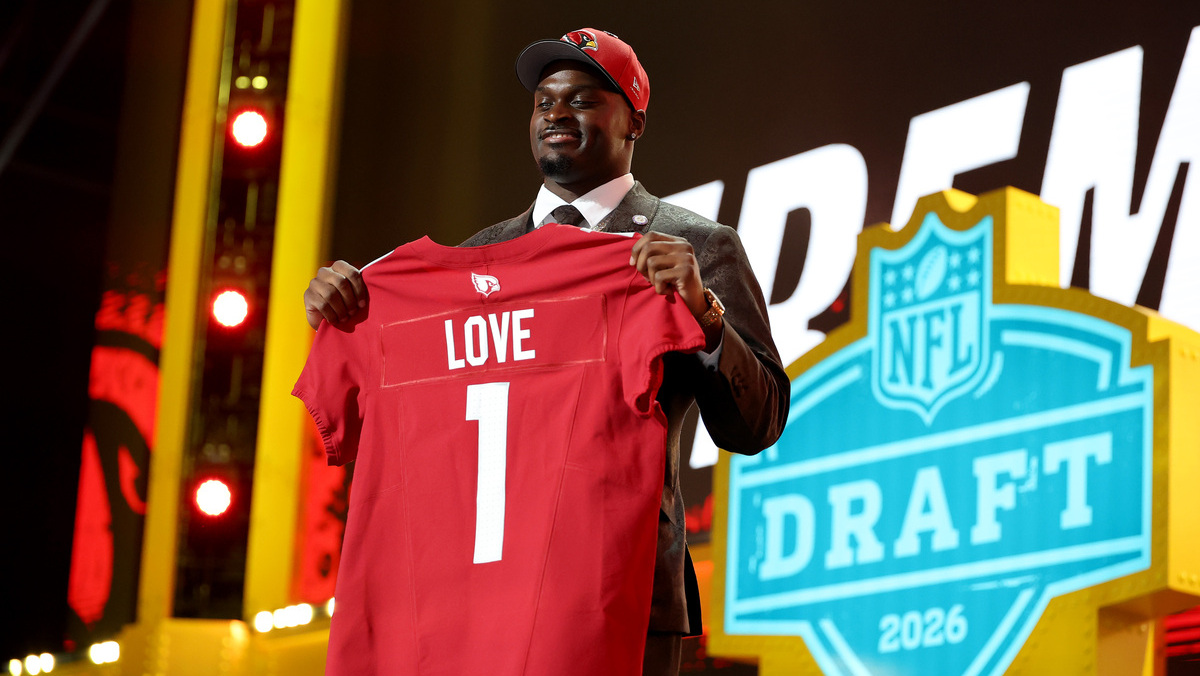
A Lot Riding On Top Draft Pick Jeremiyah Love
Ossenfort and Arizona knew this whole offseason they had the No. 3 overall pick in the draft. They knew who the top prospects were, including Notre Dame star running back Jeremiyah Love.
So when they restructured veteran running back James Conner’s contract to bring him back for $3 million this season and then signed former Falcons RB Tyler Allgeier to a two-year, $12.25-million free agent deal, while also still having once-promising Trey Benson in the mix as well, it sure seemed clear the plan was to use that No. 3 overall pick on another position of need.
Like, say, an edge rusher to pair with Josh Sweat on what is otherwise a paper-thin position group. Or trading down to address safety after losing stalwart Jalen Thompson to the Cowboys in free agency. Or upgrading the right side of the offensive line.
Nope, the Cardinals took Love.
That move on its own is fine and understandable for a team that ranked a dreadful 31st in rushing (93.1 YPG) last year.
Even with the perilous history of drafting running backs that high (especially by teams with bigger roster needs that aren’t putting the finishing touches on building a contender), that’s not even the criticism here. Love was incredible at Notre Dame, may indeed be a generational talent and buck the trends of past top 5 RB draft picks while proving to be a true difference-maker for Arizona.
But couldn’t the Cardinals have maybe figured out that plan even a month and a half sooner and not committed to pay Allgeier $12.25 million over the next two years and Conner $3 million this year on top of Love’s four-year, $53.02-million rookie contract that comes with being the No. 3 overall pick (another reason why RBs are rarely taken so highly)?
Again without getting into the minutiae of NFL salary cap math — per Spotrac.com, Allgeier’s cap hit is just $4.35 million in 2026 vs. $7.9 million in 2027, for instance — we’ll simplify the point.
Using straightforward annual average contract value, the Cardinals are the only team in the NFL with three of the top 35 highest-paid running backs (including Love at No. 10), on top of still having Benson and Bam Knight on the roster (for now) too. A few other teams have two RBs on that list while most just one, as it’s a position with one of the greatest supply-over-demand advantages making it an easy one to satisfy shrewdly while saving money for the more costly demand-over-supply positions.
It just seemed like the Cardinals didn’t know what their plan was until it happened.
Some Reason For Optimism In 2026
Nonetheless, Arizona should in theory, on paper, however one wants to say it, be one of the more exciting offensive teams in the NFL.
But aside from the addition of Love, the same could have been suggested last year.
Again, Brissett wasn’t the problem. He threw for at least 243 yards in 10 of his 12 starts, had multiple touchdown passes in 10 starts as well and only one game with multiple picks.
Trey McBride set the NFL single-season record for tight ends with 126 receptions (for 1,239 yards and 11 TDs), and wide receiver Michael Wilson enjoyed a third-year breakout with 78 catches for 1,006 yards and 7 TDs.
Meanwhile, former No. 4 overall pick Marvin Harrison Jr. was coming off a rookie season of 62 catches for 885 yards and 8 TDs with hopes he’d take a second-year leap.
Even with Murray’s early season-ending injury, that should have been a productive offense overall.
Instead, the Cardinals ranked 19th in total offense (325.8 YPG) and tied for 22nd in scoring (20.9 PPG).
Losing Conner to a season-ending Week 3 foot injury and then Benson to a season-ending Week 4 knee injury hurt as the RB depth was starkly different last year, with Michael Carter (333 yards, 1 TD), Emari Demercado (312-0) and Knight (269-4) going on to head that second-worst ground attack in the NFL.
(If any team was going to feel compelled to overpay for RBs in 2026, perhaps the Cardinals were the obvious one.)
And Harrison, the prized young wide receiver, struggled through drops, inconsistency and an array of physical setbacks to play just 12 games with a 41-608-4 line.
Maybe indeed the extra investments at running back and Love’s top-end potential, along with splurging for former Steelers left guard Isaac Seumalo on a three-year, $31.5-million free agent deal will make the difference in turning the offense’s 2025 weakness into a 2026 strength. Maybe Harrison will finally put it all together and play up to his draft slot.
That’s all reasonable to imagine.
But even if so, will it matter?
A Bad Defense With Zero Upgrades
Because perhaps the most confounding (to bring it back one more time) component of the Cardinals’ offseason was the abject failure to even address one of the worst defenses in the league after giving up the fourth-most points (28.7 per game) and sixth-most yards (357.7 per game).
In fact, on paper, Arizona arguably got worse defensively!
If the Cardinals’ defense had an identifiable strength before, it was probably the tandem of safeties Budda Baker (an 8-time Pro Bowl selection, including last year, and two-time first-team All-Pro) and Thompson. But as noted, after seven seasons as a well-regarded starter for the team, Thompson (ranked 30th out of 98 qualifying safeties by PFF last year) left for the Cowboys and was replaced by longtime Jaguars reserve safety Andrew Wingard (who moved into a starting role last year and graded out 75th out of 98 safeties by PFF).
Additionally, veteran defensive end/tackle Calais Campbell (6.5 sacks last season at age 39) left for the Ravens and second-leading tackler Akeem Davis-Gaither (albeit graded poorly by PFF) left for the Colts.
The Cardinals added DT Roy Lopez — their most notable defensive free agent signing — while hoping 2025 first-round pick Walter Nolen III can make a belated impact after being limited to six games (11 tackles and 2 sacks) by injury as a rookie. At linebacker, they signed former Patriot Jack Gibbens, who is expected to rotate in with 2025 fourth-round pick Cody Simon and Mack Wilson Sr. (limited to eight games last season).
The Cardinals didn’t draft a defensive player until the fourth round when they picked intriguing but raw DT Kaleb Proctor from Southeastern Louisiana of the NCAA’s second-tier FCS level.
So how is that defense — with the same coordinator in place and zero clear roster upgrades — going to be substantially better from where it finished in 2025?
Or a better question, why didn’t the front office do more to address it? Perhaps some of that money spent paying so many quarterbacks and running backs could have been useful elsewhere.
(Picture winking emoji here 😉)
Essentially, the Cardinals have been constructed like a fantasy football lineup. Unfortunately, for Arizona fans, their team still competes in the reality of the NFL.
Already Covered In Our “32 Teams In 32 Days” Series: No. 32 Miami Dolphins, No. 31 Las Vegas Raiders, No. 30 Cleveland Browns
Arizona Cardinals Reset
2025 Finish: 3-14
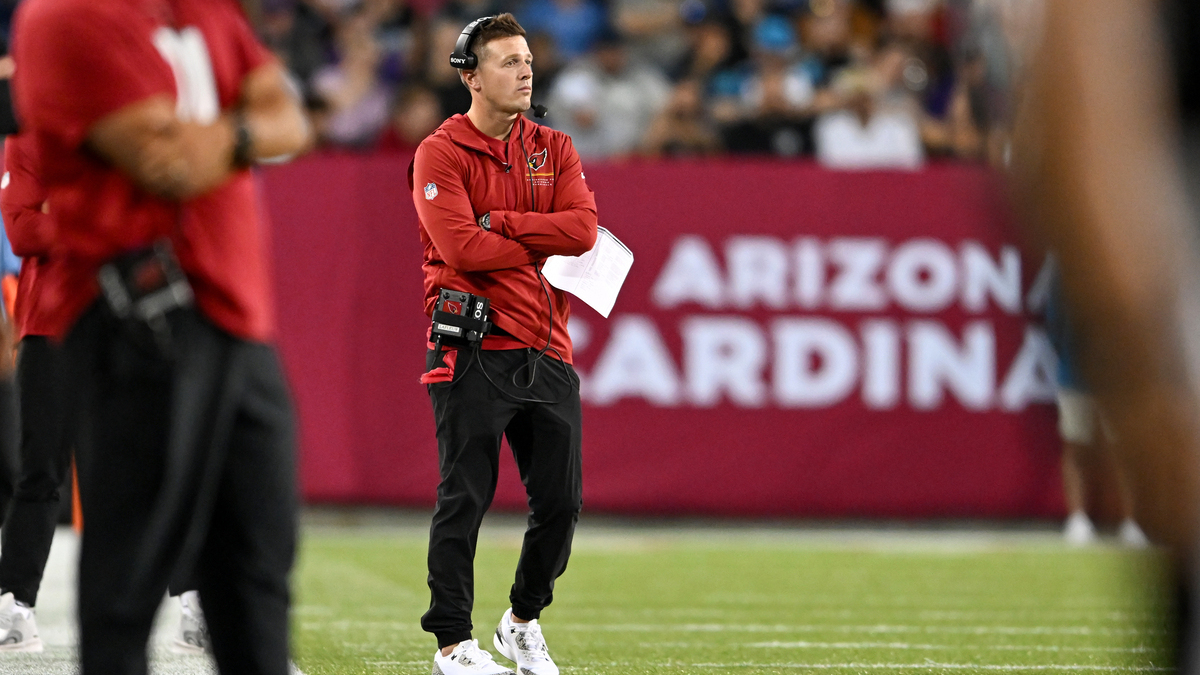
Head Coach: Mike LaFleur, first season (first as NFL HC)
Hot Seat Meter (0-10): 0
Offensive Coordinator: Nathaniel Hackett, first season (former Broncos HC and OC for Bills, Jaguars, Packers and Jets)
Defensive Coordinator: Nick Rallis, fourth season
Best Offseason Move: Upgrading the running game.
You’ll notice, we didn’t simply say drafting Love — and that is not in any way a statement on Love.
He looks like the real deal. He should be considered the favorite for NFL Offensive Rookie of the Year. If we had to bet on how his career plays out, we’d say he lives up to expectations individually in the same way Saquon Barkley did as the No. 2 overall draft pick in 2018.
The key word there is individually.
Ultimately, taking Barkley No. 2 overall did nothing to really transform the New York Giants. Barkley was awesome overall in his time in New York, and yet in his six seasons there the Giants went 5-11, 4-12, 6-10, 4-13, 9-7-1 and 6-11. Because the Giants were so far from a finished product at the time that drafting even an elite running back at No. 2 was a luxury they couldn’t ultimately afford.
Or how about Ashton Jeanty as the No. 6 overall pick to the Las Vegas Raiders last season. The Raiders had so many more pressing needs, they tumbled to the worst record in the NFL (and actually got even worse in the run game because of the state of the offensive line).
Might some of this also be true for the Cardinals, given what we just laid out about the defense? Time will tell.
But absolutely, Love and Allgeier — and Seumalo, a Pro Bowl pick in 2024, at left guard — will transform Arizona’s rushing attack from bottom of the league to potentially a top 10 unit.
Worst Offseason Move: Even if we’re in the minority on this opinion, which may well be, perhaps the logic laid out above at least sells the argument for why the decision to release Murray at extraordinary cost might prove foolish. Especially if he delivers a rejuvenated career year in a much better situation in Minnesota.
We also didn’t like any of the coaching hires.
LaFleur was the least inspiring head coach hire of the 10 made this cycle. Just like hiring Bill Belichick’s defensive coordinators or Andy Reid’s offensive coordinators or Adam Gase (twice) because he spent two seasons standing next to Peyton Manning on the Denver Broncos sidelines.
LaFleur struggled as the New York Jets offensive coordinator from 2021-22. He then suddenly enjoyed exceptional success as the Los Angeles Rams OC the last three seasons.
Could that stark difference maybe be because he was working under Sean McVay with Matthew Stafford at quarterback, Puka Nacua (and Davante Adams last season) at wide receiver and Kyren Williams at running back?
The Rams were a great offense before LaFleur — winning the Super Bowl in 2022 — and they’ll be an elite offense again this season because of McVay and the star-studded lineup. So it’s hard to know what the Cardinals are even getting in LaFleur. This isn’t like the Chicago Bears hiring Ben Johnson or the Jacksonville Jaguars hiring Liam Coen — offensive coordinators who were directly and clearly responsible for their respective units.
Then, LaFleur hired Hackett as offensive coordinator. Yeah, he’s been around the league for a long time, but since flaming out in less than one season as Denver Broncos head coach in 2022, he had two lackluster seasons as the Jets’ OC (replacing LaFleur!) and then spent last season as a defensive analyst for LaFleur’s brother Matt LaFleur in Green Bay. It just feels like an uninspiring hire of familiarity with limited actual upside.
And we already touched on the decision to retain Rallis as defensive coordinator.
Arizona Cardinals Roster Breakdown
Biggest Strength: Offensive playmakers.
Love, Conner and Allgeier (a steady backup for most of his time in Atlanta but with a 1,000-yard season as a rookie in 2022) would be as good a three-depth running back depth chart as there is in the league if Love lives up to the hype.
Harrison has had his issues with drops and hasn’t yet lived up to his draft slot as the No. 4 overall pick two years ago, but the talent is absolutely there. His struggles seem more mental. If that gets worked, out, the Cardinals have an enviable trio of pass-catchers in he, Wilson and McBride at tight end, with Kendrick Bourne (37 catches for 551 yards last season in San Francisco) coming over from the 49ers as a free agent No. 3 WR.
Biggest Weakness: Since we can’t say general manager … we’ll go depth at edge rusher.
First, it needs to be noted that the one great edge rusher Arizona has, Josh Sweat (career-high 12 sacks last season) reportedly initially requested a trade when Gannon (who he also played for in Philadelphia) was fired. The Cardinals have made clear they will not trade Sweat, but he nonetheless has not been active in training camp while on the physically unable to perform list managing a knee injury.
That raises the concern level about the lack of depth behind him.
That group is headed by sixth-year veterans Zaven Collins (40 tackles, 1.5 sacks last season) and Baron Browning (34 tackles, 2 sacks), BJ Ojulari (1 sack in 8 games last season; career-high 4 in 2024 before a torn ACL) and 2025 third-round pick Jordan Burch (23 tackles, 1 sack as a rookie). But the Cardinals saw no need to draft an edge rusher this spring …
Most Intriguing Rookie: It’s all about Love.
While Beck has generated a wave of fresh buzz after completing 15 of 19 passes for 188 yards, 1 TD and 0 INTs in his preseason debut in the Hall of Fame Game last week, we’re remaining hesitant to buy the former Miami and Georgia QB as a viable NFL starter. (He did not play in the second preseason game.)
But if Brissett struggles, it may behoove the Cardinals more to see what Beck can do at some point rather than Minshew.
Breakout Player: Love.
While the coaches have been tight-lipped about how they’ll divide carries among the running backs, and even though Allgeier was listed as the first-team RB on the team’s first preseason depth chart, the Cardinals didn’t spend the No. 3 pick on Love to ease him in.
He’s the 10th-highest-paid RB in the NFL already as a rookie, and the Cardinals are going to get their value out of that investment.
But we’ll also throw out a vote of confidence that Harrison turns in a career-best season and overcomes the inconsistencies that have limited him thus far.
MVP Pick: Hmmm. Heck, let’s go Love again.
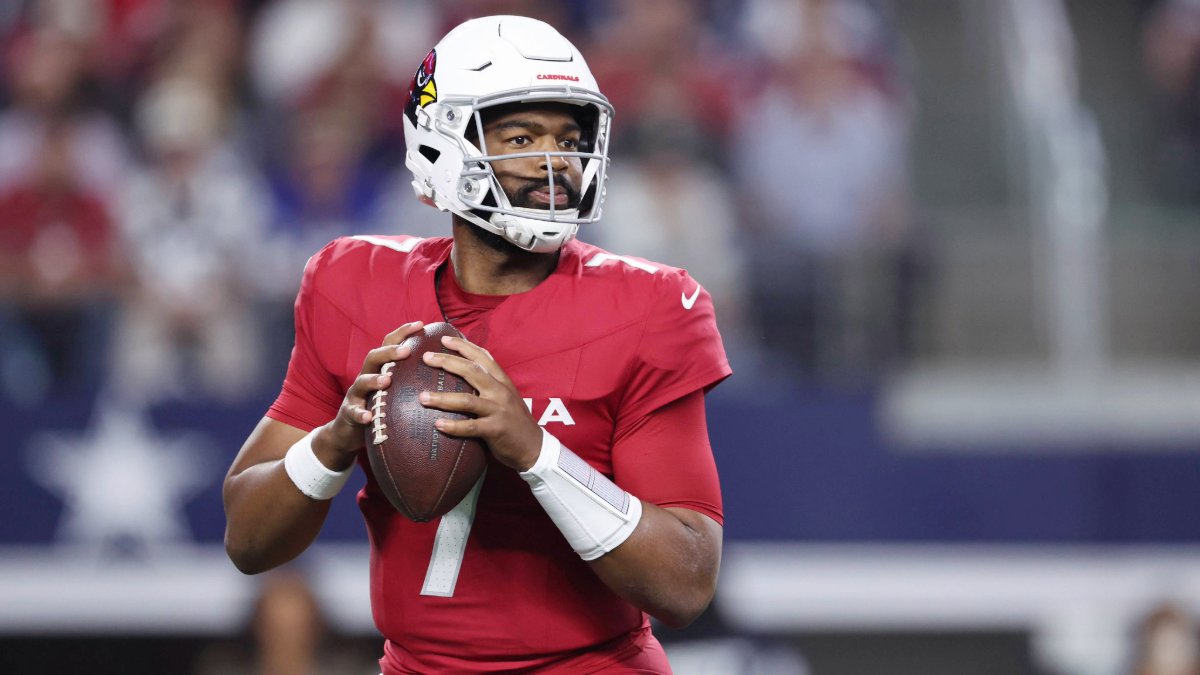
Arizona Cardinals 2026 Schedule
| Date | Opponent | Time (ET) |
| Week 1, Sept. 13 | at Los Angeles Chargers | 4:25 p.m. |
| Week 2, Sept. 20 | vs. Seattle Seahawks | 4:25 p.m. |
| Week 3, Sept. 27 | at San Francisco 49ers | 4:05 p.m. |
| Week 4, Oct. 4 | at New York Giants | 1 p.m. |
| Week 5, Oct. 11 | vs. Detroit Lions | 4:25 p.m. |
| Week 6, Oct. 18 | at Los Angeles Rams | 4:05 p.m. |
| Week 7, Oct. 25 | vs. Denver Broncos | 4:05 p.m. |
| Week 8, Nov. 1 | at Dallas Cowboys | 1 p.m. |
| Week 9, Nov. 8 | at Seattle Seahawks | 4:25 p.m. |
| Week 10, Nov. 15 | vs. Los Angeles Rams | 4:05 p.m. |
| Week 11, Nov. 22 | at Kansas City Chiefs | 1 p.m. |
| Week 12, Nov. 29 | vs. Washington Commanders | 4:25 p.m. |
| Week 13, Dec. 6 | vs. Philadelphia Eagles | 4:05 p.m. |
| Week 14 | BYE WEEK | |
| Week 15, Dec. 20 | vs. New York Jets | 4:05 p.m. |
| Week 16, Dec. 27 | at New Orleans Saints | 1 p.m. |
| Week 17, Jan. 3 | vs. Las Vegas Raiders | 4:05 p.m. |
| Week 18, TBD (Flex Game) | vs. San Francisco 49ers | TBD |
Arizona Cardinals Season Prediction And Parting Thoughts
Season Prediction: 4-13
What a brutal schedule!
The worst thing the Cardinals are up against for the foreseeable future is being stuck in the NFC West, where Seattle Seahawks, Los Angeles Rams and San Francisco 49ers are all top-tier Super Bowl contenders. It was the best division in football last year.
Arizona also has to play the entire AFC West, which might be the second or third best division in football with more Super Bowl contenders in the Denver Broncos, Kansas City Chiefs and Los Angeles Chargers (plus the Las Vegas Raiders).
The Cardinals also drew the Detroit Lions, Dallas Cowboys (on the road) and Philadelphia Eagles.
The Cardinals will be major underdogs in at least 10 of those games if not all 12.
There just aren’t a lot of favorable matchups on the schedule — there are some — and factor in the defensive concerns and Brissett as a bottom-third starting quarterback in the league and it’s hard to see a lot of wins for Arizona.
But the Cardinals could still be plenty entertaining with that offense.