The Super Bowl histories of the New England Patriots and Seattle Seahawks are, of course, forever intertwined by their unforgettable showdown 11 years ago and one of the all-time wildest finishes in the Big Game
Perhaps you’ve heard a reference or two to that already this week. If not, we’ll jog your memory in a moment.
Overall, New England is set to make its NFL-record 12th Super Bowl appearance Sunday and shares the record for most championships at six with the Pittsburgh Steelers, while Seattle makes its fourth appearance with one championship so far.
Before the 1996 season, the Patriots had just one Super Bowl appearance and the Seahawks none, but in the last 25 years they’ve arguably been two of the most successful franchises in football.
That need not be stated for New England, obviously, but NFL fans may not realize that Seattle is tied for the third-most Super Bowl appearances this century (the 2000 season to now), with Kansas City (5) second on the list and Philadelphia also at 4.
From the 2001-2018 seasons, either the Patriots, Seahawks or both appeared in 11 of 18 Super Bowls.
But none since, until this week, as both franchises have pulled off successful resets with the potential once again for extended championship windows moving forward.
Second-year coach Mike Macdonald has refashioned the Seahawks once more into one of the league’s most fearsome defenses with a young core of talent on both sides of the ball.
And the Patriots have incredibly — fortuitously — ended up yet again with one of the best coach-quarterback tandems in the NFL with Mike Vrabel in his first season and Drake Maye in his second.
Both teams were considered long shots before the season, with New England at 80-1 odds to win the Super Bowl and Seattle at 60-1, but the safe bet moving forward would be to expect one or both of these teams to find their way back to this stage again in the near future and continue standing out as two of the best franchises in the sport.
But before their showdown Sunday night in Santa Clara, California, let’s look back and refamiliarize with the Super Bowl histories of both teams to this point.
GO TO: Super Bowl XX / Super Bowl XXI / Super Bowl XXXVI / Super Bowl XXXVIII / Super Bowl XXXIX / Super Bowl XL / Super Bowl XLII / Super Bowl XLVI / Super Bowl XLVIII / Super Bowl XLIX (Pats) / Super Bowl XLIX (Seahawks) / Super Bowl LI / Super Bowl LII / Super Bowl LIII
New England Patriots Super Bowl History
Previous Super Bowl appearances: 11 | Super Bowl wins: 6
Last Super Bowl win: Super Bowl LIII (2019 vs. Rams)
Super Bowl XX (Jan. 26, 1986, in New Orleans): Bears 46, Patriots 10
New England has had a knack for being part of some of the most iconic Super Bowls of the last 40 years, and technically that was true in this case too, but this was not one to remember for the Patriots.
Coach Mike Ditka’s 1985 Bears are still referenced as one of the greatest teams in NFL history. They went 15-1 in the regular season while allowing just 12.4 points per game, then shut out the Giants and Rams in their first two playoff games before steamrolling over the Patriots. It stands as the second-most-lopsided Super Bowl in history (behind only San Francisco’s 55-10 win over the Broncos four years later).
It was the first Super Bowl appearance for both teams (though Chicago had won eight NFL championships before the AFL-NFL merger), and the Patriots were a bit of an underdog story.
They were in their first full season under head coach Raymond Berry, the legendary Baltimore Colts Hall of Fame receiver. He had actually been out of football for a few years since serving as New England’s WRs coach through the 1981 season before the entire staff was replaced. He was working in real estate in Massachusetts until the Patriots fired Ron Meyer in the middle of the 1984 season and hired Berry to replace him.
The Pats won their final six games in 1985 to finish 11-5, but that was only good enough for third place in the AFC East and the conference’s final wild card spot. They would become the first team to reach the Super Bowl by winning three road playoff games, over the Jets, Raiders and Dolphins.
In the Super Bowl, New England scored first on a short field goal set up by a Walter Payton fumble on the second play from scrimmage, but Chicago reeled off 44 straight points from there. The Patriots didn’t get into the end zone until the fourth quarter and managed just 123 yards to the Bears’ 408. It stands as the second-fewest yards by any Super Bowl team (just ahead of Minnesota’s 119 in Super Bowl IX vs. Pittsburgh).
Chicago’s defense notched as many sacks as rushing yards it allowed (7) and punctuated the domination with a sack and safety of QB Steve Grogan in the fourth quarter. The veteran Grogan had taken over for an ineffective Tony Eason early in the game.
“It was a total embarrassment,” Patriots offensive lineman Ron Wooten would say afterward (per the Providence Journal).
Super Bowl XXI (Jan. 26, 1997, in New Orleans): Packers 35, Patriots 21
New England would make the playoffs just two of the next 10 seasons before its next Super Bowl breakthrough.
Bill Parcells, already having won two Super Bowl championships with the New York Giants, got the Patriots to the Big Game in his fourth season. That 1996 Pats team went 11-5 and won the AFC East led by fourth-year star QB Drew Bledsoe and future Hall of Fame RB Curtis Martin.
New England’s defense went to another level in the postseason as the Patriots beat the Steelers 28-3 and the Jaguars 20-6 to reach the Super Bowl, but they couldn’t slow down future HOF QB Brett Favre, who was in the middle of his run of three straight MVP seasons.
After the teams combined for 24 first-quarter points, Green Bay scored the next 17 in the second quarter. New England cut its deficit to 27-21 in the third quarter on an 18-yard Martin TD run, but Desmond Howard returned the ensuing kickoff 99 yards for a touchdown for the Packers and won game MVP honors as that’s where the score finished.
Bledsoe threw for 253 yards and 2 TDs but also 4 INTs while Favre threw for 246 yards and 2 scores to win his only Super Bowl title.
New England was now 0-2 in Super Bowls, and nobody could have predicted they were about to become the most successful franchise in the league.
Super Bowl XXXVI (Feb. 3, 2002, in New Orleans): Patriots 20, Rams 17
It looked like the QB Kurt Warner and St. Louis Rams’ “Greatest Show On Turf” teams were just starting a long run of postseason prominence when they won the Super Bowl after the 1999 season and got back to the Big Game two years later.
Instead, that would be Warner’s last full season as the team’s starter, the last deep playoff run for that iteration of the Rams and the launch of the Patriots’ dynasty under coach Bill Belichick and QB Tom Brady.
It was their second season together, but nobody knew then that the sixth-round draft pick who attempted just 3 passes as a rookie was about to begin the most successful career of any quarterback in history.
The story is the stuff of legend now, of course.
Bledsoe was still the Patriots starter to open that season until a hard hit in Week 2 vs. the Jets left him with internal bleeding, as Brady took the reins of the offense and never let go on the way to six Super Bowl titles and nine appearances in 20 years with New England, three MVPs and four Super Bowl MVPs (plus another while winning his unprecedented seventh championship with Tampa Bay).
Brady led the Patriots to an 11-5 record, opening the playoffs with a 16-13 overtime win over the Raiders in the famous “tuck rule” snow game and followed with a 24-17 win over the Steelers.
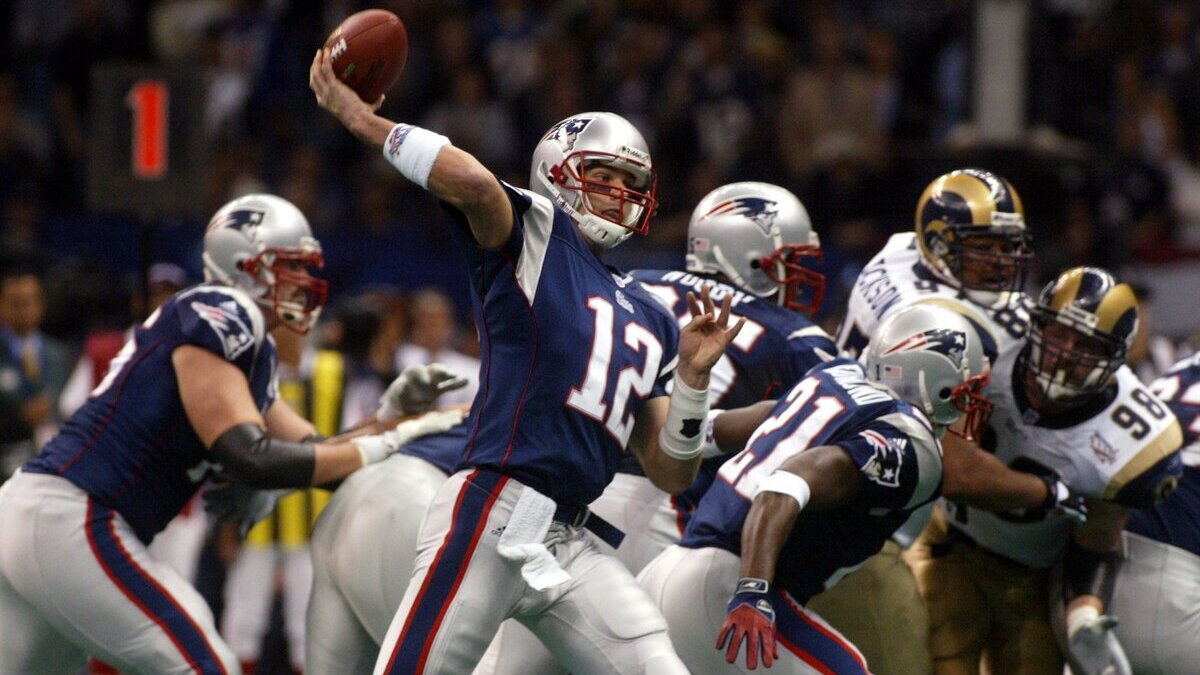
In his first Super Bowl, Brady completed 16 of 27 passes for just 145 yards and a TD while Warner threw for 365 yards for the Rams, but the Patriots’ defense delivered a few game-swinging plays to lead the way.
Ty Law’s 47-yard interception return for touchdown in the second quarter put the Pats up 7-3, and later that quarter Antwan Harris forced a fumble from Rams receiver Ricky Proehl that Terrell Buckley recovered for New England in Rams territory. Brady capitalized and eventually hit David Patten for an 8-yard TD and 14-3 lead.
Otis Smith intercepted Warner late in the third quarter, giving the Patriots possession at the Rams’ 33 and setting up an eventual Adam Vinatieri field goal to make it 17-3.
In the fourth quarter, a holding penalty on linebacker Willie McGinest negated a 97-yard fumbled return for touchdown by teammate Tebucky Jones, and Warner scored on a 2-yard rushing TD two plays later to make it 17-10.
Warner later took advantage of a bad punt that set up the Rams at the Patriots’ 45-yard line with under 2 minutes remaining, as he completed three straight passes for the game-tying score on a 26-yard TD to Proehl.
Starting at his own 17 with 1:21 to go, Brady completed 5 of 8 passes to get the Patriots to the Rams’ 30 and set up Vinatieri’s game-winning 48-yard field goal as time expired for the first Super Bowl title in franchise history and the first of Brady’s record five Super Bowl MVP awards.
It was the first time a Super Bowl had been won on the final play of the game, and with that the Patriots’ dynasty had been set in motion.
Super Bowl XXXVIII (Feb. 1, 2004, in Houston): Patriots 32, Panthers 29
The dynasty really took off two years later, though.
New England would follow up that first Super Bowl win with a 9-7 finish in 2002 to miss the playoffs before starting a streak of 17 straight seasons with double-digit wins while missing the postseason only one other time in the Brady/Belichick Era — in 2008 when Brady sustained a season-ending knee injury in the first game (even though the team would finish 11-5 nonetheless).
The 2003 Patriots went 14-2 and won their second Super Bowl in three years, again in thrilling fashion.
The game remained scoreless for the first 26:55, but the Patriots and Panthers would ultimately combine for 868 yards overall and 37 fourth-quarter points in a frenetic finish.
New England led 21-10 before Carolina scored back-to-back touchdowns on a 33-yard DeShaun Foster run, an interception in the end zone by Reggie Howard on Brady to deny the Patriots and then an 85-yard TD pass from Jake Delhomme to Muhsin Muhammad for a 22-21 lead (missing 2-point conversion attempts on both scores).
Brady answered back with a 68-yard touchdown drive capped by a 1-yard pass to linebacker (and now Patriots head coach) Mike Vrabel and a 2-point conversion to make it 29-27 with just under 3 minutes remaining.
Delhomme led the Panthers right back down the field and hit Proehl for a 12-yard TD on third-and-8 to tie it — but ultimately leaving Brady 1:08 on the clock, which the rest of the NFL would learn was a perilous position to be in.
Brady would complete 4 of 5 passes for 47 yards, including a 17-yard gain to Deion Branch on third down to get the Patriots to the Panthers’ 23 and call timeout with 9 seconds remaining.
Just like two years earlier, Vinatieri finished the job with a 41-yard game-winning field goal, leaving only a final kickoff before the Pats celebrated their second championship.
Brady was again named Super Bowl MVP after passing for 354 yards, 3 TDs and 1 INT while Branch caught 10 passes for 143 yards and a score.
Super Bowl XXXIX (Feb. 6, 2005, in Jacksonville): Patriots 24, Eagles 21
The Patriots went 14-2 again the next season on the way to winning their third Super Bowl in four years, but it would be another dramatic duel to the end.
It was 14-14 entering the fourth quarter when New England seized control on a go-ahead 2-yard Corey Dillon TD run, a quick Eagles three-and-out and then a 22-yard Vinatieri field goal for a 10-point lead.
Philadelphia later narrowed the deficit with a 13-play drive and 30-yard TD pass from Donovan McNabb to Greg Lewis to make it a 3-point game with 1:55 remaining, but that’s as close as the comeback came. After a Patriots punt pinned the Eagles at their 4 with 46 seconds left, McNabb was soon intercepted by Rodney Harrison to end it.
Branch was named the Super Bowl MVP this time with 11 catches for 133 yards, while Dillon rushed for 75 yards and a TD and Brady threw for 236 yards, 2 TDs and 0 INTs. McNabb passed for 357 yards and 3 TDs for the Eagles but also threw 3 picks — two to Harrison and another to linebacker Tedy Bruschi.
Super Bowl XLII (Feb. 3, 2008, in Glendale, Arizona): Giants 17, Patriots 14
The 2007 Patriots were one of the best teams of the entire Belichick/Brady run but the first of those teams to fall short in the Big Game.
Boosted by the addition of future Hall of Fame WR Randy Moss, Brady threw for 4,806 yards, 50 TDs and 8 INTs to win his first regular-season MVP award while the Patriots went 16-0 to become the first undefeated team since the 1972 Dolphins.
New England beat the Jaguars 31-20 in the divisional round and the Chargers 21-12 in the AFC championship game before running into a team that would become their postseason kryptonite.
The Patriots were 12-point favorites for the Super Bowl matchup with the Giants, but New England led just 7-3 entering the fourth quarter.
New York took the lead on a 5-yard TD pass from Eli Manning to David Tyree, the Patriots later took it back on a 6-yard TD pass from Brady to Moss with 2:42 remaining and needed just one more defensive stop to complete a perfect season and go down as arguably the greatest team in NFL history.
But we all know what happened …
On third-and-5 with 1:15 to go, Manning somehow avoided a sack with three Patriots having a chance to bring him down in the backfield and uncorked the ball downfield to Tyree for an improbable 32-yard completion as Tyree pinned the ball to his helmet for one of the most iconic plays in NFL history.
Manning then converted on third-and-11 to Steve Smith before finding Plaxico Burress for the 13-yard game-winning touchdown with 35 seconds left.
The Patriots couldn’t rally and turned the ball over on downs for the loss that haunts the franchise and its fans more than any other.
Brady threw for 266 yards and a TD, with Wes Welker catching 11 passes for 103 yards, but they were upstaged by Manning (255 yards, 2 TDs and 1 INT) and the Helmet Catch.
Super Bowl XLVI (Feb. 5, 2012, in Indianapolis): Giants 21, Patriots 17
It took the Patriots four seasons to get back to the Super Bowl, only to run into Manning and the Tom Coughlin-coached Giants again.
This Giants team had gone just 9-7 during the season, winning three of its final four games to finish atop the NFC East while finding momentum at just the right time entering the playoffs. New York then rolled past the Falcons 24-2, won 37-20 on the road over the Packers and won 20-17 in overtime on the road against the 49ers in the NFC championship game.
New England, meanwhile, was having a typical Belichick/Brady season while going 13-3 with 10 straight wins, including a 45-10 demolition of the Broncos in the divisional round and a 23-20 win over the Ravens in the AFC championship game.
But those pesky Giants would get the best of the Pats yet again, setting an NFL record for worst regular-season record by a Super Bowl champion.
New England scored 17 straight points to take a 17-9 lead early in the fourth quarter before another late let-down to Manning and Co.
Two Lawrence Tynes field goals brought the Giants to within 17-15 entering the fourth quarter, and Manning later guided the game-winning touchdown drive with a 38-yard pass to Mario Manningham on first down while completing 5 of 6 passes for 74 yards on series before Ahmad Bradshaw’s go-ahead TD run with 57 seconds left.
Brady converted on fourth-and-16 with a 19-yard pass to Branch to keep hope alive for the Patriots but ultimately couldn’t get them beyond their own 49.
Manning (30 of 40 for 296 yards and 1 TD) won his second Super Bowl MVP and dealt Brady (276 yards, 2 TDs and 1 INT) his second Super Bowl setback.
Super Bowl XLIX (Feb. 1, 2015, in Glendale, Arizona): Patriots 28, Seahawks 24
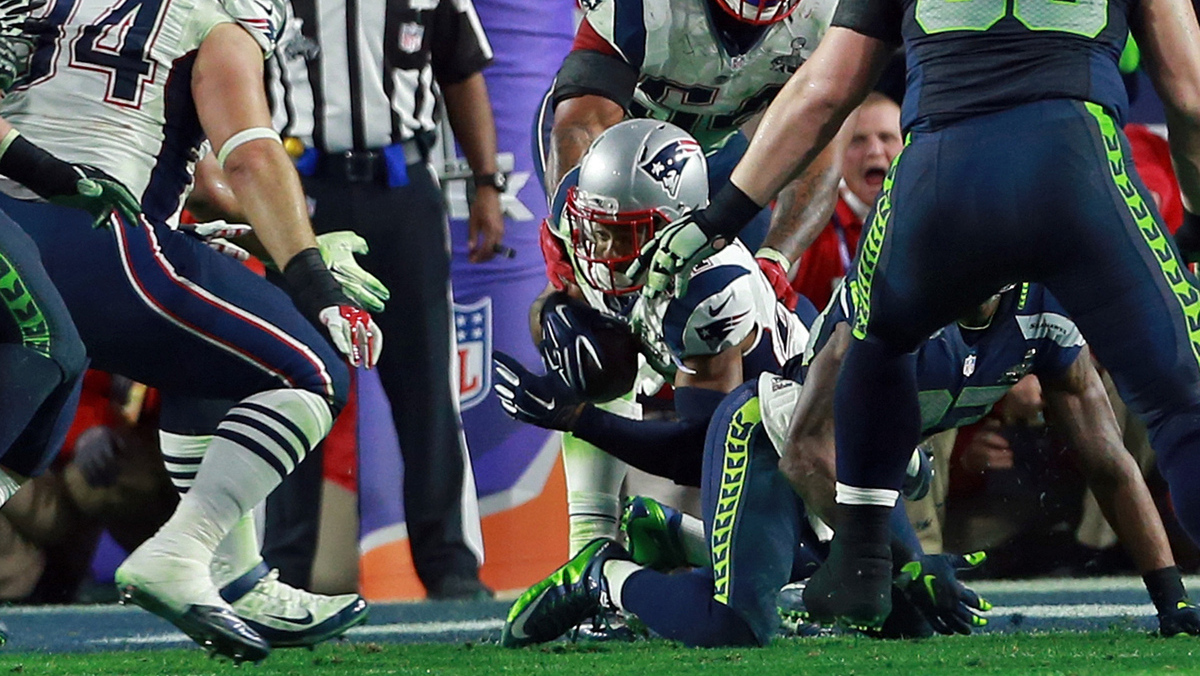
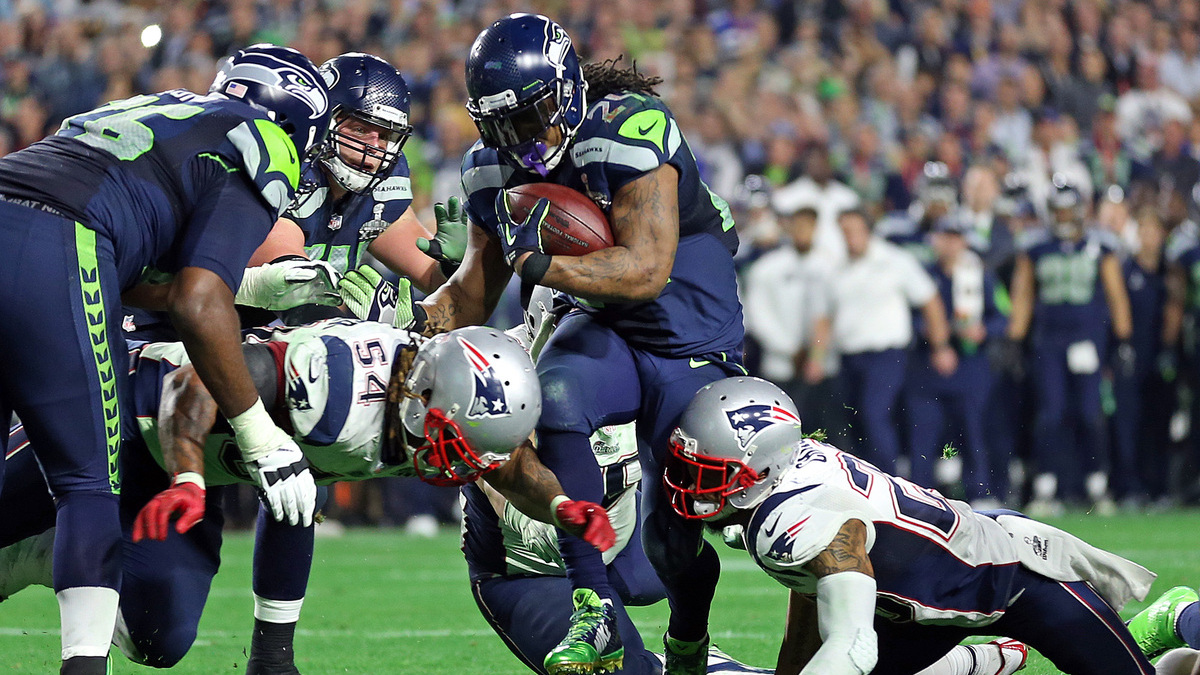
The last time New England and Seattle clashed in the Super Bowl delivered one of the most dramatic finishes in NFL history — the one referenced up top — which, of course, is the Malcolm Butler game-saving interception.
It’s been talked about enough this week that the details should be vividly fresh by now.
Seattle, going for its second straight Super Bowl title, led 24-14 entering the fourth quarter, but Brady threw two TD passes in the final 8 minutes against the Seahawks’ vaunted defense — 4 yards to Danny Amendola to cap a 68-yard drive, and 3 yards to Julian Edelman to cap a 64-yard drive and take a 28-24 lead with 2:02 remaining.
It looked like the Seahawks were going to steal the game back after Russell Wilson connected with running back Marshawn Lynch for a 31-yard gain to start the final drive, converted on third-and-10 at midfield with an 11-yard completion to Ricardo Lockette and then immediately hit Jermaine Kearse down the right sideline for 33 yards on an incredible catch against Butler to the Patriots’ 5. Lynch then rammed forward for 4 yards to the 1 to set up that fateful second-and-goal.
Time wasn’t an issue at that point, and in fact Seattle let the clock dwindle down so as to limit what Brady and the Patriots would have to work with after a Seahawks score. There was every opportunity to continue hammering Lynch — the RB known as “Beast Mode” — into the line until he scored. Instead, the Seahawks dialed up a pass play, Butler, who had just re-entered the game based on the Seahawks’ goal line personnel, read it perfect and made the interception.
And the rest is, literally, history.
It is considered one of the greatest plays in NFL history and also one of the most questionable and consequential decisions by the Seahawks to throw the ball there.
The story behind the play is almost as incredible, as the Patriots had practiced against that very look — despite never using that specific goal line package all season — and Butler had failed in coverage during practice, learning how he’d need to adjust if it came up in a game.
While the Belichick/Brady Patriots won six Super Bowls, this was their first championship in 10 years and kicked off a second flurry of three titles in the span of five seasons.
Brady won his third Super Bowl MVP to tie Joe Montana’s record, completing 37 of 50 passes for 328 yards, 4 TDs and 2 INTs while leading that fourth quarter comeback while Edelman had 9 catches for 109 yards and a score.
Super Bowl LI (Feb. 5, 2017 in Houston): Patriots 34, Falcons 28
As astounding as the Patriots’ pure total of Super Bowl wins and appearances are, so too is how many all-time great finishes they were a part of (on both sides of the outcome) along the way.
The first game-winning field goal as time expired in a Super Bowl, the 37 combined fourth quarter points vs. the Panthers, the Helmet Catch, the Malcolm Butler interception and then “28-3.”
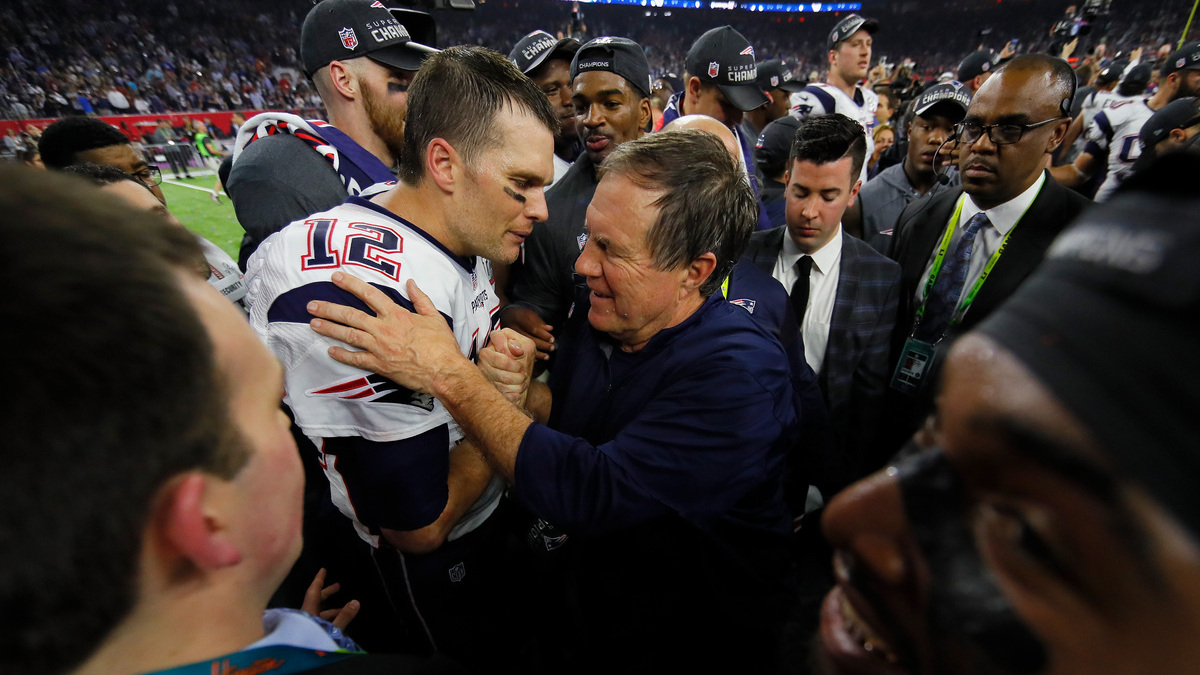
That’s, of course, the lead the Falcons held late in the third quarter before Brady and the Patriots authored the greatest comeback in Super Bowl history.
Here was the series-by-series rundown of what transpired after the Falcons went up 28-3 with 8:31 left in the third quarter:
– Patriots 13-play, 75-yard TD drive, including a fourth-and-3 conversion from Brady to Amendola for 17 yards and capped by a 5-yard Brady TD pass to James White followed by a missed PAT. Falcons lead 28-9.
– Falcons recover a Patriots onside kick attempt but go three-and-out with a costly holding penalty and punt.
– Patriots get a 33-yard Stephen Gostkowski field goal. Falcons lead 28-12 with 9:44 left.
– Falcons QB Matt Ryan fumbles on a sack by Dont’a Hightower and Alan Branch recovers for New England at the Atlanta 25.
– Patriots score in 5 plays on a 6-yard Brady TD pass to Amendola, White rushes in for the 2-point conversion. Falcons lead 28-20 with 5:56 remaining.
– Falcons drive to the New England 22, but a 1-yard loss on a rush, a 12-yard loss on a Trey Flowers sack and a holding penalty lead to a fourth-and-33 from the 45 and a punt.
– Taking over with 3:30 left down 8, Brady leads a 10-play, 91-yard game-tying drive, converting on an early third-and-10 with a 16-yard pass to Chris Hogan, hitting Edelman for 23 yards across midfield, and following with a 20-yard strike to Amendola and completions of 13 and 7 yards to White down to the Atlanta 1. White rushes in for the TD and Brady hits Amendola for the game-tying 2-point conversion to make it 28-28 with just under a minute remaining.
– In the first Super Bowl game to go to overtime, the Patriots win the coin toss, take the ball and drive 75 yards on 8 plays as Brady completes 5 of 6 passes for 50 yards and White wins it on a 2-yard TD run.
Brady, of course, won his fourth Super Bowl MVP, completing 43 of 62 passes for 466 yards, 2 TDs and an INT, setting Super Bowl records for completions, attempts and passing yards. White had 14 catches for 110 yards and a TD and 29 rushing yards with 2 TDs.
Super Bowl LII (February 4, 2018, in Minneapolis): Eagles 41, Patriots 33
Reaching the Super Bowl for the second straight season and third time in four years, the Patriots were part of another of the most entertaining Super Bowls in history.
The Patriots and Eagles set a record for any NFL game with 1,151 combined offensive yards (613 for New England, 538 for Philadelphia) and a Super Bowl record for fewest combined punts with just one.
Brady broke his own Super Bowl record from the previous year with 505 passing yards and 3 TDs with Amendola (8 catches for 152 yards), Hogan (6-128 and a TD) and tight end Rob Gronkowski (9-116-2) all putting up huge lines.
And yet it wasn’t enough to stop the Eagles and backup QB Nick Foles, who had taken over when Carson Wentz tore his ACL in Week 14.
Foles passed for 373 yards, 3 TDs and 1 INT, and he famously caught a touchdown pass from tight end Trey Burton on fourth-and-goal from the 1 in the second quarter to put the Eagles up 22-12 and put “Philly Special” into the football lexicon.
New England had trailed nearly the entire game before pulling ahead 33-32 on a 4-yard TD pass from Brady to Gronkowski with 9:22 left in the game, but Foles led the Eagles right back on a 14-play, 75-yard touchdown drive.
On third-and-7 from the 11, he connected with tight end Zach Ertz for the go-ahead score to make it 38-33 with 2:21 left.
Brandon Graham then sacked Brady, forcing and recovering a fumble, and the Eagles tacked on a field goal to go up 8 with 1:05 remaining. The Patriots got to their own 49 but no further — there would be no comeback this time.
Super Bowl LIII (Feb. 3, 2019, in Atlanta): Patriots 13, Rams 3
In Brady’s penultimate season with the Patriots, he got them back to the Super Bowl for a third straight year and fourth time in five seasons.
Much like his first championship, Brady’s final in New England also came thanks to the defense, which held the Rams to 260 yards and just a lone field goal.
It was 3-3 into the fourth quarter before Brady led a 69-yard touchdown drive with a 2-yard Sony Michel TD run, Stephon Gilmore then intercepted Rams QB Jared Goff, and the Patriots drove 72 yards for a 41-yard Gostkowski field goal and a 10-point lead.
Edelman was named Super Bowl MVP with 10 catches for 141 yards — accounting for half of Brady’s passing total as he finished with 262 yards, 0 TDs and 1 INT.
But with a record sixth Super Bowl ring for both he and Belichick.
Seattle Seahawks Super Bowl History
Previous Super Bowl appearances: 3 | Super Bowl wins: 1
Last Super Bowl win: Super Bowl XLVIII (2014 vs. Broncos)
Super Bowl XL (Feb. 5, 2006, in Detroit): Steelers 21, Seahawks 10
It took the Seahawks 30 years of existence to breakthrough to their first Super Bowl.
They’d only ever reached even one conference championship game in that span (in 1983), but the franchise made a power move after the 1998 season to hire coach Mike Holmgren away from the Green Bay Packers, giving him control of player personnel and making him the highest-paid coach in the league.
After 10 straight seasons missing the playoffs, the Seahawks made it in Holmgren’s first year but not again until his fifth season in 2003, when they won 10 games for just the third time in franchise history. Two years later, Holmgren’s Seahawks set a then-team-record with 13 wins and broke through with the first Super Bowl appearance.
After beating Washington 20-10 in the divisional round and Carolina 34-14 in the NFC championship game, the Seahawks met their match in the Super Bowl.
Down 14-3, Kelly Herndon set a then-Super Bowl record with a 76-yard interception return to set up a 16-yard touchdown pass from Matt Hasselbeck to Jerramy Stevens midway through the third quarter, cutting the deficit to 14-10.
But Seattle wouldn’t score again while the Steelers got a 43-yard touchdown pass from WR Antwaan Randle El to Super Bowl MVP Hines Ward in the fourth quarter to pull away.
Holmgren got the Seahawks back to the playoffs the next two seasons but never past the divisional round again.
Super Bowl XLVIII (Feb. 2, 2014, in East Rutherford, N.J.): Seahawks 43, Broncos 8
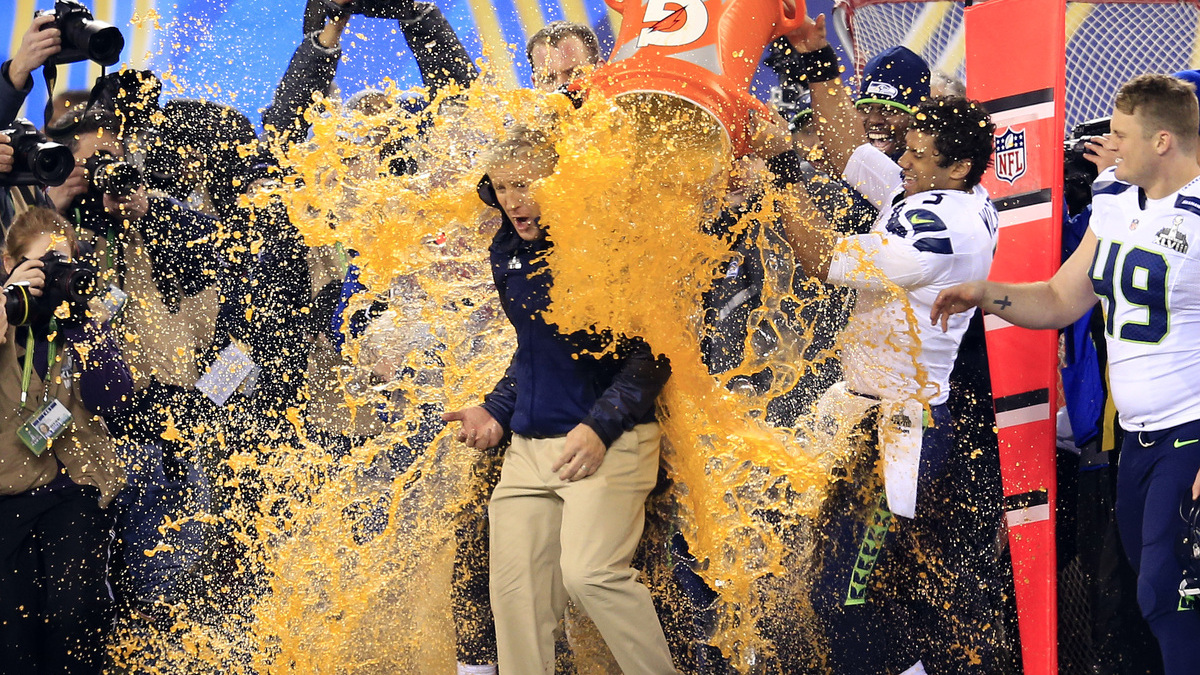
The lone Super Bowl championship in franchise history came in coach Pete Carroll’s fourth season, as the Seahawks’ “Legion of Boom” defense made a statement.
It was the first Super Bowl matchup in 23 years to features the league’s No. 1 scoring offense vs. the No. 1 scoring defense, as the Broncos and Hall of Fame-bound QB Peyton Manning had set NFL records for most points scored in a season (606) and most passing yards (5,572) while Manning earned his record fifth NFL MVP award.
Denver was a 2-point favorite for the Super Bowl, but that didn’t faze Seattle at all.
The Seahawks led 22-0 at halftime and were up 36-0 before the Broncos finally scored their lone touchdown at the end of the third quarter.
The 35-point margin of victory was the most ever by an underdog in the Super Bowl and tied for the third-most overall in the history of the Big Game.
The tone was set on the opening play as the Broncos snapped the ball before Manning was ready, resulting in a safety as running back Knowshon Moreno fell on the ball in the end zone and was downed by Cliff Avril.
Safety Kam Chancellor’s interception of Manning later set up the Seahawks at the Broncos’ 37, leading to a Marshawn Lynch touchdown run and 15-0 lead.
And Super Bowl MVP Malcolm Smith had a 69-yard interception return for touchdown late in the first half, after Avril disrupted Manning’s pass, to get it to 22-0 and the rout was on from there.
The Seahawks held Manning to 280 yards, 1 TD and 2 INTs and allowed just 27 rushing yards.
For Seattle, Russell Wilson passed for 206 yards, 2 TDs and 0 INTs, with Doug Baldwin and Jermaine Kearse hauling in those scores.
Super Bowl XLIX (February 1, 2015, in Glendale, Arizona): Patriots 28, Seahawks 24
Which again brings us back to the last Super Bowl meeting between New England and Seattle, which we covered in the Patriots section.
It sure felt like the Seahawks were just starting a long Super Bowl window, especially as they made it back to the Big Game for a second straight season, but the Malcolm Butler interception ended the momentum abruptly.
“For it to come down to a play like that, I hate that we have to live with that,” Carroll said afterward. “Because we did everything right to win the football game.”
Seattle continued to be an almost perennial playoff team throughout the rest of Carroll’s tenure, which ended after the 2023 season, but he never got them past the divisional round of the playoffs again.
That Super Bowl-clinching interception has hung over the franchise until this reset with Macdonald the last two years, “The Dark Side” defense now looking to be the successor to the “Legion of the Boom” and the Seahawks so fittingly back on this stage 11 years later against none other than the Patriots.
What a poetic narrative it would be for Seattle to launch this new era with a Super Bowl championship over that franchise.