

Each day leading up to the 2026 NFL Draft — April 23-25 — TeamFB7 will break down a different team’s biggest draft need and the best selection to address it. Granted, teams will most often use their first-round pick on the best available player/value and not necessarily always their biggest need, so this isn’t going to compile together into a mock draft in the end. It’s more a breakdown of how each team could best address its most paramount priority if it chooses.
Ideally, a rebuild/reset starts with the right head coach in place first, but the Tennessee Titans are doing it a little backward, of course.
After all, this is the organization that fired coach Mike Vrabel and replaced him with Brian Callahan, which might be the most extreme negative net difference possible from an NFL coaching change. (Tennessee has gone 3-14 in back-to-back seasons since that move, while Vrabel of course took the Patriots to the Super Bowl in his first season there.).
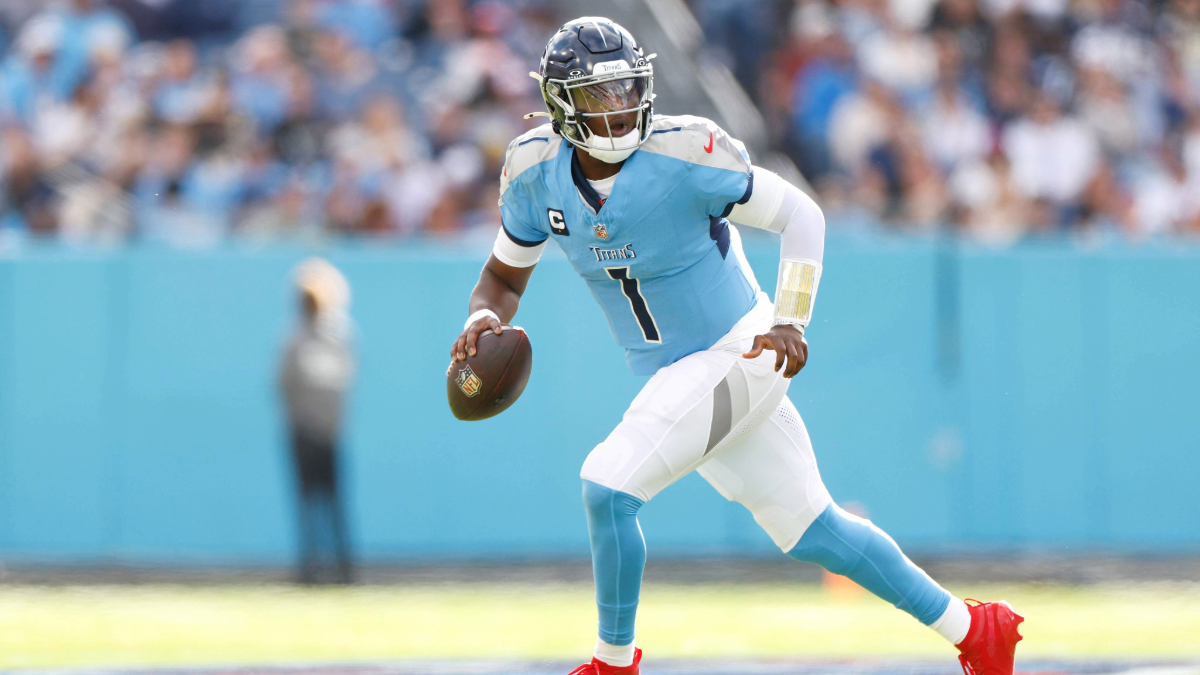
But that catastrophic decision — and others, like letting running back Derrick Henry leave as a free agent still in the peak of his prime — actually belong to some combination of team owner Amy Adams Strunk (who was reportedly behind the Vrabel firing) and former Titans general manager Ran Carthon.
Last offseason, the team fired Carthon and hired longtime Kansas City Chiefs executive Mike Borgonzi to take over the rebuild. He drafted quarterback Cam Ward No. 1 overall in the 2025 NFL Draft and needed to see only six games last season before firing Callahan, clearing the way to hire former New York Jets coach and San Francisco 49ers defensive coordinator Robert Saleh as head coach in January and truly begin the franchise’s full reset.
The Titans now have their coach, they’re heavily committed to hoping Ward is their franchise quarterback for years to come and they splurged in free agency to start addressing some of the priority needs on the roster.
Per Spotrac.com, Tennessee spent the most money in NFL free agency this year in terms of total contract values (more than $404 million) and the second-most in total guaranteed money (more than $233 million).
The big-ticket additions were WR Wan’dale Robinson (4 years, $70 million), DL John Franklin-Myers (3 years, $63 million) and CBs Alontae Taylor (3 years, $58 million) and Cordale Flott ($3 years, $45 million).
Now Borgonzi has a full spate of draft picks to utilize next month in continuing the roster rebuild. Here are the picks the Titans hold — listed by round (overall pick): 1 (4), 2 (35), 3 (66), 4 (101), 5 (142), 5 (144), 6 (184), 6 (194), 7 (225).
Before weighing in on what Tennessee should do with that No. 4 overall pick, lets identify the Titans’ most pressing needs.
What Is The Titans’ Biggest Draft Need?
Ward didn’t exactly stake his claim as one of the league’s emerging star quarterbacks last year, putting up middling production as a rookie while completing 59.8% of his passes for 3,169 yards, 15 touchdowns and 7 interceptions with 2 rushing TDs.
Not only was that the fewest passing yards of any NFL QB who played all 17 games last season, it was 499 less than the next lowest such total and also less than two quarterbacks who played only 14 games.
If the Titans want Ward to flourish and deliver on the potential that made him the No. 1 overall pick in the last draft, they need to give him more playmakers and better protection.
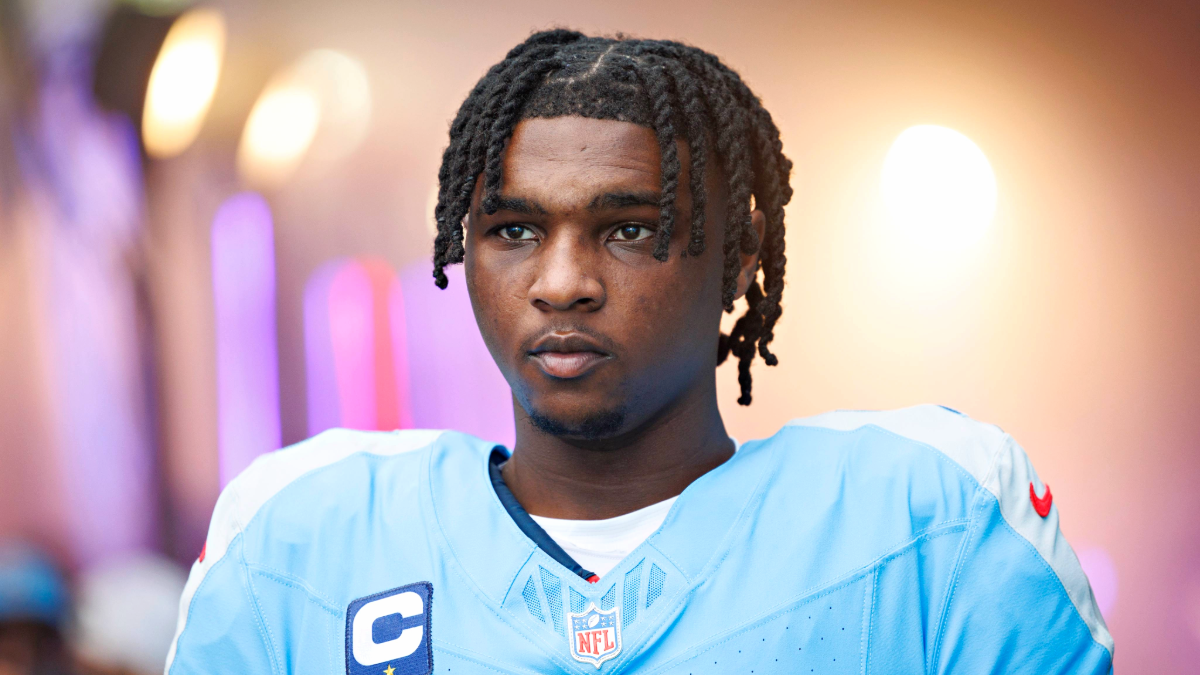
We weren’t huge fans of the Robinson signing (at least at that cost) as his delayed fourth-year breakout (92 catches for 1,014 yards and 4 TDs) came after the Giants lost star WR Malik Nabers to an early season-ending injury, leaving veteran No. 3-caliber WR Darius Slayton the only real competition for targets. Somebody had to catch passes for that team.
But, new Titans offensive coordinator Brian Daboll was the Robinson’s head coach in New York and knows what he’s getting, so we’ll give some deference to schematic fit and Daboll’s specific plan for Robinson. Regardless, the team’s WR corps is largely set now with Calvin Ridley, Robinson, Elic Ayomanor and Chimere Dike. It’s not a top 10 receiving corps in the league, but Ayomanor and Dike were rookies last season and the team is going to want to see how they develop.
Tony Pollard is back at running back and has posted four straight 1,000-yard rushing seasons. He’s joined again by backup Tyjae Spears. Again, not a top 10 rushing unit either, but for all the buzz linking the Titans to Notre Dame RB Jeremiyah Love — and maybe they indeed will take him — that seems like the wrong move at this point in the rebuild. (We’ll expound more in a bit).
The Titans let veteran tight end Chig Okonkwo walk in free agency (to the Washington Commanders), but mostly because they believe in the potential of second-year TE Gunnar Helm (44-357-2 as the team’s TE2 last year) while pairing him with another of Daboll’s former Giants, Daniel Bellinger.
So if Tennessee is going to do anything to help Ward in the draft this year, it would be continuing to upgrade an offensive line that contributed to Ward tying for the league lead in sacks taken at 55 (with the Raiders’ Geno Smith).
Tennessee made one notable move there in free agency, signing center Austin Schlottmann, formerly of the Giants, to a modest 2-year, $7-million deal. PFF graded him 10th out of 40 qualifying centers last year, and he should be a nice upgrade over 2025 starter Lloyd Cushenberry III (who graded out 36th out of 40 at the position).
But the Titans are likely losing right guard Kevin Zeitler, who was the team’s second-highest-graded offensive lineman last season (74.5 PFF grade, 13th out of 81 qualifying centers). He remains a free agent while the Titans already signed free agent guard Cordell Volson, a three-year starter for the Bengals (mostly at left guard) before missing last season recovering from shoulder surgery. That’s not an upgrade.
Left guard Peter Skoronski (the team’s highest-rated lineman, ranking 6th out of 81 OGs with a 79.0 PFF grade), left tackle Dan Moore Jr. and right tackle JC Latham are all back.
Neither of the tackles were exceptional, allowing a combined 16 sacks and 81 pressures, per PFF, but Latham was the No. 7 overall pick in the 2024 draft and entering the third year of his four-year rookie contact, and Moore signed a four-year, $82-million contract a year ago with $50 million guaranteed.
So the Titans have to ride it out with both tackles for the foreseeable future and hope for the best — Latham could still develop into a real asset for the team.
The best they could hope to do in the draft to help the offensive line at this point is consider using that high second-round pick on a guard to play over Volson — and there are some worthy OG targets in that range (Georgia Tech’s Keylan Rutledge, Oregon’s Emmanuel Pregnon and perhaps, if he falls, Texas A&M’s Chase Bisontis).
That leaves us believing Tennessee’s biggest addressable draft need with that No. 4 overall pick comes on the defensive side — which would also make sense for a defensive-minded head coach like Saleh to want to continue upgrading that unit.
The Titans already invested heavily in the secondary, signing cornerbacks Taylor, Flott and former Chiefs backup Joshua Williams for more than $42 million in combined annual average value, and adding free agent safety Tony Adams (a former Saleh player who made 35 starts the last three seasons for the Jets). Adams joins returning starter Amani Hooker (81 tackles, 3 tackles for loss, 8 passes defended in 2025) and promising second-year safety Kevin Winston to solidify that group.
Tennessee has one foundational linebacker in the middle of the defense in Cedric Gray, who ranked fourth in the NFL with 164 tackles as a second-year pro in 2025 and graded out 7th out of 88 qualifying linebackers by PFF. Well-traveled veteran Cody Barton was just OK next to him with 81 tackles, 4 TFL and 3 interceptions, but he’s in the middle of the three-year, $21-million contract signed last year. Add in free agent pickup Mohamoud Diabate (18 starts in three seasons with the Browns) and the Titans are probably set here for 2026 as well.
Up front, Saleh (along with defensive coordinator Gus Bradley) has a star defensive tackle who plays right into his preferences in Jeffery Simmons, who had a career-high 11 sacks last season.
He then doubled-down by bringing in another of his former standouts with the Jets. Franklin-Myers, the big free agent signing, can slide out to the edge, but his true value is as a wrecking ball on the interior. He totaled 14.5 sacks over the last two seasons with the Broncos after previously playing for and developing under Saleh with the Jets, and pairing him with Simmons on as two elite defensive tackles could be a true ton-setter for the Titans’ defense.
But that brings us to our biggest roster question then — the edge rushers.
The Titans have some intriguing depth pieces on the edge but all come with question marks.
They traded for Jermaine Johnson II, who had 7.5 sacks with Saleh’s Jets in 2023 but hasn’t come close to that production since. Maybe a reunion with Saleh again unlocks his potential. The team is high on 2025 second-round pick Femi Oladejo, but he was limited to just six games as a rookie by a fractured leg. That in turn opened the door for Jaylen Harrell, a 2024 7th-rounder, to break out late last season with 4 sacks in the final five games (and 4.5 overall for the season). And they signed veteran journeyman Jacob Martin, who set a career-high with 5.5 sacks last season with the Commanders, but his overall production in 8 NFL seasons has been modest.
What this defense — and team in general — is truly lacking is a star edge rusher.
That is Tennessee’s singular biggest draft need, and if the Titans hit on an instant-impact EDGE in this draft, this could absolutely be one of the most improved defenses in the NFL in 2026 — after finishing bottom half of the league in yards allowed last season while giving up the fifth-most points per game (28.1).
Who Should The Tennessee Titans Draft At No. 4 Overall?
While we chart our own course here, it’s at least interesting to look at some of the notable mock drafts to see what other thoughts are out there. Here’s how five prominent draft gurus project the Titans using their first-round pick:
ESPN’s Mel Kiper Jr.: Notre Dame RB Jeremiyah Love
ESPN’s Field Yates: Ohio State LB Sonny Styles
The Ringer’s Todd McShay: Miami EDGE Rueben Bain Jr.
NFL.com’s Daniel Jeremiah: Love
NFL.com’s Bucky Brooks: Love
That’s a lot of love for … the Notre Dame running back at No. 4 in the draft. Love’s stock has absolutely been soaring through his final season with the Fighting Irish (1,372 rushing yards, 6.9 YPC, 280 receiving yards, 21 total TDs) and his impressive NFL Scouting Combine performance.
And it’s believed Love is indeed going to go very early in this draft and that’s why the Saints at No. 8 and Chiefs at No. 9 instead signed expensive free agent running backs rather than hoping Love would be available at those spots.
There is an argument to be made that pairing Love with Pollard for a year and leaning on a heavy rushing attack would take a lot of pressure off Ward and help in his development in Year 2. We don’t even disagree.
But taking a running back fourth overall is a luxury more befitting a ready-made contender looking for a final missing piece/upgrade.
While equal on the sack totals, the Titans’ offensive line wasn’t quite as bad as the Raiders’ last season, but how did it turn out for Las Vegas drafting the can’t-miss RB of the 2025 draft, Ashton Jeanty, No. 6 overall? (Not well — and certainly not because of Jeanty necessarily).
Pollard is a fine placeholder for now while the Titans advance their rebuild and bolster the foundation of the roster. Splurge for a star running back later — after continuing to upgrade the offensive line this next year or two.
Saleh is a defensive-minded head coach who is going to want to make a statement on that side of the ball in his first season. The team has largely done a good job shoring up most areas of the unit with exception to edge rusher.
It only makes sense to take a swing at that spot in a draft with three top-end prospects at the position in Texas Tech’s David Bailey, Ohio State’s Arvell Reese (albeit it’s unclear yet if he’ll settle as a true edge rusher — his preference — an off-ball linebacker or a bit of both in the NFL) and Miami’s Rueben Bain Jr.
Reese will most likely be off the board by pick No. 4. Bailey could be as well.
Yes, the 6-foot-2, 263-pound Bain got the dreaded “short arms” stigma coming out of the combine and he’s not exactly built like Myles Garrett, but there’s been a lot of push back on that critique relative to Bain’s overwhelming game film for Miami, where he was the face of a defense that led the Hurricanes to the national championship game.
PFF ranked Bain No. 3 out of 852 FBS defensive ends last season and credited him with 67 total pressures along with his 54 tackles, 15.5 tackles for loss and 9.5 sacks.
Most mock drafts have Bain going a few picks later, but he did have a formal meeting with the Titans, and our purpose here is to match each team’s most pressing need with the best possible answer in the draft.
For the Titans, that’s Bain (or Bailey if he falls to No. 4). We’d take Bailey if available because of his more prototypical frame at 6-foot-4, 251 pounds, but he likely won’t be available. So Bain it is.
Editor's Pick
 Way Too Early Predictions For 2026 NFL Awards