This may be the most attention the Pro Football Hall of Fame has gotten in quite a while — and not good attention.
Undercutting any suspense leading up to the revealing of the 2026 Hall of Fame class on Thursday night were the leaks and reports last week that Patriots coach Bill Belichick and his six Super Bowl championships (eight including as a defensive coordinator) had not made it in on the first ballot. (Ditto for two-time Super Bowl MVP and champion Eli Manning).
Thus, the bulk of the news cycle and conversation leading up to this Hall of Fame announcement has been about admonishing voters who took some principled stand against Belichick (and perhaps Patriots owner Robert Kraft, who also did not make it) over Spygate and such matters.
Hall of Fame coach Tony Dungy has been deflecting questions about whether he did or did not vote for Belichick, while longtime Indianapolis Colts general manager/team president Bill Polian has been on the defensive denying that he led the push to deny Belichick.
As a result, there’s been almost no preceding buzz about the individuals who did actually get voted into the Pro Football Hall of Fame.
Maybe now there will be time for that.
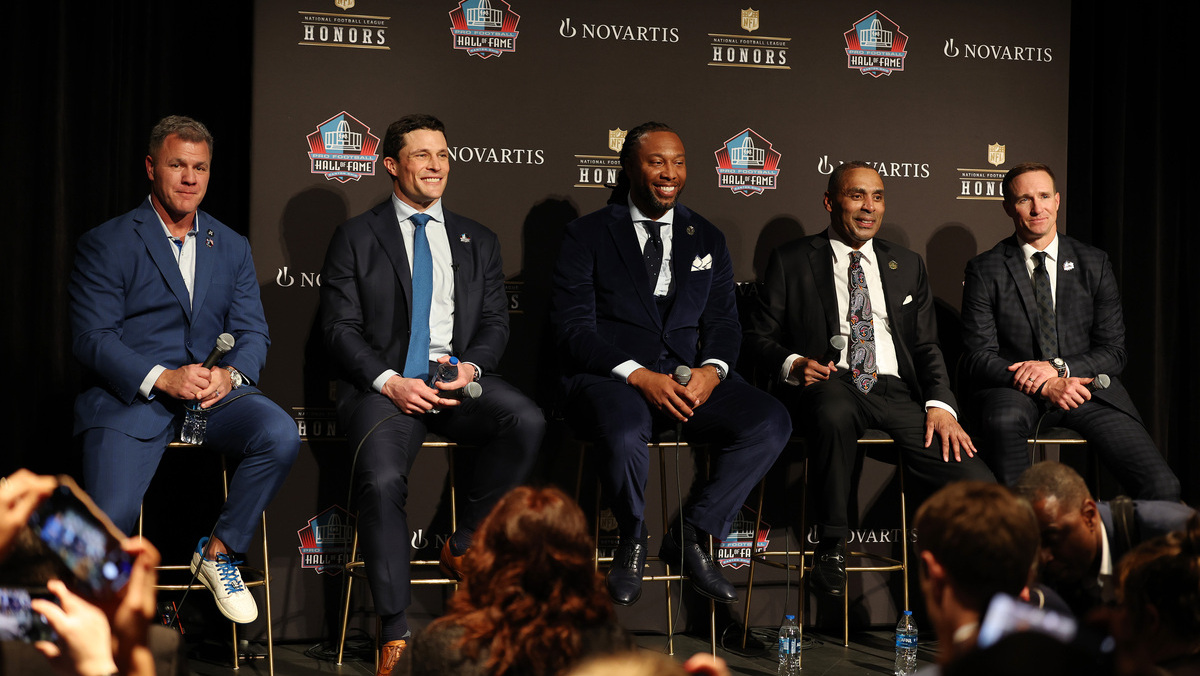
It was announced Thursday night during the NFL Honors show/ceremony in San Francisco that New Orleans Saints QB Drew Brees and Arizona Cardinals WR Larry Fitzgerald made it through as first-ballot Hall-of-Famers, while Carolina Panthers LB Luke Kuechly and Patriots K Adam Vinatieri are headed to Canton in their second year of eligibility and San Francisco 49ers RB Roger Craig finally made it in more than 30 years after his retirement.
Brees, Fitzgerald, Kuechly and Vinatieri were part of 15 modern era finalists. Craig was on a separate ballot as one of three “senior” players considered along with Cincinnati Bengals QB Ken Anderson and Pittsburgh Steelers DE L.C. Greenwood, one coach (Belichick) and one contributor (Kraft) with voters able to vote for three of the five. Candidates needed 80 percent of the vote to make it into the Hall of Fame.
The Hall of Fame selection committee is a 50-person panel made up mostly of NFL media with some notable football legends like Dungy, Dan Fouts and James Lofton and former longtime executive Polian.
Before adding any further dialogue about who didn’t get in, let’s take a moment to spotlight the newest Hall of Famers.
2026 Pro Football Hall of Fame Class
New Orleans Saints QB Drew Brees
This was an easy decision for the voters.
Brees, who played for the Chargers from 2001-05 and the Saints from 2006-20, ranks second all-time behind only Tom Brady in career passing yards (80,358), passing touchdowns (571), completions (7,142) and attempts (10,551) and third in completion percentage (67.7%) for now behind active QBs Joe Burrow and Tua Tagovailoa.
He led the Saints to their only Super Bowl championship, after the 2009 season, earning Super Bowl MVP honors and was named NFL Offensive Player of the Year twice, led the NFL in passing yards seven times and TDs four times, earned one first-team All-Pro selection, four second-team All-Pro selections and 13 Pro Bowl nods.
Brees also won the NFL’s Comeback Player of the Year award in 2004, which really helps to put his successive accomplishments in context.
A second-round pick (32nd overall) of the Chargers in the 2001 NFL Draft, Brees was the backup to QB Doug Flutie as a rookie and then struggled in his first two years as a starter, tossing a combined 28 TDs and 31 INTs over the 2002-03 seasons. He was just 2-9 as a starter in 2003, losing the job back to Flutie for a stretch of that season.
The next year, he bounced back with 3,159 yards, 27 TDs and only 7 INTs while going 11-4 in 15 starts, but his future with the Chargers was already in jeopardy as the team had used the No. 4 overall pick in the 2004 draft on QB Philip Rivers. The Chargers applied the franchise tag to Brees to keep around one more year in 2005 before letting him leave as a free agent.
And he faced even more doubt about his future at that point after sustaining a major injury to his throwing shoulder — dislocation, complete labrum tear along with rotator cuff damage — late in that 2005 season.
The Saints gambled on the health of his right arm, and the rest is history.
Arizona Cardinals WR Larry Fitzgerald
Another clear choice for the voters — see, their job isn’t all that difficult.
Fitzgerald, a No. 3 overall draft pick who played his entire career from 2004-20 with the Cardinals, ranks second all-time in career receptions (1,432) and receiving yards (17,492) behind only Jerry Rice and sixth in receiving TDs (121).
He led the NFL in receptions and receiving TDs twice, earned one first-team All-Pro and two second-team All-Pro selections, was picked for the Pro Bowl 11 times and was named the Walter Payton NFL Man of the Year in 2016.
Fitzgerald helped the Cardinals to the Super Bowl after the 2008 season when he had a career-high 1,431 receiving yards (96 receptions, 12 TDs) before having a legendary postseason — 6 catches for 101 yards and a TD vs. the Falcons, 8-166-1 vs. the Panthers, 9-152-3 in the NFC championship game vs. the Eagles and 7-127-2 in a 27-23 loss to the Steelers in the Super Bowl.
Carolina Panthers LB Luke Kuechly
Kuechly presented an interesting case for voters. He played only eight seasons before retiring at age 28 due to concern over the number of concussions he’d sustained in his career.
There is ample precedent for players making the Hall of Fame after short but significantly impactful careers.
HOF Bears RB Gale Sayers played just seven seasons and also walked away at 28, ditto for HOF Seahawks DB Kenny Easley whose career was cut short by kidney disease, and there are other older examples.
Ultimately, Kuechly packed a lot into those eight seasons and was unquestionably one of the best linebackers in the NFL during that time.
The No. 9 overall pick in the 2012 NFL Draft, Kuechly led the league with 164 tackles his first season while winning Defensive Rookie of the Year, finished fourth the next year with 156 tackles along with 10 tackles for loss, 4 interceptions and 2 sacks and was named NFL Defensive Player of the Year, and then led the league again in tackles again the following season with 153.
He spent his entire career with the Panthers and was named first-team All-Pro five times and second-team All-Pro two other seasons, a 7-time Pro Bowl selection and finished his career with 1,092 total tackles, 75 TFLs, 12.5 sacks, 7 FF, 18 INTs and 66 passses defended.
Kuechly helped the Panthers to the Super Bowl after the 2015 season, delivering a pick-6 vs. the Seahawks in the divisional round of the playoffs and another in the NFC championship game vs. the Cardinals. He had 10 tackles and a sack in Carolina’s 24-10 Super Bowl loss to the Broncos.
New England Patriots/Indianapolis Colts K Adam Vinatieri
Vinatieri is only the third full-time place-kicker to make the Pro Football Hall of Fame, following Jan Stenerud and Morten Andersen.
And absolutely deserves it.
Undrafted in 1996 out of South Dakota State, Vinatieri played 24 NFL seasons for the Patriots (1996-2005) and Colts (2006-19), winning four Super Bowls and stamping his name all over the NFL record book.
He is the all-time leader in field goal attempts (715), field goals made (599), scoring (2,673 points) and combined regular-season/postseason games played (397) while also setting a record for consecutive field goals made at 44 from 2015-16. He also set postseason records for field goal attempts (69), field goals made (56) and points (238).
More than the volume, though, Vinatieri is known for his clutch kicks. He made 29 winning field goals, including 10 in overtime. He helped launch the Patriots dynasty during their 2001 run to the Super Bowl, famously making a 45-yard field goal in heavy snowfall with 27 seconds left to force overtime vs. the Raiders in the divisional round before later making the 23-yard game-winner.
He then delivered the first walk-off winner in a Super Bowl, as his 48-yard field goal as time expired gave the Patriots a 20-17 win over the Rams and their first championship.
Many more legendary kicks followed from there for Vinatieri, who was named to the NFL’s 100th anniversary team and now takes his rightful place in Canton.
San Francisco 49ers RB Roger Craig
Craig waited a long time to get this call and had long been cited as one of the most deserving players not already in the Pro Football Hall of Fame.
Especially as offense exploded in the NFL in the decades since Craig retired in 1993, his raw numbers don’t overwhelm. In 11 seasons — eight with the 49ers, one with the Raiders and two with the Vikings — he finished with 8,189 rushing yards, 566 receptions for 4,911 yards and 73 combined TDs.
But context is everything here, and Craig is regarded as an influential pioneer in setting the standard for pass-catching running backs.
He was the first player in NFL history to have 1,000 rushing yards and 1,000 receiving yards in the same season — in 1985 when he rushed for 1,050 yards and 9 TDs and caught a league-high 92 passes for 1,016 yards and 6 TDs.
Only two players since have matched that feat — Hall-of-Famer Marshall Faulk and current 49ers star Christian McCaffrey.
Craig was a key cog on three 49ers Super Bowl championship teams (for the 1984, 1988 and 1989 seasons), made four Pro Bowls and was named the NFL’s Offensive Player of the Year while finishing third in MVP voting in 1988, when he rushed for a career-high 1,502 yards and 9 TDs and caught 76 passes for 534 yards and a TD.
5 Most Notable Snubs From 2026 Pro Football HOF Class
New England Patriots coach Bill Belichick
There was good reason for the uproar over Belichick not getting in on his first turn on the ballot. He won a record six Super Bowl championships as head coach of the Patriots, two more as defensive coordinator of the New York Giants, totaled 302 regular-season wins (third-most in NFL history) and a record 31 postseason wins, among countless other feats and accolades. (Many are also critical of Patriots owner Robert Kraft not making the HOF this year, but we’re more interested in the individuals who built their resumes on the field rather than those watching from luxury suites).
New York Giants QB Eli Manning
Manning is an interesting case in that he was never really ever all that close to the regular-season MVP discussion and he had almost twice as many losing/.500/incomplete seasons in his career (9) than seasons with double-digit wins (5). But he’s one of just six players to win two Super Bowl MVPs — beating the Belichick/Brady Patriots both times — and the rest of that list is in the Hall of Fame (Joe Montana, Terry Bradshaw, Bart Starr) or surely will be (Brady, Patrick Mahomes). Manning also ranks 11th all-time with 57,023 passing yards and 366 passing touchdowns.
St. Louis Rams WR Torry Holt
A HOF finalist for the seventh year in a row, Holt ranks 17th all-time in receiving yards (13,382), but his elite consistency is what sets him apart. He is one of two wide receivers in league history with six straight 1,300-yard seasons (along with Julio Jones). One of the stars of the Rams’ “Greatest Show on Turf” Super Bowl team, he averaged 83.6 receptions and 1,216.5 receiving yards per season for his career, finishing with 920 receptions and 74 TDs.
Indianapolis Colts WR Reggie Wayne
Also in his seventh year as a finalist, Wayne is 10th all-time in receiving yards (14,345) and 11th in receptions (1,070), scored 82 TDs and also won a Super Bowl. He played 14 years in the league from 2001-14, all with Indianapolis, and had a nine-year stretch from 2004-12 in which he averaged 91.6 receptions for 1,246 yards and 7.4 TDs per season.
Dallas Cowboys TE Jason Witten
For now at least, pending Travis Kelce’s plans for the future, Witten is second in NFL history among tight ends with 1,228 receptions and 13,046 yards and sixth with 74 TDs. Those numbers should certainly be enough to get him in eventually. Witten played from 2003-17 and returned in 2019 out of retirement with the Cowboys and finished up with the Raiders in 2020. He was an 11-time Pro Bowl selection, two-time first-team All-Pro and two-time second-team All-Pro.
Other 2026 Pro Football Hall Of Fame Finalists Who Didn’t Make It
QB Ken Anderson (1971-86 Bengals)
OT Willie Anderson (1996-2007 Bengals, 2008 Ravens)
OG Jahri Evans (2006-16 Saints, 2017 Packers)
RB Frank Gore (2005-14 49ers, 2015-17 Colts, 2018 Dolphins, 2019 Bills, 2020 Jets)
DE L.C. Greenwood (1969-81 Steelers)
Owner Robert Kraft (1994-present Patriots)
DE Terrell Suggs (2003-18 Ravens, 2019 Cardinals, 2019 Chiefs)
DT Kevin Williams (2003-13 Vikings, 2014 Seahawks, 2015 Saints)
S Darren Woodson (1992-2003 Cowboys)
OG/OT Marshal Yanda (2007-19 Ravens)