From 99-0, TeamFB7 is looking back on the greatest players in NFL history to don each jersey number. No ties allowed, tough decisions will be made — next is No. 85 and Jack Youngblood.
The enduring legacy of Jack Youngblood’s NFL career is often concentrated down to one singular feat.
Playing in the playoffs and Super Bowl XIV on a broken leg.
Youngblood, the star defensive end for the Los Angeles Rams, had sustained the injury (a broken fibula in his lower left leg) during the first half of a divisional round playoff win over the Dallas Cowboys. He asked the team doctor to “tape it up” and returned for the second half.
And then again for the NFC championship win over the Tampa Bay Buccaneers. And again for the Super Bowl showdown with the mighty Pittsburgh Steelers.
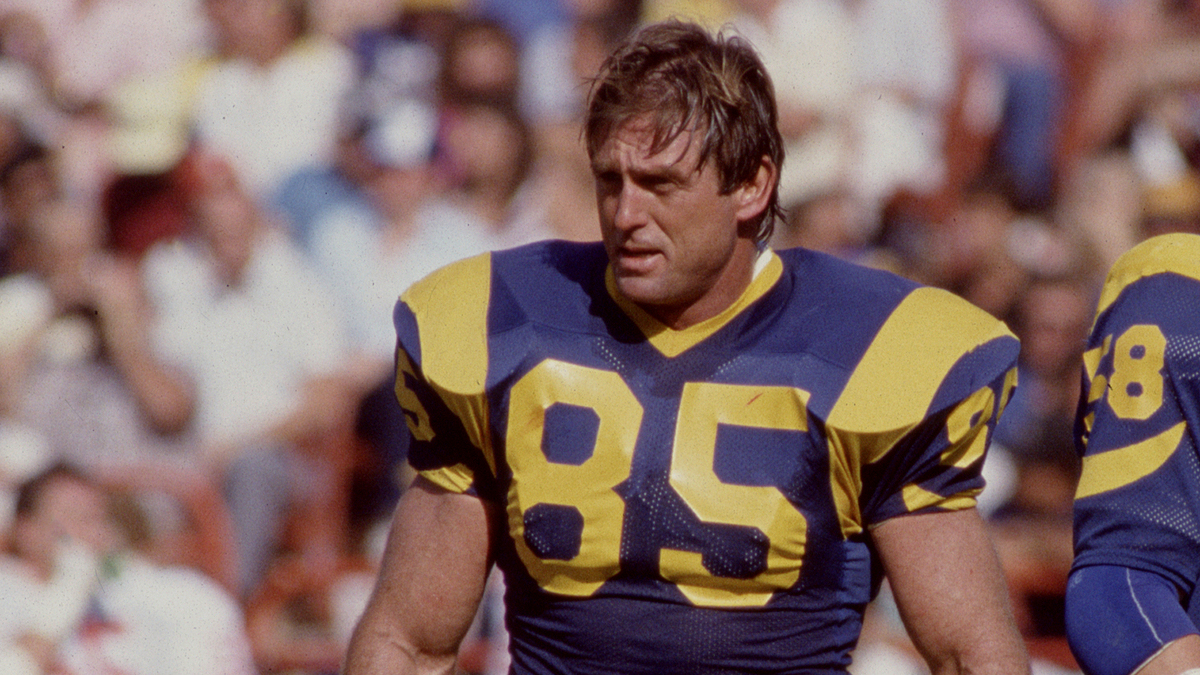
For good measure, Youngblood even surprised everyone by showing up the next week in Hawaii for the Pro Bowl.
And thus, for the next four-plus decades and counting, Youngblood’s toughness has been the stuff of NFL legend.
Deservedly so.
“If a Martian landed in my backyard, knocked on my door and asked me, ‘What’s a football player?’ I’d go get Jack Youngblood,” iconic coach and broadcaster John Madden once said.
But there’s so much more to his career than that.
Path To the Hall of Fame For Jack Youngblood
A first-round draft pick of the Rams in 1971 out of Florida, Youngblood was one of the most prolific pass rushers of his era and a catalyst for one of the best defensive lines in football at the time.
Although sacks didn’t become an official NFL statistic until 1982, near the end of his career, Youngblood unofficially totaled 151.5 of them over his 14-year career from 1971-84.
That ranks sixth all-time — unofficially.
He ripped off a string of elite seasons over a long, sustained prime, including a four-year run with 16.5, 15, 15 and 14.5 sacks back when the NFL still played a 14-game schedule. He later had a career-high 18 sacks in that fabled 1979 season. In all, he had eight seasons with double-digit sacks and 10 with at least 9.5 sacks.
Youngblood played in seven straight Pro Bowls and earned five first-team All-Pro honors (with one second-team honor). Back then, in addition to the Associated Press’ NFL Defensive Player of the Year award, United Press International named defensive players of the year for both conferences, selecting Youngblood as the NFC honoree in 1975.
Meanwhile, his toughness wasn’t just isolated to that Super Bowl run in 1979 — he played in 201 consecutive games, missing only one game his entire career (late in his final season).
How Jack Youngblood Became An NFL Legend
As for that 1979 postseason for which he’ll forever be best known …
The Rams had lost in the NFC championship game in four of the previous five years, and despite a 9-7 finish after a mid-season quarterback change with young Vince Ferragamo replacing injured starter Pat Haden, they won their seventh straight division title — an NFL-record at the time.
And Youngblood wasn’t about to miss what would prove to be his last best chance at chasing an elusive Super Bowl ring.
In the first half of the divisional round against the reigning NFC champion Cowboys, Youngblood had an offensive lineman land his left foot as his leg twisted awkwardly. The Rams team doctor Clarence Shields evaluated him and delivered the bad news — a broken fibula.
“He said, ‘Jack, you’ve got a broken leg,'” Youngblood recalled in an interview with CBS Sports a few years back. “I said, ‘Tape it up, Clarence. … I can still run, tape this dadgum thing up.’ He said, ‘Jack, I don’t know how to tape. My orthopedic doctor doesn’t know how to tape.’ I mess with him all the time. … We still laugh about it.”
‘Tape It Up’
Youngblood helped seal a 21-19 win with a sack late in that game on quarterback Roger Staubach.
“When I was walking around in the huddle, going back to the line of scrimmage and then lining up, it was painful. When the ball was snapped, the pain went away. I wasn’t 100%, I was probably 90 at best, but I knew that I wanted to get after Roger Staubach,” Youngblood said in that interview.
Thus, the legend was born — or it would become one eventually. The Rams managed to keep the severity of Youngblood’s injury mostly under wraps until after the Super Bowl.
With the defense leading the way in a 9-0 win over the Buccaneers in the NFC championship game, the Rams earned their first Super Bowl appearance and a shot at the most dominant team of the decade. Ultimately, the Steelers would win their fourth Super Bowl title, beating the Rams 31-19, but Youngblood’s legacy was set.
Again, though, the totality of Youngblood’s Hall of Fame career is why he’s the choice here as the greatest No 85 in NFL history over a pair of exceptional runner-up candidates.
Other All-Time Great No. 85s
Chad Johnson, ol’ “Ocho Cinco” himself, would have been such a fitting pick, and he indeed merited strong consideration.
Johnson compiled 766 career receptions for 11,059 yards and 67 touchdowns over 10 seasons with the Cincinnati Bengals and one with the New England Patriots from 2001-11. That included an NFL-leading 1,369 yards in 2006 — one of five seasons in which he had at least 1,250 yards (with a high of 1,440).
He was named to six Pro Bowls along and received two first-team All-Pro nods (plus one second-team honor).
But Johnson may well never reach the Hall of Fame when similar talents with even better stats like Reggie Wayne (14,345 career yards), Torry Holt (13,382) and others having been passed over for several years now. Johnson also played in just two playoff games with the Bengals, both losses, before playing a bit role for the 2011 Patriots team that lost Super Bowl XLVI.
The Case For Antonio Gates
Then there is Hall of Fame Chargers tight end Antonio Gates — a legendary story in his own right.
A college basketball player at Kent State, he got his chance in the NFL as an undrafted free agent in 2003 due to his combination of size (6-foot-4, 255 pounds) and agility and the new tight end archetype that Tony Gonzalez had created for the position.
Gates went from an unknown to one of the greatest tight ends in NFL history, catching 955 passes for 11,841 yards and 116 touchdowns over 16 seasons for the Chargers from 2003-18. That TD total ranks 8th all-time and tops among tight ends. He made eight Pro Bowls and earned three first-team All-Pro honors (and two second-team honors).
Gates absolutely deserved strong consideration here, but ultimately his true all-around peak was shorter than perhaps remembered. He had two 1,000-yard seasons (compared to seven for Travis Kelce and four each for Gonzalez and Jason Witten, among other all-time great tight ends) and topped 800 yards only twice in his final nine seasons as he lost a step and relied more on his size and strength.
Hall of Fame Dolphins linebacker Nick Buoniconti (1962-76) also donned the 85 in his storied career.
In the end, Youngblood’s sustained elite peak, his postseason success (8.5 sacks in 17 career playoff games) as a fixture on one of the great defensive lines of the 1970s and, sure, a little bit of legend all gave him the narrow edge as the greatest No. 85 in NFL history.
Greatest NFL Players By Number
99 | 98 | 97 | 96 | 95 | 94 | 93 | 92 | 91 | 90 | 89 | 88 | 87 | 86