From 99-0, TeamFB7 is looking back on the greatest players in NFL history to don each jersey number. No ties allowed, tough decisions will be made — next is No. 90 and Julius Peppers.
Unlike some other all-time greats already featured in this series — like John Randle and Kevin Greene, to name a couple — there is no exceptional adversity or humbling obstacle that shaped Julius Peppers’ path to the Hall of Fame.
Quite the opposite.
He was nationally recognized as an elite athlete in high school, exceptional in college at North Carolina, expected to be great in the NFL when the Carolina Panthers drafted him with the No. 2 overall pick in 2002, and over a remarkably healthy and consistent 17-year career Peppers was exactly that.
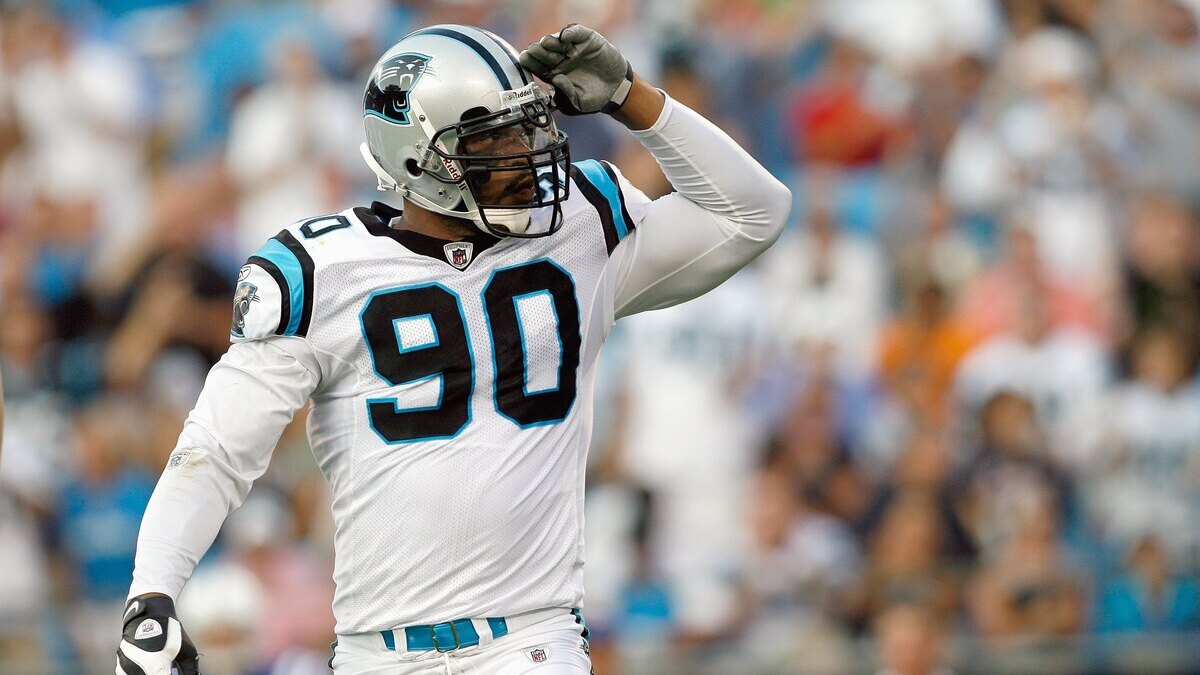
In fact, it seemed such greatness was expected from him all along as he was named Julius Frazier Peppers after basketball legends Julius Erving and Walt Frazier.
While Peppers was a talented basketball player — all-conference four straight years at Southern Nash High School in North Carolina and good enough to play for the Tar Heels’ basketball team as a walk-on, notably scoring 21 points with 10 rebounds in a second-round NCAA tournament game vs. Penn State in 2001 — he was an elite football talent.
The Path From High School Star To Elite NFL Pass Rusher For Julius Peppers
As a redshirt sophomore at North Carolina in 2000, Peppers led college football with 15 sacks and a school-record 24 tackles for loss while scoring touchdowns on both a fumble return and interception return.
The next year, he had 63 tackles, 9.5 sacks, 19 tackles for loss and 3 interceptions (including another TD return), earning unanimous first-team All-American honors, the Chuck Bednarik Award as college football’s top defensive player, the Lombardi Award as best lineman and the Bill Willis Trophy as best defensive lineman nationally.
The expectations on Peppers only kept mounting, especially when the hometown Panthers took him No. 2 overall in the 2002 NFL Draft — and he continued to meet or exceed them.
As an NFL rookie, the 6-foot-7, 295-pound Peppers was an immediate force. He had 3 sacks and a forced fumble in his second game and went on to tally 12 sacks in just 12 games with 5 forced fumbles, an interception and 6 pass deflections — showcasing the broad skill set he brought to the position.
Peppers was suspended the final four games of that season for testing positive for a banned dietary supplement, but he nonetheless was voted NFL Defensive Rookie of the Year by a wide margin.
Over the next 16 seasons for the Panthers, Chicago Bears, Green Bay Packers and Panthers again, Peppers would play in 254 out of a possible 256 games, make 9 Pro Bowls, earn 3 first-team and 3 second-team All-Pro Honors and twice finish fourth in NFL Defensive Player of the Year voting.
He was named to both the 2000s and 2010s NFL All-Decade Teams, as chosen by the Pro Football Hall of Fame selection committee.
Peppers had 10 seasons with double-digit sacks and finished with 159.5 for his career. Since sacks became an official NFL stat in 1982, that ranks fourth behind Bruce Smith (200), Reggie White (198) and Kevin Greene (160).
But again, Peppers’ impact was well-rounded.
An NFL Hall of Fame Career
He nabbed 11 career interceptions, including 9 while playing defensive end (and 2 as an outside linebacker). Different sources have different rankings for such things due to such positional classification, but per StatMuse.com Peppers ranks third in NFL history in interceptions among defensive linemen behind Ron McDole (12 from 1961-78) and Bill Forester (10 as an interior defensive lineman in the 1950s before moving to linebacker and finishing with 21 total).
Peppers also had 82 pass deflections (with 14 coming when he was technically labeled an outside linebacker late in his career with the Packers). Per StatMuse.com, since that became a tracked NFL stat in 1999, his 68 PDs at defensive end rank fourth with the top mark set at 73 by longtime Vikings defensive tackle Kevin Williams.
Peppers’ 51 forced fumbles rank second all-time (since it became a tracked NFL stat in 1978), just behind former Colts standout Kevin Mathis’ 52.
And he scored six defensive touchdowns.
Add it all up and Peppers was a first-ballot Hall of Famer in 2024 — and a clear choice for our purposes as the greatest No. 90 in NFL history.
(Peppers switched to 56 for his three seasons with the Packers late in his career before returning to 90 in his return to the Panthers for two final years).
For now, at least.
Current Pittsburgh Steelers star edge rusher T.J. Watt may be able to usurp Peppers in time as the most accomplished No. 90. Watt has 115 sacks and counting in nine seasons, was the 2021 NFL Defensive Player of the Year, has five top-4 DPOY finishes overall and has earned 8 Pro Bowl invites, 4 first-team All-Pro honors and 1 second-team All-Pro.