From 99-0, TeamFB7 is looking back on the greatest players in NFL history to don each jersey number. No ties allowed, tough decisions will be made — next is No. 91 and Kevin Greene.
There are plenty of humble Hall of Fame origin stories — like legendary defensive tackle John Randle going from undrafted and cut by two teams to earning his place in Canton and a spot on our list as the greatest No. 93 in NFL history.
But Kevin Greene’s is an all-timer.
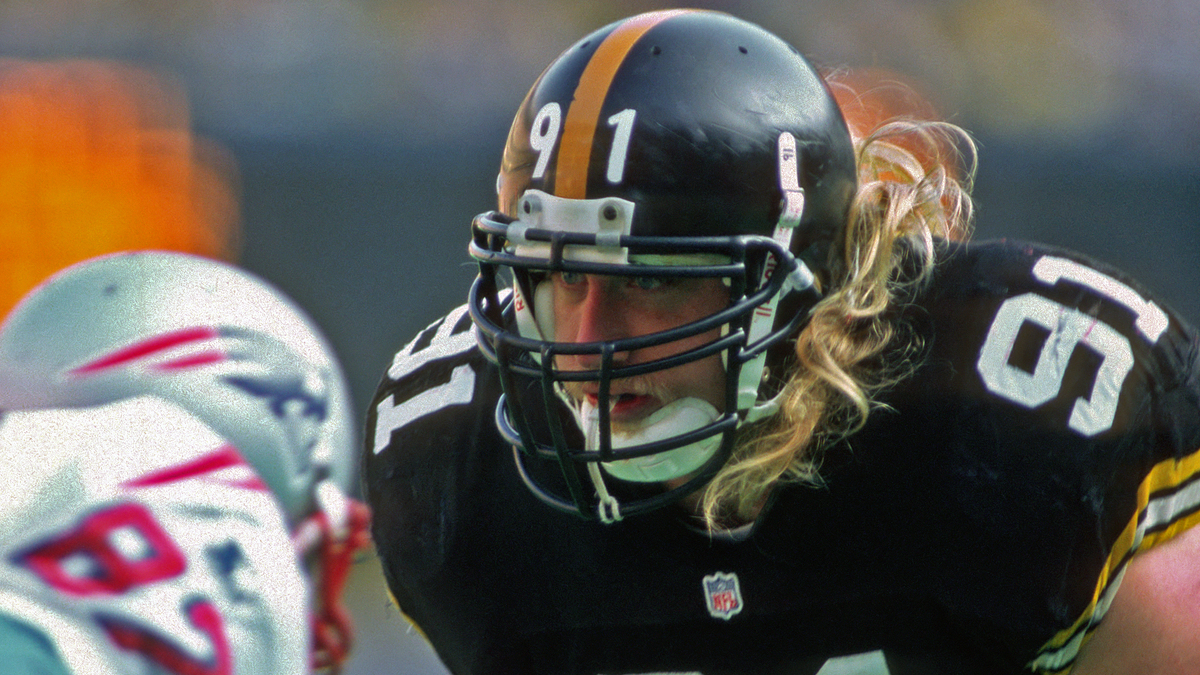
Before Greene became one of the most fearsome pass rushers in NFL history, he was a walk-on punter at Auburn. Actually, that’s even overstating it.
After joining Auburn as a walk-on in 1980, the coaches quickly determined Greene didn’t actually serve much use as a punter and moved him to scout team running back. By September, he’d had enough of that and left the team. It wasn’t until three years later that he tried walking on with the program again, this time as a defensive end.
Greene played special teams that 1983 season before earning a role on defense as a fifth-year senior in 1984. He didn’t become a starter until the final four games, yet still managed to rack up 11 sacks, which unofficially led the SEC (as sacks weren’t an official stat for the league back then). He won the Zeke Smith Award as Auburn’s defensive player of the year and was selected by the Los Angeles Rams in the fifth round of the 1985 NFL Draft.
Fifteen years later, Greene had etched his name in the record books with 160 career sacks — the third-most ever behind Bruce Smith and Reggie White since sacks became an official NFL stat in 1982. Even accounting for the great pass rushers of earlier eras, Greene would still rank fourth with only Deacon Jones’ unofficial 173.5 sacks moving ahead of him.
He made five Pro Bowls, earned two first-team and one second-team All-Pro honors and finished second in NFL Defensive Player of the Year voting in 1996.
That’s a heck of a career considering it almost never happened.
Humble Beginnings For Kevin Greene Before The NFL
Greene recounted the story of his inauspicious start at Auburn in an appearance on The Jim Rome Show in 2016 when he was elected to the Pro Football Hall of Fame.
“I was just another piece of meat,” Greene said, as quoted by Al.com. “I got a couple of reps here and there, and I was getting crushed. I was a running back on the meat squad, and after about two weeks, I said, ‘Man, enough of this.’ So I basically walked off, and that was September or so of 1980, and then I just started going to school at Auburn and knocking out my courses, going through ROTC … and working out in the weight room.
“And three years later in 1983, I said, ‘What the heck, I’m going to walk back on to the Auburn Tigers.’ Because I didn’t want to wake up and be 30, 35 years old and have that regret of the unknown in my life of: ‘I should have walked back on. I think I could have done that. I could have played for the Auburn Tigers, but I didn’t have the nuts to do it.’ And I didn’t want to wake up at 30 years old and feel that regret. So I ended up walking on. And it was, obviously, just the best decision I ever made.”
Just as at Auburn, Greene wasn’t an immediate success in the NFL either. He totaled just 15 tackles and 0 sacks in 15 games as a rookie before notching his first NFL sack in a playoff game that season.
Per the Los Angeles Daily News, Greene pestered Rams coach John Robinson throughout that season about what he needed to do to get more opportunity.
“At the time, he threatened to send my butt back to Alabama,” Greene recalled. “I just kept knocking on the door.”
Greene’s persistence paid off once again as he had 13.5 sacks over the next two seasons despite still not starting a single game. The problem was he struggled with the pass coverage responsibilities at outside linebacker but also wasn’t considered strong enough to play full-time as a 3-4 defensive end.
Eventually, Robinson and Rams defensive coordinator Fritz Shurmur realized they had to find a way to better take advantage of the thing Greene did so undeniably well. They adjusted the scheme to free him from coverage responsibilities and unleashed him as full-time edge rusher.
Greene flourished, finishing second in the league with 16.5 sacks in 1988. He matched that total the next year and then had 13 sacks in 1990, and those 46 sacks were the most of any player in that three-year stretch.
Then the Rams changed defensive coordinators and switched from a 3-4 defense to a 4-3 defense. Greene was jostled between outside linebacker and defensive end and managed only 3 sacks. After a 3-13 season, the Rams fired the coaching staff (including DC Jeff Fisher), but the team stuck with a 4-3 defense and Greene lamented that his pass rushing opportunities were limited mostly to third downs even as his production improved with 10 sacks in 1992.
The Move To Pittsburgh
A free agent after that season, Greene sought out a better fit in a 3-4 defense and signed with the Steelers.
In three seasons in Pittsburgh, followed by a big year with the Carolina Panthers, a season with the San Francisco 49ers and three more back with the Panthers, Greene remained productive until the end of his 15-year career.
He twice led the league in sacks with 14 in 1994 with Pittsburgh and 14.5 in 1996 with Carolina, managed 15 sacks at age 36 and 12 in his final season as he turned 37.
Overall, Greene was a model of consistency. In his final 12 seasons, he had double-digit sacks in 10 of them (and 9 another year) and missed only four games in that time.
He has the most career sacks by any player who primarily played linebacker/outside linebacker.
And yet, it took 12 years on the Hall of Fame ballot before Greene finally made it into Canton in 2016.
Sadly, he died four years later of a heart attack at age 58.
Greene’s legacy endures, though, as one of the great pass rushers in NFL history and one of the great stories of persistence and perseverance in sports lore overall.
Honorable mentions for all-time great No. 91s include former Eagles defensive tackle Fletcher Cox (6 Pro Bowls, 1 first-team All-Pro honor, 3 second-team All-Pro honors, 70 sacks in 12 seasons) and former edge rusher Leslie O’Neal (6 Pro Bowls, 1 second-team All-Pro honor, 132.5 sacks in 13 seasons for the Chargers, Rams and Chiefs).