At least in the context of preseason betting odds, Seahawks-Patriots might be the most unlikely Super Bowl matchup of all-time.
Per BetMGM, the Patriots opened the season with 80-1 odds to win the Super Bowl after coming off back-to-back 4-13 finishes, while the Seahawks had 60-1 odds — last among all NFC West teams, even the Arizona Cardinals (50-1).
That part is a little hard to reconcile, given that the Seahawks won 10 games last year with a well-regarded young head coach and … aren’t the Cardinals. But we digress.
Covers.com, which tracks such things through its Sports Odds History database, shows that this is the first Super Bowl matchup featuring teams that each had preseason odds that low to win it all (at least dating back to 1977, which is the earliest that such data is available).
The next-closest on the preseason improbability scale would be Super Bowl XVI to decide the champion for the 1981 NFL season, as the San Francisco 49ers beat the Cincinnati Bengals 26-21.
The 49ers had 50-1 preseason odds to win the Super Bowl and the Bengals 60-1. We’ll dive deeper into that Niners team in a moment.
Furthermore, though, as it relates to the Patriots and Seahawks, it wasn’t just Vegas oddsmakers who expected little from these teams.
Per Yahoo Sports, New England drew just 1.3% of all preseason Super Bowl championship bets at BetMGM while Seattle drew 0.9%.
So whichever team wins it all Sunday will move into second on the list of most unexpected NFL preseason underdogs to go all the way.
With that in mind, let’s take a look at the other most surprising Super Bowl champs who were perceived as steep underdogs entering the season.
1999 St. Louis Rams (150-1)
We know the 1999 Rams now as “The Greatest Show On Turf” and quarterback Kurt Warner as one of the most incredible individual underdog stories in American sports lore.
But at the time, nobody was thinking Super Bowl championship for that team.
The Rams had posted nine straight losing seasons, including 5-11 and 4-12 in coach Dick Vermeil’s first two seasons, and the franchise had only ever been to one Super Bowl — 20 years earlier.
To make that Rams team less inspiring in the moment, starting quarterback Trent Green was lost to a season-ending knee injury in the preseason, thrusting his little-known and thoroughly-untested backup into the spotlight.
Warner had gone undrafted out of Northern Iowa in 1994, been cut in training camp by the Packers that summer, took a job stocking shelves at a grocery store in Iowa, spent 1995-97 playing for the Arena Football League’s Iowa Barnstormers before signing with the Rams in 1998. He appeared in just one game that season, completing 4 of 11 passes for 39 yards.
Suddenly he was the starting QB for a franchise that had won just four games the previous season and last posted a winning record a full decade earlier.
It’s easy to see why the Rams weren’t given much chance to win it all.
But Warner had other plans. He threw for 3 touchdowns in his first three NFL starts — the first QB to ever do that — and then threw 5 TDs the next week in a 42-40 win over the 49ers, who had won 17 of the previous 18 meetings between the teams.
By the end of the regular season, Warner had thrown for a franchise-record 4,353 yards and a league-leading 41 TDs with 13 INTs while also leading the NFL in completion percentage (65.1%), powering the Rams to a 13-3 record (the most wins in team history) and league-league 32.9 points per game on their way to Super Bowl XXXIV vs. the Tennessee Titans.
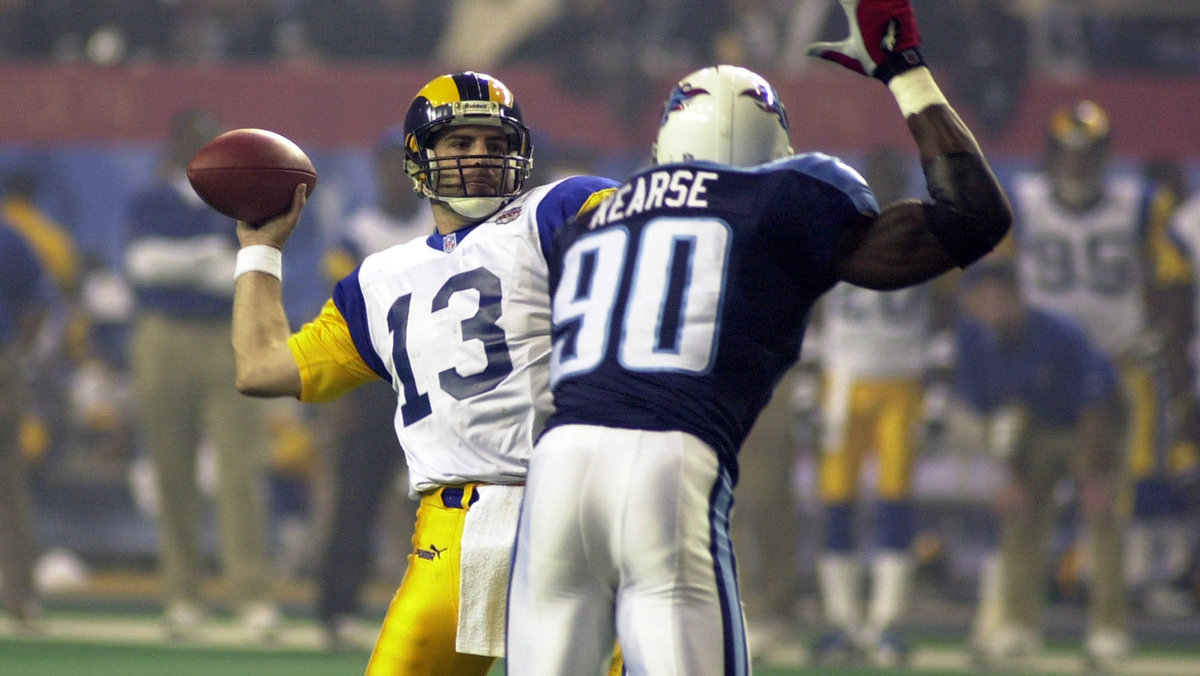
After winning the first of his two career MVP awards, Warner added Super Bowl MVP honors as well, passing for 414 yards, 2 TDs and 0 INTs in the Rams’ 23-16 win over the Titans.
Of course, it wasn’t a one-man show. Far from it. Vermeil is now in the Pro Football Hall of Fame along with Warner, RB Marshall Faulk (2,429 combined rushing/receiving yards that season and 12 TDs) and WR Isaac Bruce (77 catches for 1,165 yards and 12 TDs) while fellow WR Torry Holt (52-788-6 as a rookie) has been a HOF finalist the last seven years. The Rams’ defense was also a major factor, ranking fourth in the league in points allowed (15.1 per game).
2001 New England Patriots (60-1)
Well, this is a bit kismet, isn’t it? The last time the Patriots were launching a new era with an elite defensive-minded head coach and talented young second-year quarterback, they also reached the Super Bowl as long shots.
New England had gone 5-11 in coach Bill Belichick’s first season, while much like Warner, Tom Brady was a little-known backup who was drafted in the sixth round and attempted just 3 passes his first season.
When starter Drew Bledsoe sustained internal bleeding on a punishing hit in Week 2, Brady took over the offense and never let go of the reins.
The Patriots were 5-5 after a mid-November loss to Warner’s Rams before winning their final six games.
They started the playoffs with the famous tuck-rule 16-13 overtime win in the snow vs. the Raiders, with newly minted Hall of Famer Adam Vinatieri making a 45-yard field goal in the snow to force OT and then a 23-yarder to win it.
A 24-17 road win over the top-seeded Steelers in the AFC championship game set the Patriots up with a matchup against those Warner-led Rams in Super Bowl in Super Bowl XXXVI.
Vinatieri struck again with a 48-yard game-winning field goal as time expired, marking the first time in Super Bowl history the winning score had ever come on the final play of the game.
Brady threw for just 145 yards and a TD, but he led that game-winning drive and took home the first of his record five Super Bowl MVPs as the Patriots won the first of six Super Bowl titles of the Brady/Belichick dynasty.
Not only were the Patriots historic preseason underdogs, but they were 14-point underdogs entering the game, marking the biggest upset in the Big Game since Joe Namath’s Jets beat the Colts in Super Bowl III.
1981 San Francisco 49ers (50-1)
The 49ers weren’t yet the 49ers as we now know them back when the 1981 season started.
To that point, they’d yet to reach a Super Bowl and were coming off four straight losing seasons and eight straight seasons missing the playoffs. Bill Walsh and his innovative offense hadn’t yet found much success as he went 2-14 and 6-10 in his first two seasons as head coach.
And Joe Montana wasn’t yet Joe Montana yet, as we know him.
A third-round draft pick in 1979, Montana backed up Steve DeBerg for a season and a half before taking the starting job midway through the 1980 season. He entered 1981 as the unquestioned starter and was about to fully launch what would be one of the most legendary careers for any quarterback.
But nobody knew that in the moment, and so the 49ers were given 50-to-1 odds to win the Super Bowl.
San Francisco had also drafted safety Ronnie Lott out of USC with the No. 8 overall pick that offseason, as the pieces were starting to fall into place for the dynasty-like run that was brewing.
When the 49ers started 1-2 and got blown out by the Falcons in Week 3 with Montana tossing 2 interceptions, there certainly still wasn’t any Super Bowl buzz for this San Fran squad.
Then the Niners reeled off seven straight wins, lost a close 15-12 game to the Browns and then won the final five games to finish 13-3.
Ronnie Lott’s Impact for the 49ers
Lott, the first-round draft pick, was an instant tone-setter on defense with 7 interceptions, 3 returned for touchdowns, 5 forced fumbles and 89 tackles as a rookie. Fellow safety Dwight Hicks notched 9 picks, and defensive end Fred Dean had 12 sacks in 11 games for San Francisco after coming over in a trade from the Chargers. The additions of Lott and Dean, in particular, helped the 49ers rank second in the league in scoring defense at 15.6 PPG.
Lott finished sixth in the MVP voting while Montana was second.
Montana Made His Name In The Playoffs
The QB was solid, leading the league in completion percentage (63.7%) while throwing for 3,565 yards, 19 TDs and 12 INTs, but his clutch poise in the postseason is really what would come to define his legacy, starting with that 1981 season.
San Francisco opened the playoffs with a 38-24 win at home over the Giants, with Montana throwing for 304 yards (a career-high to that point), 2 TDs and an INT.
He’d toss 3 interceptions in the NFC championship game against the Cowboys, but when it mattered most Montana delivered.
Dallas had gone up 27-21 early in the fourth quarter and then intercepted Montana for a third time a few plays later. But the 49ers defense eventually forced a punt, leaving Montana and the Niners 4:54 on the clock while starting at their own 11. Ultimately, they faced a third-and-3 from the Cowboys’ 6 with less than a minute remaining when Montana threw one of the most iconic passes of his career — the go-ahead touchdown in the back of the end zone to a leaping Dwight Clark that would hence forth be known as “The Catch.”
It was an exclamation point on a career-best season for Clark, who set highs with 85 catches for 1,105 yards (and 4 TDs) in the regular season, followed by 104 yards in the playoff win over the Giants and then 8 catches for 120 yards and 2 TDs in that NFC championship game.
“The Catch” gave the 49ers a 28-27 lead and, after Dallas QB Danny White was sacked for a game-sealing fumble, their first trip to the Super Bowl to face another surprise team.
The Cincinnati Bengals had gone 6-10 the previous year and had never won a playoff game before surging all the way to the Big Game with QB Ken Anderson winning the MVP award.
In Super Bowl XVI, San Francisco capitalized on three game-swinging Bengals first-half turnovers — a Hicks INT at the SF 5-yard line, a forced fumble by CB Eric Wright on WR Cris Collinsworth recovered by Lynn Thomas as the SF 8 to again negate a prime scoring opportunity and then a muffed squib kick by Cincinnati RB Archie Griffin recovered by Milt McColl at the Bengals’ 4 in the waning seconds of the half. That set up a Ray Wersching field goal for a 20-0 halftime lead, as Montana had already contributed a passing and rushing touchdown.
The Bengals cut the deficit to 20-14 early in the fourth quarter, but Wersching added his third and fourth field goals of the game on the 49ers’ next two series with a second Anderson interception (by Wright) in between. That made it 26-14, and the Bengals wouldn’t score again until the final minute when it was too late.
Montana was 14 of 22 for 157 yards, 1 TD and 0 INTs plus a rushing TD while notably leading a 92-yard touchdown drive in that big first half. He won the first of his three Super Bowl MVP awards while the 49ers claimed the first of their four Super Bowl titles in the 1980s (with another to follow in 1994).
Just like the Patriots two decades later, the Niners’ dynasty started with little warning or expectation before a sustained run of dominance.
2017 Philadelphia Eagles (40-1)
The 2017 Eagles weren’t totally off the radar entering the season. There were 12 teams with better preseason odds to win the Super Bowl and then a logjam of six all sharing those same 40-1 odds.
But Philadelphia was coming off back-to-back 7-9 seasons entering its second year under coach Doug Pederson, and the franchise had still never won a Super Bowl at that point. So sure, the Eagles were longshots to win it all heading into Week 1.
They’d go on to match the franchise record for wins with a 13-3 finish while second-year QB Carson Wentz was on his way to a likely MVP award (3,296 yards, 33 TDs, 7 INTs) before tearing his ACL in a Week 14 win over the Rams.
That made what was to come even more improbable.
Nick Foles, who had been the Eagles’ starting QB years earlier and returned in 2017 after a year on the bench in Kansas City, would take over and go on one of the most legendary postseason runs ever for a backup QB.
After opening the playoffs with a 15-10 win over the Falcons in which he completed 23 of 30 passes for 246 yards but 0 TDs (or INTs), Foles went 26 of 33 for 352 yards, 3 TDs and 0 INTs in a lopsided 38-7 NFC championship game win over the Vikings.
In Super Bowl LII vs. the Patriots, Foles completed 28 of 43 passes for 373 yards, 3 TDs and 1 INT and caught a TD on the iconic “Philly Special” on a pivotal fourth down late in the first half.
Foles later drove the Eagles 75 yards in 14 plays for the game-winning score — an 11-yard TD pass to tight end Zach Ertz for a 38-33 lead with 2:21 remaining in the fourth quarter.
On the ensuing Patriots possession, Brandon Graham stripped Tom Brady on a sack and Derek Barnett recovered the fumble for the Eagles at the New England 31. Jake Elliott kicked a 46-yard field goal with 1:05 remaining, and the Patriots final drive ended on a failed Hail Mary pass as the Eagles won their first Super Bowl title.