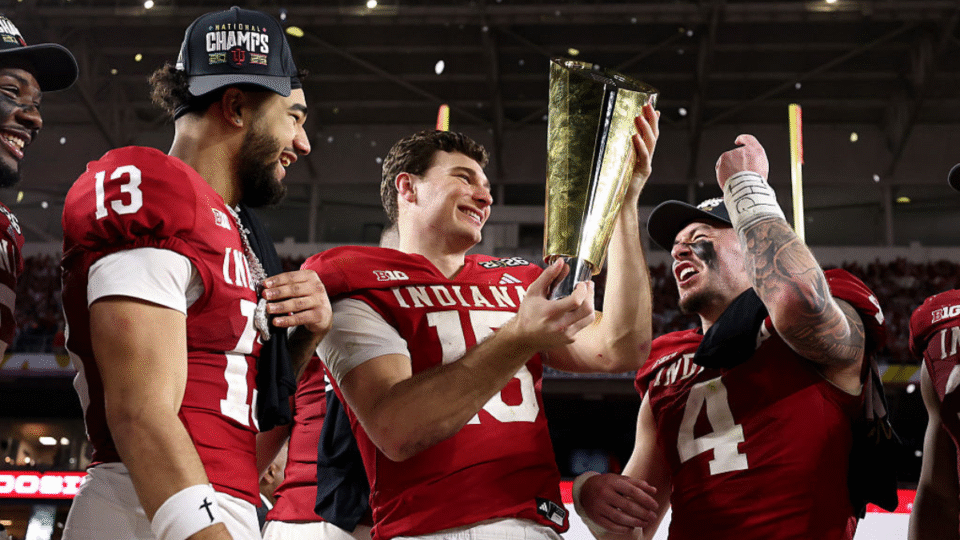
Curt Cignetti, Fernando Mendoza and the Indiana Hoosiers improbably reached college football immortality Monday night, defeating the Miami Hurricanes in Miami’s home stadium to become the first team to claim a 16-0 record since the 1894 Yale Bulldogs.
Yes, that started with an 18, not a 19.
There’s no question that becoming the first undefeated champion of the expanded playoff era puts them in the pantheon of the greatest teams we’ve ever seen. A more interesting question is just how large that pantheon is.
In modern discourse, it seems like ‘the greatest college football team of all time’ debate has come to favor a handful of post-millennium powerhouses. As such, some of the sport’s defining teams from deeper in the past fall through the cracks. Is that truly a result of recency bias, or did the turn of the century usher in an era of talent consolidation for the sport?
Because of the historic nature of Indiana’s improbable national title, there’s no better time than the start of the college football “offseason” to break down where these Hoosiers rank in history among the greatest teams.
The 10 Greatest Teams
GO TO: No. 1 | No. 2 | No. 3 | No. 4 | No. 5 | No. 6 | No. 7 | No. 8 | No. 9 | No. 10
10. 1945 Army Cadets (9-0, Independent)
You can’t mention the greatest teams in college football history without mentioning the team that was considered the standard for the sport for the better part of half a century. The 1945 Cadets were the definition of dominance, outscoring their opponents 416-49 (!) throughout the course of the season. Army’s offense scored at least 48 points in seven of the team’s nine games and the defense pitched a shutout in four of those nine contests.
Because America was in the midst of World War II at the time, all of the country’s best and brightest athletes were shipped off to West Point to play football with the encouragement of the government, which saw the physical benefits and boost in morale provided by the sport as beneficial toward the country’s war efforts. As a result, the 1945 Cadets boasted a loaded roster that featured Heisman Trophy-winning fullback Doc Blanchard and 1946 Heisman Trophy-winning halfback Glenn Davis, who were known as Mr. Inside (Blanchard) and Mr. Outside (Davis) for their dual-threat rushing attack.
Aside from Blanchard and Davis, the Cadets featured three other College Football Hall of Famers in John Green, Barney Poole, and Arnold Tucker. Not All-Conference. Not All-American. Hall of Fame. In an era where military academies were able to stack all of the country’s top athletic talent, no one put together a group anywhere near as dominant as the one at West Point in 1945.
9. 1999 Florida State Seminoles (12-0, 8-0 ACC)
Despite the fact that there’s actually a pretty good ESPN documentary that chronicles just how dominant the 1999 Florida State football team was, it still seems like those Seminoles are largely forgotten in the modern discourse surrounding the greatest college football team of all time. For those who witnessed it, all you have to do is say the name “Peter Warrick” and the memories come flooding in.
Although injuries shortened Warrick’s career, there are plenty of well-respected people around the sport who will swear he was the best player to ever touch a college football field. Two of those people, Chad Ochocino and Brandon Marshall, were superstar receivers in the NFL themselves.
for a certain generation of fan, Peter Warrick is just that dude. Ocho and Brandon Marshall are former all-pro NFL WRs that get flat out giddy talking about Peter Warrick https://t.co/LbZPNMVp3R
— Chris B. Brown (@smartfootball) February 23, 2021
It wasn’t just Warrick, either. Quarterback Chris Weinke was the perfect point guard for coach Bobby Bowden’s all-star offense, racking up over 3,100 yards and 24 touchdowns through the air.
The Seminoles entered the 1999 campaign ranked No. 1 in the country after falling to Tennessee in the previous season’s national title game, and they didn’t exactly ease into a light schedule. Back-to-back wins over No. 10 Georgia Tech and No. 20 NC State kick-started Florida State’s path toward redemption. A 31-21 win over No. 19 Miami at the halfway point solidified their path, and a 30-23 win over rival No. 3 Florida in a de facto playoff game to close the regular season sent them back to the title game.
Florida State didn’t let the opportunity slip this time. The Seminoles trounced the Michael Vick-led Virginia Tech Hokies in what was the signature game of Warrick’s career. The star receiver caught a 64-yard touchdown pass in the first quarter, topped that with a 59-yard punt return for a touchdown in the second, and then scored again on a 43-yard connection in the fourth that served as the final dagger. To this date, 1999 Florida State is the last team to go wire-to-wire as the No. 1 team in the country.
8. 2004 USC Trojans (11-0, 7-0 Pac 10)
Despite the fact that Pete Carroll’s USC dynasty was quite literally erased from the history books, the truth is that you can’t tell the story of modern college football history without mentioning the Trojans’ run in the 2000s. You certainly can’t mention 2005 Texas, whose crowning achievement was beating them.
After losing to Aaron Rodgers and Cal in September 2003, USC kicked off a run that largely defined the first half of the decade. The Trojans would go on to finish 11-1 in 2003 and claimed a share of the national championship with LSU after the BCS Championship game failed to convince the national voting media, who ranked USC No. 1 in the final AP poll the old-fashioned way.
Still, that snub in 2003 lit a fire under everyone’s backside in South Central Los Angeles in 2004. And boy, did they show it. Led by Matt Leinart, the ‘04 Heisman Trophy winner, USC started the season with a 24-13 neutral-site victory against Virginia Tech (who would finish No. 10 in the AP Poll) in Landover, Md., that was essentially a Hokies’ home game.
A quick scare against a pre-Harbaugh Stanford team in September raised some questions, but they were quickly answered with a 23-17 revenge victory over No. 7 Cal and a 45-7 blowout of No. 15 Arizona State in the first two weeks of October. From that point, it was smooth sailing for the Trojans, who would go on to trounce Jason White and Oklahoma 55-17 in the Sooners’ second consecutive national title game loss.
🎥 #ChampionshipMoments 2004
USC 55 | OKLAHOMA 19The muffed punt started the quick collapse for OU — led to a 55-3 USC scoring run.
Game featured 3 eventual Heisman winners (first time since 1946) pic.twitter.com/QAKdf2ugHk
— Pick Six Previews (@PickSixPreviews) January 8, 2024
7. 2005 Texas Longhorns (13-0, 8-0 Big 12)
If you asked most respectable college football pundits who are still around to tell the story, the majority would probably tell you in some way or another that Texas’ triumph over USC in the 2006 Rose Bowl is the greatest college football game ever played. Vince Young and the Texas Longhorns came into Pasadena and spoiled what was essentially supposed to be a going-away party for the great USC seniors who were on the verge of a 35th consecutive win and one of the greatest dynasties the sport has ever seen.
Because of how memorable that game is (and how shocking the result was), it tends to overshadow how truly dominant Texas was throughout the entire season. The Longhorns proved they had the muscle to contend for the title early on with a 25-22 road win over No. 4 Ohio State, then they proceeded to score at least 40 points in every game for the remainder of the season. In Big 12 play, Texas won by an average of 37 points per game and took home the conference championship with an infamous 70-3 beatdown of Colorado. At the time, the Longhorns’ 652 points in 2005 were the Division I single-season record.
While Vince Young eventually would turn down the 2005 Heisman after it was vacated from USC’s Reggie Bush, one could argue he was the one who truly deserved it in the first place. The junior quarterback was infallible, becoming the first player in Division I football history to compile over 3,000 yards passing and 1,000 yards rushing in a single season.
As a team, Texas ran for 3,574 yards and 55 touchdowns in 2005 thanks to Young and a running back corps headlined by future Kansas City Chiefs star Jamaal Charles. The defense featured the Jim Thorpe award winner, Michael Huff, as well as another first-team All-American in defensive end Rodrique White.
Plus, like Indiana, the sentimentality behind the Longhorns’ triumph that season mattered. It was a quintessential sports moment in a decade where Americans so desperately needed one following the devastation of Hurricane Katrina. It felt like one of the last non-Super Bowl sporting events the entire country had its eyes on, and Young prancing into the end zone for the win will always be looked back upon as one of the sport’s classic moments — in large part because of that.
6. 1972 USC Trojans (12-0, 7-0 Pac 8)
Like the dominant ‘71 Nebraska team the previous season, USC wasn’t the No. 1 team in the preseason AP poll. In fact, it wasn’t even in the top five, coming in at eighth. However, it didn’t take long for the voters to course correct, and it was the only thing they could do.
In an era where the South’s grip on the sport was as firm as ever, Sam “Bam” Cunningham and company traveled down to Arkansas and handled business against the No. 4 Razorbacks, 31-10. The win immediately earned the ‘71 Trojans their worthy respect in the rankings, as they shot to No. 1 in the AP poll and remained there for the rest of the season.
The 1972 national champion USC Trojans were as perfect as this Neil Leifer photo in @SInow.
The USC huddle features 6 All-Americans, including Lynn Swann, Charles Young, Sam "Bam" Cunningham and Anthony Davis.#FightOn | #TBT pic.twitter.com/NQyylaQT6j
— USC Trojans (@USC_Athletics) August 23, 2018
And not only did they remain atop the poll, they did so in about as decisive of a fashion as you could imagine. The Trojans scored 50+ points to topple each of their next three opponents, before playing their closest contest of the season in a 30-21 win over No. 15 Stanford in Palo Alto. In that win over the Cardinal, Cunningham trucked Stanford’s All-American defensive end Roger Stillwell, setting the tone for the rest of USC’s run to the national title that season.
Longtime USC coach John McKay then led the team down a gauntlet to close the season, and his team proved to be every bit worth its salt. Decisive wins over No. 18 Washington along with ranked rivals No. 14 UCLA and No. 10 Notre Dame sent the Trojans to the Rose Bowl for the de facto national title game against Ohio State, where they slammed the door shut on Woody Hayes and the Buckeyes in a dominant 42-17 showcase that served as the first chapter in one of the 70’s great rivalries.
5. 2019 LSU Tigers (15-0, 8-0 SEC)
For anyone a quarter-century or younger, the 2019 LSU Tigers are the greatest college football team you’ve ever seen by a pretty wide margin (until Indiana, at least). As a result, Joe Burrow and company have somewhat become the recent standard-bearer for what an all-time great college football team is. And you can’t really argue that it’s not for good reason.
Simply put, across all of college football history, you’ll find few offensive seasons prolific as what Burrow and his all-star cast of characters put on tape that year. It wasn’t a slow burn, either. The Tigers’ offense burst out of the gates with reckless abandon, opening the season with a 52-point win over Georgia Southern before parlaying that with a 45-38 win at No. 9 Texas in Week 2 that truly jumpstarted the path to glory.
2019 LSU TIGERS WERE TRULY SPECIAL 🌟
🐯 15-0 SEASON
🐯 BEAT 7 TEAMS IN TOP 10
🐯 WON NATIONAL CHAMPIONSHIP
🐯 HAD 32 TOTAL NFL DRAFT PICKS
🐯 OVER $700M IN NFL CONTRACTS pic.twitter.com/TToY1D9U5N— Bleacher Report (@BleacherReport) August 28, 2025
LSU proved it was the frontrunner to win the program’s third national title with a 46-41 win in an instant early November classic against Tua Tagovailoa and Alabama. The Bayou Bengals would go on to trounce Georgia in the SEC championship before doing the same to both Oklahoma and Clemson in the playoffs, cementing Burrow and the boys as the greatest team of the 2010s.
Like 2001 Miami, it’s also likely the mythos around this LSU team only grows as time goes on and the stars of the team prove to be transcendent NFL talents. Burrow, Ja’Marr Chase, and Justin Jefferson are name brand offensive superstars, while guys like K’Lavon Chaisson, Grant Delpit and Patrick Queen have developed into key pieces on three of the best defenses in the NFL. That Tigers team averaged 568.4 yards per game and 48.4 points per game, and beat opponents ranked in the final AP top 10 by an average of over 23 points per game.
4. 2025 Indiana Hoosiers (16-0, 9-0 Big Ten)
It’s still fresh, but it’s hard to think of many stories in the history of American sports more unbelievable and awe-inspiring than Indiana’s two-year turnaround from perennial national laughing stock to an undefeated national champion under coach Curt Cignetti.
While there were certainly a couple cardiac-inducing moments this season, namely the Penn State game and the final quarter of the national championship, the Hoosiers were for the most part one of the most dominant teams in recent history. They beat their opponents (including No. 3 Oregon on the road and No. 1 Ohio State in the Big Ten title game) by an average of 31.5 points, and that average margin of victory actually increased to 34.5 in the playoffs.
Indiana passing 2019 LSU as the single greatest team ever is now a real thing that needs to start being debated. pic.twitter.com/Nfp2r75idV
— Trevor Knight (@undercoveraggie) January 10, 2026
Unlike 2001 Miami, which had a rather pedestrian offense, and 2019 LSU, which wasn’t superhuman by any means defensively, the 2025 Hoosiers were among the very best teams in the country on both sides of the ball. The Hoosiers ranked second nationally in both offensive and defensive SP+, and their total 32.4 rating is the highest of the College Football Playoff era. In terms of the standard of dominance, 2025 Indiana will be remembered as the team of the 2020s, just like how 2019 LSU was the team of the 2010s, and 2001 Miami was the team of the 2000s.
This poster is going to be on every wall in the state of Indiana for the rest of time.
Fernando Mendoza saved his best for last. What a run. What a season.
HeisMENDOZA. pic.twitter.com/7URCXrL4q3
— Mike Kennedy (@MikeKennedyNFL) January 20, 2026
However, when you’re deciding something as meaningful as the greatest college football team of all time, sometimes it is about the story and how it resonates with people. It matters that Cignetti reversed the fortunes of the most tortured team in American sports history and, as a result, had the entire nation behind them. It matters that Fernando Mendoza became the most charismatic Heisman winner (and national champion) since his mentor Tim Tebow, with all of the defining moments and classic quotes to boot.
As the diehard college football fan in a friend group that mostly has a passing interest, Monday’s national championship brought more intrigue and excitement to the group chat than we’ve had for a sporting event in quite some time. That matters. And it will certainly factor into this team’s place in history and how they’re remembered.
3. 1995 Nebraska Cornhuskers (12-0, 7-0 Big 8)
Plenty of Gen X fans will point to the 1995 Huskers as the best team in college football history, and it’s hard to blame anyone for doing so when you consider the magic feet of Tommie Frazier and company. The ‘95 Huskers, albeit in a weakened Big 8 Conference, averaged a whopping 53.2 (!) points per game and beat their opponents by nearly 40 points per game en route to coach Tom Osborne’s first national title as a head coach and his third as a member of the Huskers’ coaching staff.
Frazier and the Huskers looked historically great from the opening game, beating Oklahoma State 64-21 in the season opener before hanging 77 points on Arizona State two weeks later to move to 3-0. Nebraska would finish the regular season by rattling off nine more decisive victories, winning each game by multiple touchdowns while scoring at least 41 points in all but two of them.
Blowout wins over No. 8 Kansas State, No. 7 Colorado and No. 10 Kansas propelled the Huskers to the No. 1 ranking heading into the national title game against Danny Wuerffel and unbeaten No. 2 Florida at the Fiesta Bowl. It was that fateful night at Tempe’s Sun Devil Stadium where Frazier immortalized himself with one of the great plays in college football history, reaching a level of reverence in the sport that few others have.
🎥 #ChampionshipMoments 1995
NEBRASKA 62 | FLORIDA 24Tommie Frazier runs through the entire Florida defense
Nebraska wins back-to-back national titles, a combined 25-0 runpic.twitter.com/VBPQaYb6JY
— Pick Six Previews (@PickSixPreviews) January 19, 2026
One thing the ‘95 Huskers have in their favor that some of these great teams don’t, however, is that they were just the start of a dominant run to close the 90s that also saw Nebraska win the title in 1997 and lose in the championship game in 2001. The Huskers haven’t been back since, but Indiana’s rapid rise shows anything is possible. And Cignetti should be taking a page from Osborne’s book regarding how to build on an all-time championship season.
2. 2001 Miami Hurricanes (12-0, 7-0 Big East)
When you talk about classic teams that have stood the test of time, few have aged better than the 2001 Miami Hurricanes have in the quarter-century since they took the college football world by storm with a roster so stacked full of All-Pro NFL talent that it’s genuinely hard to fathom in hindsight. One of my favorite descriptions of those 2001 Hurricanes comes from former Miami tight end, Greg Olsen, who was a freshman with “The U” two seasons later.
“Sean Taylor, Antrell Rolle and Kellen Winslow were running down on kickoff,” Olsen told Pardon My Take. “Because they weren’t good enough. Willis McGahee was moved to backup fullback because he was third string tailback, behind Frank Gore and Clinton Portis.”
If you’re counting, every single one of those players named made a Pro Bowl in the NFL. And that’s just the tip of the iceberg. The starting free safety was Ed Reed and the WR1 was Andre Johnson, just two Hall of Famers. Not to mention future Super Bowl champions LT Bryant McKinnie and MLB Jonathan Vilma. And none of those players had quite the impact that Jeremy Shockey had right away in the NFL, as Shockey earned Rookie of the Year and first-team All Pro honors with the Giants in 2002 after one of the great debut seasons in the history of the sport.
It took most of these teams an entire season to prove they belonged in the All-Time tier, but Larry Coker’s Hurricanes proved they were there from the season’s opening kickoff. In the opener, Miami forced Joe Paterno and Penn State to wave the white flag after taking a 30-0 lead into the locker room at halftime. That was parlayed into an eye-popping 61-0 victory over Rutgers the following week, and at that point, the nation’s eyes were turned to Miami.
A 22-point win over No. 13 Florida State in October set the tone for a bloodbath in Big East play. A month later, the Hurricanes beat No. 15 Syracuse 59-0 and No. 11 Washington 65-7 in consecutive weeks before a hard-fought 26-24 win over No. 14 Virginia Tech completed a perfect regular-season and wrapped a trip to the national title game against Nebraska. Spoiler, it wasn’t close.
1. 1971 Nebraska Cornhuskers (13-0, 7-0 Big 8)
While the 1995 Huskers are the squad most commonly brought up in the greatest team of all time discussion, you could make an even better case that the 1971 team has a stronger claim to that title. Nebraska ran through a loaded Big 8 that featured two of the other top 3 teams in the country in Oklahoma and Colorado. The Sooners served as Nebraska’s only true test over the course of the 13-game season, but a 35-31 Huskers victory in a “Game of the Century” set Bob Devaney’s team on a path toward unbeaten immortality for the second straight season.
The 1971 season, Nebraska had two #1 vs #2 match-up.
As a young boy, I thought Johnny Rodgers did this all the time.
Note vs Alabama, a tough punt to handle.
The field was wet from a pregame rain shower.
You can see the ball splash when it hits the turf. pic.twitter.com/fRiz4b0azL— Paul Jake Jacobsen (@HuskerTapes) August 4, 2024
Aside from that classic 4-point win over Oklahoma, Nebraska wasn’t even in the same stratosphere as its other opponents. In its other 12 games, including the 1970 Orange Bowl against Bear Bryant and No. 2 Alabama that served as the national title game, Nebraska won by an average of 33.2 points and didn’t allow more than 17 points. Perhaps craziest of all, the Blackshirts defense held its opponents to an unbelievable 130.5 yards total yards and 44.5 (!) total passing yards per game.
Nebraska claimed the No. 1 ranking in the AP poll after the first week of the season and didn’t relinquish it for the rest of the way. Halfback Johnny Rodgers, who would win the following year’s Heisman Trophy, highlighted a class of six first-team All-Americans that also included Outland Trophy winner Larry Jacobsen. Jacobsen was the leader of an offensive line that still stacks up with the greatest in college football history, helping propel the Rodgers’ led run game to 3,100 total yards on the season (258.3 per game).
When you consider the wire-to-wire dominance, the top tier schedule, and the signature win against Oklahoma, it’s hard to make anyone’s case over these Huskers. You can’t brush aside the target that was on their backs as defending champions after their triumph in 1970, either. In the modern college football landscape, the dominance required to supplant them as the greatest team may not even be possible.