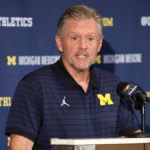
They really did it. The Indiana Hoosiers completed the greatest story and most improbable national championship season in college football history.
No, that’s not hyperbole. Not in the least bit.
It’s a lot of things, but not that.
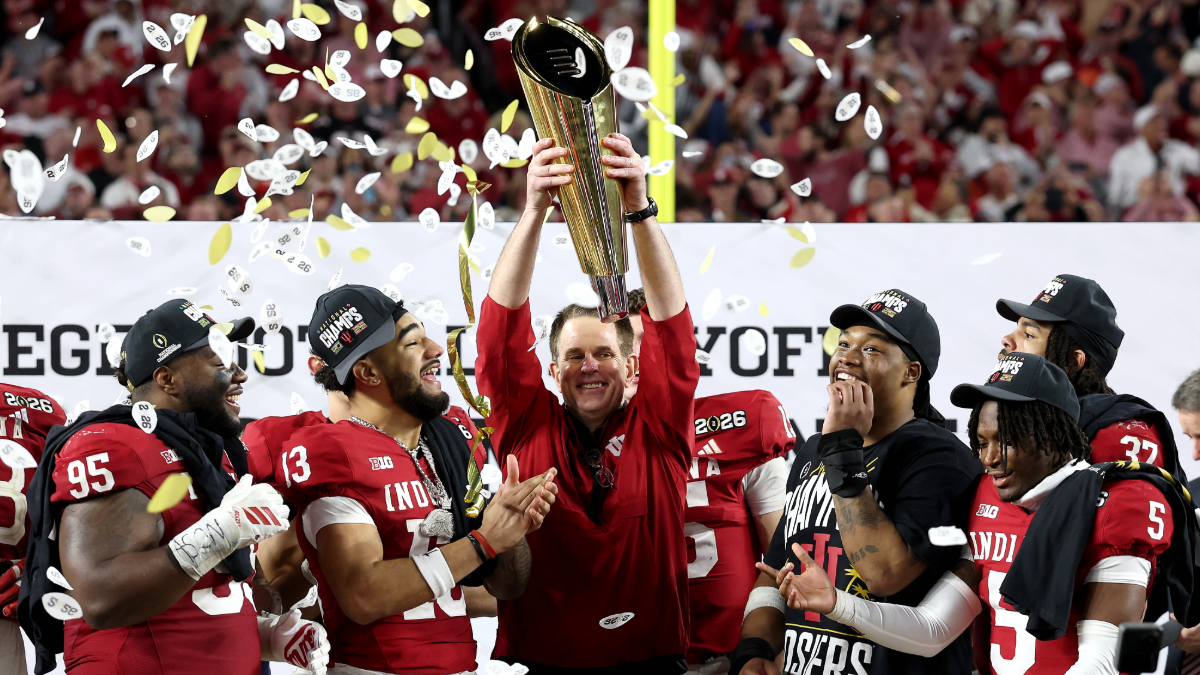
The program that had more losses than any in college football history until this fall now has one of the most dominant, impressive and significant championship seasons the sport has ever witnessed.
Indiana went 16-0 with an average margin of victory of 29.9 points per game, won half of its regular-season games by 45 points or more, beat undefeated reigning national champion Ohio State for its first Big Ten championship since 1967, beat Alabama by 35 points and Oregon by 34 in the playoffs and then finished it off with a 27-21 win over Miami — in the Hurricanes’ home stadium, no less — while never trailing in the national championship game Monday night.
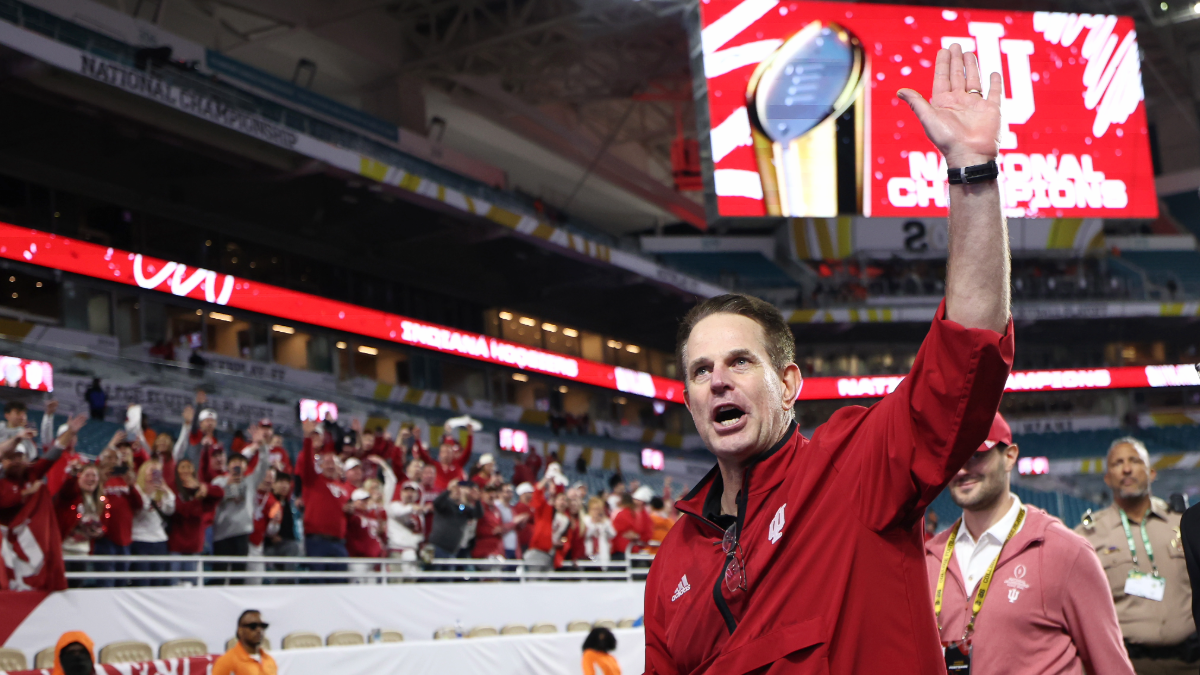
“Let me tell you, we won the national championship at Indiana University. It CAN be done,” coach Curt Cignetti said on the field afterward as confetti fell around him. “I’m so happy for our fans. Words can’t describe it.”
Maybe not, but we have to try.
The Hoosiers left no doubt as to who was the best team in college football this season.
They also left no debate that this is the greatest underdog triumph in the history of college football — and probably American sports in general — even if by the end they were no underdogs at all.
The same Indiana that had just three bowl victories in its entire history before reeling off three postseason wins in 19 days (four if including the Big Ten title game last month), that had just three winning seasons in the previous 29 years before Cignetti took over, that had gone 3-24 in the Big Ten over the three seasons prior to his arrival — that Indiana — went 27-2 the last two seasons and sits perched atop the sport now.
The same coach who was a 49-year-old assistant working with the wide receivers at Alabama when he chose to bet on himself and take his first head coaching job at Division II IUP in 2011 and didn’t get his shot to lead a Power Four program until he was 62 now might be the best in college football. Wherever he ranks, he’s already an all-time legend.
“Back when I was waxing the staff table at IUP Thanksgiving weekend and the school was shut down … did I ever think something like this was possible? Probably not,” Cignetti said. “But if you keep your nose down in life and keep working, anything is possible.”
The same quarterback who was rated a two-star recruit and received only one Power Four scholarship offer coming out of high school, a late one from Cal, while being denied even a walk-on spot by the hometown school Miami, capped a Heisman Trophy season by beating those very Hurricanes in their home stadium to win the national championship just down the road from where he grew up.
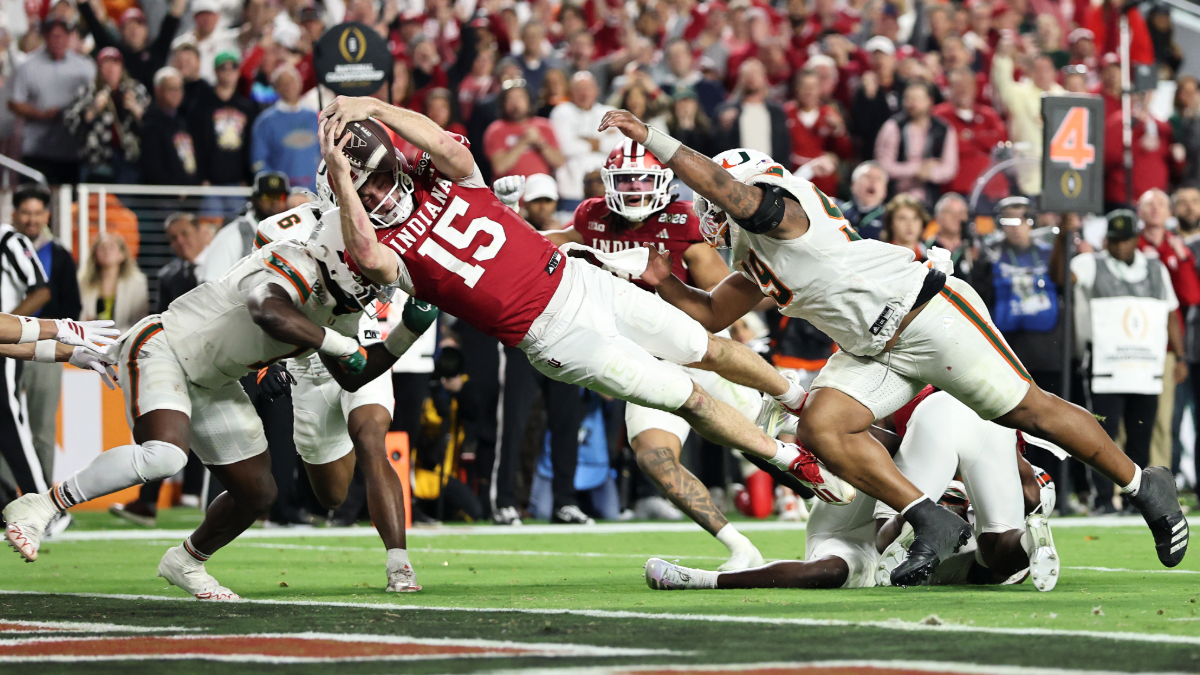
If that wasn’t enough, Fernando Mendoza did it while delivering what will go down as one of the most enduring plays from any national title game — his gutsy 12-yard touchdown run on fourth-and-4 in the fourth quarter as he weaved through one of the best defenses in college football, shook off a head-on collision, spun free and leaped into the end zone while taking another punishing hit.
That pushed the lead to 24-14 with a little more than 9 minutes remaining. More than that, it cemented Mendoza’s own legacy.
“This victory is so sweet, for everybody, for the entire Hoosier nation, but also it’s super sweet [for] myself,” he said. “I was a two-star recruit coming out of high school. I got declined a walk-on offer to the University of Miami. Full-circle moment here playing in Miami in front of all the friends and family.”
By the end of his postgame interview on the field, Mendoza broke into tears as the moment hit him. How could he not?
But there were so many key contributors with incredible personal narrative arcs and their fingerprints all over this national championship.
Like cornerback Jamari Sharpe, who same as Mendoza is from Miami and dreamed of playing for the Hurricanes but wasn’t recruited by the hometown team. The former three-star prospect (No. 826 nationally on the 247Sports Composite rankings for the 2022 recruiting class) signed with Indiana, stayed through the coaching change and made the game-sealing interception in the final minute Monday night in his own heroic homecoming.
“This game meant a lot to me, you know?” Sharpe said. “Growing up, I ain’t gonna lie, I always wanted to be a Miami Hurricane. I always wanted to play in the Dolphins’ stadium, as you can see. And you know, they didn’t recruit me, so I just took that, I just took that, brung it on the field, brought that anger on the field to make a good play to seal the deal for my team.”
Or defensive lineman Mikail Kamara, who was one of 13 transfers to follow Cignetti from James Madison to Indiana (with 7 still involved this season) and help build the core and culture of this team.
Like others on this Indiana roster, Kamara had no recruiting ranking coming out of high school — zero stars — and ended up making one of the biggest plays of the national championship game, blocking a punt that teammate Isaiah Jones recovered in the end zone for a pivotal touchdown late in the third quarter and a 17-7 lead at the time.
“To be able to do something this crazy, like this is something like you write a book about or you write a movie about,” Kamara said. “So to do this in real life and do this with all these guys I love, it’s amazing.”
Actually, if a script writer had pitched this all as a sports movie plot two years ago, even Disney would have had to send it back for being too fantastical and unrealistic.
Honestly, it may never be topped.
So no, there is no hyperbole when it comes to these Hoosiers. No shortage of mind-blowing stats and facts that make it more and more fabled — like how Indiana was 6-116-1 all-time vs. AP top-10 opponents before this season and then matched that wins total in going 6-0 in such games on this championship run.
There is simply no overstating what the Hoosiers’ roster of predominantly former three-star, two-star and unrated recruits pulled off in beating up on the traditional bullies of college football and flipping the sport upside down.
Even the ever stoic and steely Cignetti had to state the obvious once the cinematic ending was complete.
“We’re 16-0, national champions at Indiana University, which I know a lot of people thought was never possible. It probably is one of the greatest sports stories of all time,” he said, deferring credit to his players and staff.
There’s no probably about it.
There is no true precedent or comparison for what these Hoosiers accomplished and completed Monday night.
Maybe the 1980 U.S. Olympic hockey team with its band of recently assembled amateur college players beating the heavily favored, veteran Soviet Union team in the “Miracle On Ice” game and then finishing off Finland for the gold medal, but not really. That was a singularly special moment of something magical coming together. The Hoosiers bucked more than 100 years of mostly mediocrity or worse to immediately take over a sport that hadn’t made room for a first-time national champion since Florida in 1996.
Before this, Bill Snyder turning around Kansas State was the go-to college football standard for incredible success in the face of immense improbability.
The Wildcats were arguably in a worse spot then than even Indiana was before Cignetti — having gone winless in their previous 27 games, with just four winning seasons in 54 years and at the time holding that same dubious distinction of most losses all-time in Division I. And what Snyder pulled off, winning between 9 and 11 games in 10 out of 11 seasons during one stretch with five AP top-10 finishes, is still astonishing to consider. But it took him five seasons just to break K-State into the national rankings and despite coming close, his Wildcats never played for a national title.
So while that may be the best comparison for Cignetti’s breakthrough in Bloomington, it really doesn’t even compare at all.
Jim Valvano’s NC State basketball team winning it all in 1983 is always prominently mentioned among the great underdog teams.
The Wolfpack were a solid if unspectacular squad during the regular season before beating Wake Forest by a point, No. 5-ranked North Carolina in overtime and No. 2 Virginia by 3 points to win the ACC tournament and force their way into the NCAA tourney as a 6 seed. From there, NC State beat Pepperdine in double-overtime, No. 6-ranked UNLV by 1, Utah, No. 4 Virginia by 1, No. 18 Georgia and finally top-ranked 31-2 Houston, 54-52, for the national title.
A storied run, certainly, with all those close calls along the way adding to the narrative — but still not to the level of these Hoosiers, who mostly delivered dominance over dramatics and did it for the duration of a grueling college football season.
In that regard, maybe the 1999 St. Louis Rams share more overlapping traits. The Rams were coming off nine straight losing seasons and a 4-12 finish the year before, lost their starting quarterback Trent Green to a season-ending knee injury in the preseason and turned to then-little-known backup Kurt Warner, who had completed just four career NFL passes to that point.
Warner, of course, became among the best individual underdog stories of all time, from famously working the night shift at a grocery store stocking shelves to spending three years in the Arena Football League before finally getting his shot in the NFL in 1998, four years after going undrafted out of Northern Iowa. He’d turn the Rams into the “Greatest Show On Turf” and lead them to a 13-3 record and Super Bowl championship while winning MVP.
But there are dramatic year-to-year turnarounds in the NFL every season — not always quite to that level, but nonetheless anything is conceivable with salary cap parity. (Look at the New England Patriots — going from 5-11 to Super Bowl champs in the 2001 season, also turning to their little-known backup QB and launching the Tom Brady/Bill Belichick dynasty. Or the Patriots of this season, from back-to-back 4-13 finishes to 14-3 plus two playoff wins and counting heading into the AFC championship game).
In college football, though, Indiana simply is not supposed to be able to do this.
“I think we sent a message, first of all, to society that if you keep your nose to the grindstone and work hard and you’ve got the right people, anything’s possible,” Cignetti said.
Maybe the Hoosiers’ breakthrough truly does signal a change in college football where in this NIL/revenue-sharing era such previously unthinkable turnarounds are more possible. Maybe there is another Cignetti working his way up the ranks and waiting for the right opportunity.
Maybe to some degree, but not like this.
We may never see anything like this again.
So with that in mind, let’s take a look back to all the most memorable moments from Monday night as the Hoosiers’ incredible story got the ending it so richly deserved …
Instant Replay
With two of the best defenses in college football clashing, it figured points would come at a premium Monday night. And, that’s sure how it played out through the first half.
Indiana and Miami combined for six punts over the first seven series, with the Hoosiers managing the only drive longer than 5 plays in that span — a 12-play, 55-yard march for a 34-yard Nico Radicic field goal.
Miami got its shots in on Mendoza all game as the Indiana offensive line struggled in protection — with Cignetti making a point in the postgame to call out a few late hits and a shot to the head that didn’t get penalized — but the Hoosiers matched the defensive physicality and made it just as hard on the Hurricanes.
“It took a lot to get here, but I’ll tell you what it took to come out ahead in this game was a lot of guts,” Cignetti would say afterward.
Indiana pushed its lead to 10-0 on a 14-play, 85-yard touchdown drive that included a pivotal pass interference penalty on Miami on third-and-6, a 20-yard Kaelon Black run on third-and-8, a 15-yard pass from Mendoza to Charlie Becker down to the 5-yard line and a third-down 1-yard TD plunge from fullback Riley Nowakowski.
Miami’s Carter Davis missed a 50-yard field goal off the upright late in the second quarter as the game went to halftime with that 10-0 margin.
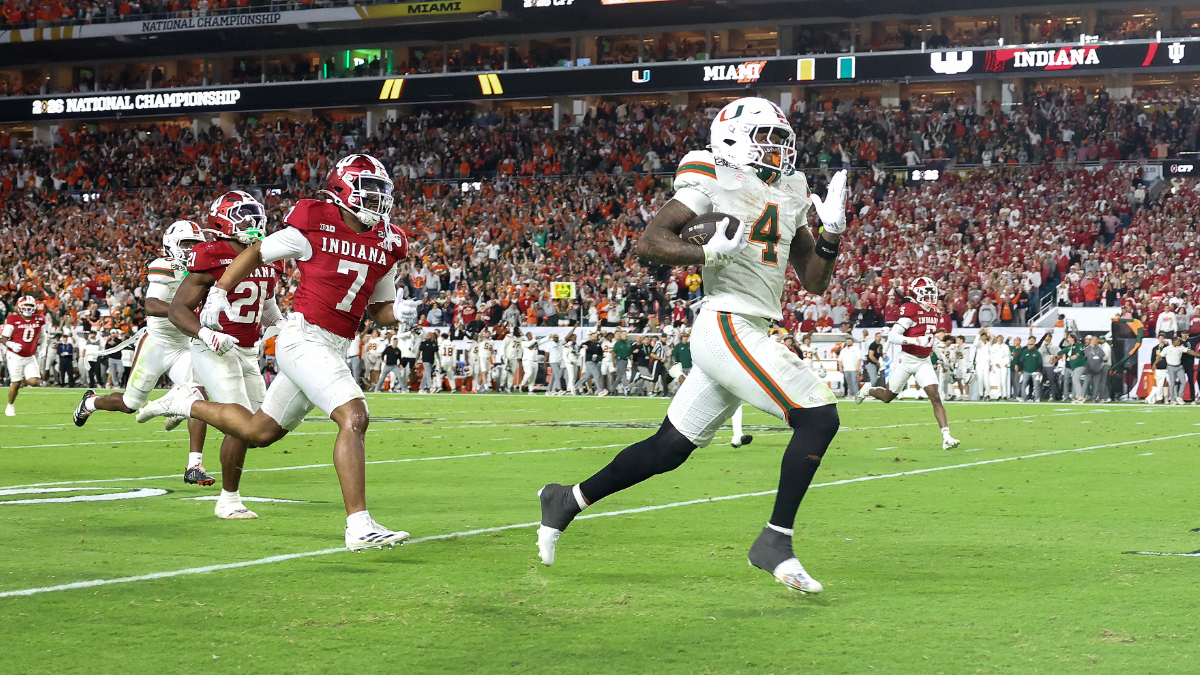
But as he’s done throughout the playoffs for Miami, running back Mark Fletcher Jr. broke through in a big way early in the third quarter with a 57-yard touchdown run to make it 10-7.
Such plays were few and far between, though.
Four more punts followed, including the one that truly swung the game for the Hoosiers. At the end of the third quarter, Indiana’s Mikail Kamara blocked Dylan Joyce’s punt for Miami and Isaiah Jones recovered it in the end zone for a Hoosiers touchdown and 17-7 lead.
Indiana hadn’t called for a punt block per se and had its punt return unit in place, but Kamara said he felt on a previous punt he had a lane to the punter nonetheless.
“I was like, if I get this opportunity again I’m going to take it,” he said. “Dominique Ratcliff, right before the snap, he’s like, ‘Hey, go get this thing.’ I was like, ‘Alright, bet. I got you.’ I got a good jump off the ball, and I just see the punter walking into my face — put my hand up, double thud.'”
Indiana tied for third in the FBS with 4 blocked kicks (all punts) this season, including one in the CFP semifinals vs. Oregon as well.
“Everybody has to buy in on teams because a special teams play, a big special teams play can change the momentum of a game more so than offense or defense,” Cignetti said. ‘Look, if you don’t buy in on teams, then you’re not going to be on this team because it’s a play for our football team.”
Credit Miami for answering right back with a 10-play, 81-yard touchdown drive, including a 24-yard pass from Carson Beck to CJ Daniels on third-and-6 and a 22-yard reception by Malachi Toney down to the Indiana 12, setting up three Fletcher runs for a TD to cut the deficit to 17-14 on the first play of the fourth quarter.
The game started to break open at that point.
Indiana followed immediately with a 12-play, 75-yard touchdown drive that included a clutch 19-yard connection from Mendoza to Becker on fourth-and-5 from the Miami 37, as Becker made an impressive adjustment back to the ball to snare it on the sideline.
That led to the play of the game.
Faced with a fourth-and-4 from the 12, Cignetti elected to go for it and put it in the hands of his Heisman Trophy winner. Mendoza took the QB draw, evaded lunging tacklers, shook off a violent collision with linebacker Wesley Bissainthe, spun free and dove toward the end zone with the ball extended while taking another big hit in the air.
We’ll go deeper on that play in a moment, but it put the Hoosiers up 24-14 with 9:18 to play and still plenty of dramatics left to come.
The Hurricanes continued their newfound offensive momentum, driving for another touchdown while going 91 yards in 8 plays. Beck found tight end Alex Bauman — who had whiffed in protection on that costly blocked punt earlier — for 22 yards on fourth-and-15. Toney, the freshman phenom, immediately turned a short catch into a 41-yard gain to the Hoosiers’ 22 and two plays later raced in for the 22-yard touchdown.
It was again a tight game at 24-21 with 6:37 remaining.
Indiana got to the Miami 17 on the ensuing possession but settled for a 35-yard Radicic field goal.
The Hurricanes would have 1:42 and no timeouts to go 75 yards for the potential winning score in what would be a poetic end to the Beck redemption narrative.
But the sixth-year senior QB who transferred to Miami seeking a better finish to his college career after two seasons as the starter at Georgia would get a much more unfortunate ending and lasting image.
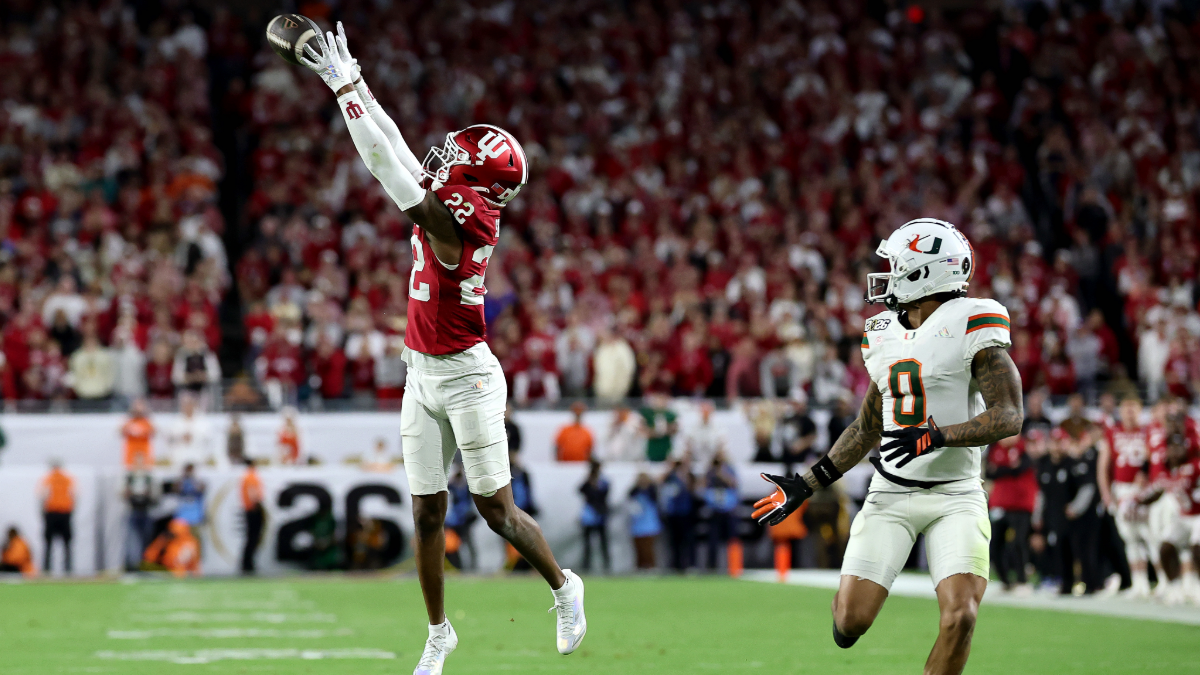
After getting Miami across midfield, Beck underthrew his target downfield and was intercepted by Jamari Sharpe to seal it for the Hoosiers.
Like Mendoza, Sharpe is from Miami and grew up wanting to play for the Hurricanes but was not recruited by the program. Again, only a perfectly befitting ending like that could have capped this incredible Indiana story.
“That moment right there was just the best moment in my life. Catching the game-winning pick in my hometown to win the national championship, it can’t get better. The best feeling ever,” Sharpe said.
It really can’t.
Player Of The Game
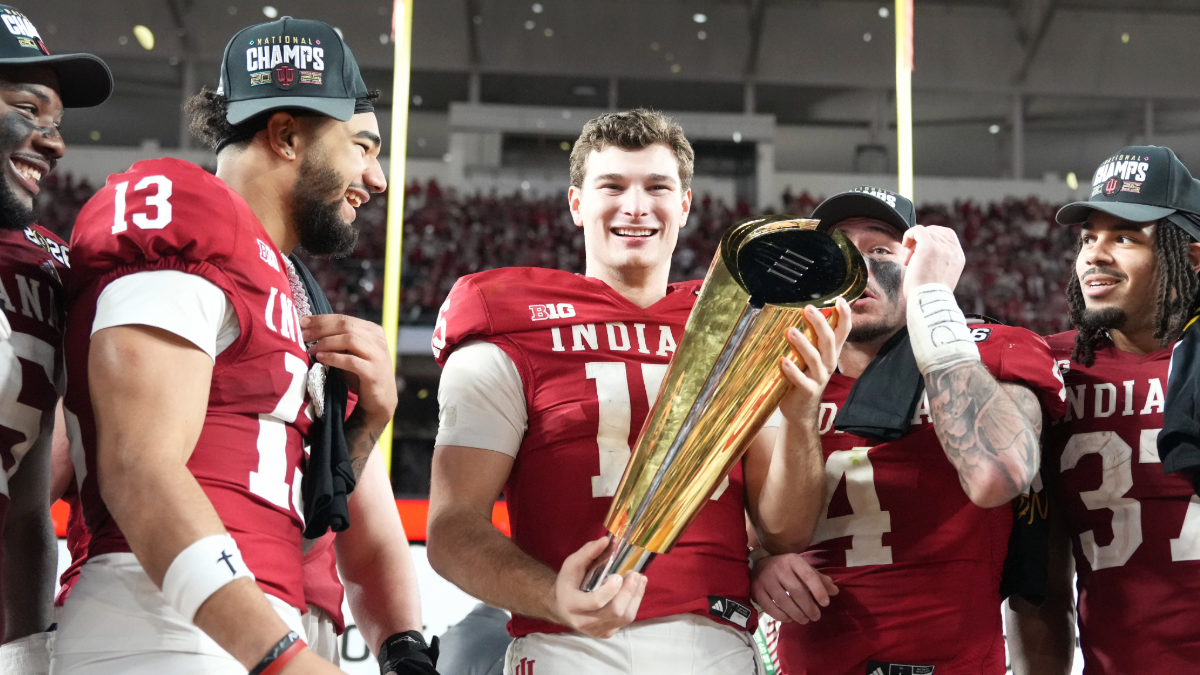
Indiana QB Fernando Mendoza
It wasn’t his most impressive passing performance of these playoffs, but how can it go to anyone else after that iconic fourth down touchdown run and everything the Heisman winner has meant to this team?
Mendoza was 16-of-27 passing for 186 yards, 0 TDs and 0 INTs — finishing the playoffs with no picks — and was named the offensive MVP of the game.
“He’s so tough. I mean, he got hit, he had no time, he keeps getting back up. Just a great competitor. There’s no way this gets done without that kind of performance at that position,” Cignetti said.
Mendoza, who transferred into Indiana after three years at Cal, finished his Heisman Trophy season with 3,535 passing yards, 41 TDs and 6 INTs plus 276 rushing yards and 7 TDs.
“Let me tell you, Fernando, I know he’s great in interviews and comes off as the All-American guy, but he has the heart of a lion when it comes to competition,” Cignetti said. “I mean, that guy competes like a warrior.”
Play Of The Game
Well, obviously …
“A big [mantra] that we’ve had this year is always bet on ourselves,” Mendoza said. “Whether it’s preseason, no one thinks we can make it, whether it’s figuring it out in situations like Oregon, Penn State and Iowa, we always figure it out. And whenever Coach Cignetti and [offensive coordinator Mike] Shanahan, they called that play, we knew, ‘Hey, we’re going to bet on ourselves one more time in the biggest stage of the game.”
Cignetti said the play was put in for this game with a lot of time spent strategizing how to block it. He liked the look he saw from Miami’s defense on the previous play and saw an opportunity.
“The coverage before. They were in the coverage where that play would work. We put it in for this game. It was quarterback draw, but it was blocked differently and we rolled the dice and said they’re going to be in it again and they were. We blocked it well, he broke a tackle or two and got in the end zone, Cignetti said.
As if the moment needed any further layers, consider that Mendoza got absolutely leveled by a similarly jarring hit from the same linebacker — Bissainthe — last year while falling just short in trying to lead Cal to an upset over the Hurricanes.
This time, he couldn’t be denied.
Supportive Stat Lines
Kaelon Black led Indiana on the ground with 17 carries for 79 yards, while Roman Hemby chipped in 60 rushing yards. Indiana’s 131 rushing yards, despite averaging just 2.9 yards per carry, were the fourth most allowed by Miami this season.
Omar Cooper Jr. led the Hoosiers with 5 receptions for 71 yards, while Charlie Becker had 4 catches for 65 yards — each feeling big in the moment.
Safety Louis Moore led Indiana with 7 tackles and a pass breakup, Jamari Sharpe had 6 tackles and a PBU in addition to his game-sealing INT, cornerback D’Angelo Ponds had 5 tackles and 3 PBUs, and linebacker Aiden Fisher had 4 tackles and a sack.
Commendable Performance In Defeat
Malachi Toney capped his incredible freshman season at Miami with 10 catches for 122 yards and a TD, while Mark Fletcher Jr. finished off a fantastic playoff run with 17 carries for 112 yards and 2 TDs.
Fletcher rushed for 507 yards and totaled 3 rushing/receiving TDs in his four playoff games.
And once more, elite edge rushers Rueben Bain Jr. and Akheem Mesidor left their mark on the game, combining for 11 tackles and 3 sacks.
More Postgame Quotes And Soundbites
Indiana LB Aiden Fisher: “From a program that is known for losing and a culture that was in a bad spot when Coach Cig got here, it was all about changing the way people think, and that’s internal and external from the building. We described it as a sleeping giant when we got here. Indiana fans and just the culture around Indiana was just hungry for a winner, and they just needed the right coach and the right players to come in and flip this thing around. It’s been a special ride. … It’s just unbelievable to be a part of, and doing it at Indiana makes it 10 times more special.”
Indiana coach Curt Cignetti: “I think that’s called a paradigm shift. It’s kind of like people can cling to an old way of thinking, categorizing teams as this or that or conferences as this or that, or they can adjust to the new world, the shift of the power balance in the way college football is today.”
More Cignetti …
Indiana CB Jamari Sharpe on his game-sealing INT:
Miami coach Mario Cristobal: “It’s a really special group of human beings. They’ve been elite competitors. They’ve been the best thing that’s happened to the University of Miami and the community in 25 years.”