From the unprecedented drama of former coach Sherrone Moore getting arrested on the same day he was fired, the jarring situation that unfolded in between and the details that have since emerged of his paranoia leading up to that unfortunate ending, to the natural questioning of the leadership within the athletic department and the future of athletic director Warde Manuel, the failed pursuits for Alabama’s Kalen DeBoer and Arizona State’s Kenny Dillingham, an ongoing obsession of at least the fan base with anyone who has ever coached under a Harbaugh brother (Todd Monken as a rumored coach of interest, really?), to interim head coach Biff Poggi’s public pining for the job despite having gone 6-16 in two seasons as the head coach at Charlotte. C’mon.
And yet, through all that, the Wolverines managed to land in a great spot in the end.
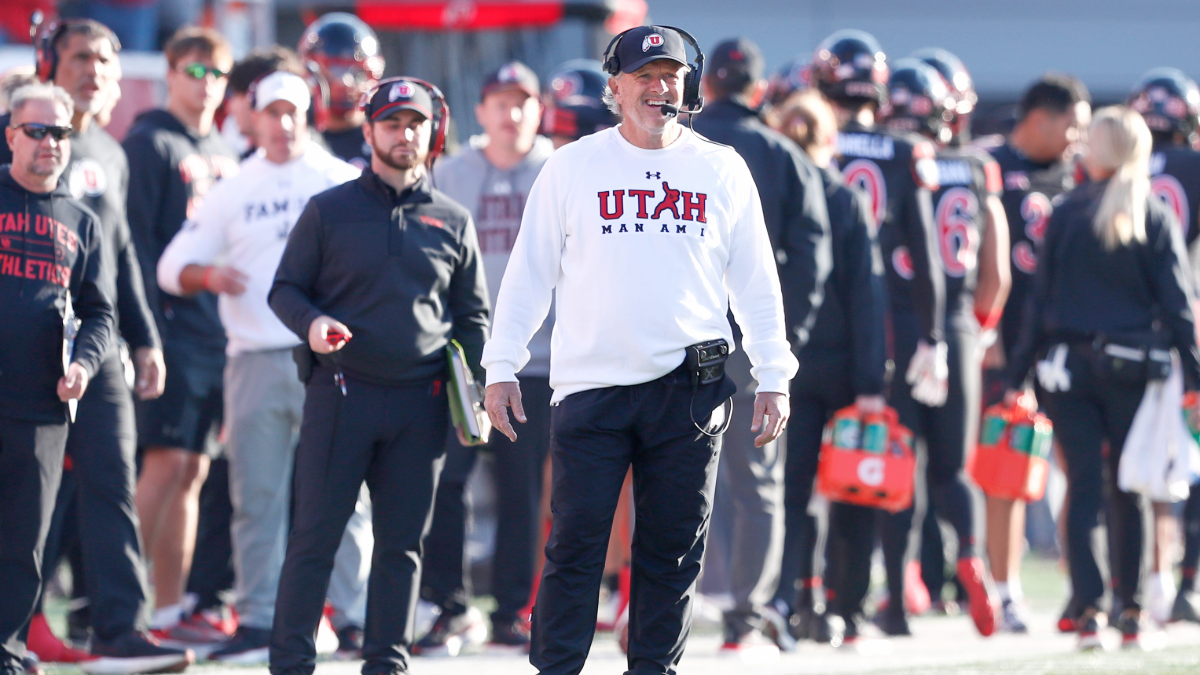
Michigan announced Friday the hiring of former Utah head coach Kyle Whittingham, ending up with a substantial upgrade from Moore and really an ideal fit in most every way.
“Kyle Whittingham is a well-respected and highly successful head coach who is widely recognized as a leader of exceptional character and principled leadership,” Manuel said in a statement Friday evening. “Throughout our search, he consistently demonstrated the qualities we value at Michigan: vision, resilience, and the ability to build and sustain championship-caliber teams. Kyle brings not only a proven track record of success, but also a commitment to creating a program rooted in toughness, physicality, discipline and respect — where student-athletes and coaches represent the university with distinction both on and off the field. We are excited to welcome Kyle to the University of Michigan family as he takes the helm of our football program.”
Whittingham, of course, announced earlier this month he was stepping down at Utah after its Dec. 31 Las Vegas Bowl matchup vs. Nebraska after 21 seasons with the program and 177 wins and counting. He made it clear, however, that he was not retiring.
“I’m stepping down, step away and reevaluate things. … I’m a free agent, I’m in the transfer portal,” he said. “It’s a different feel, but I’m at peace. And I did not want to be that guy who overstayed his welcome with people saying, ‘Hey, when’s this guy gonna leave?’ That was not my intention – ever. I hope I didn’t do that. I’m sure with some people I did do that. To me, the timing was right.”
It had long been rumored that 2025 would be Whittingham’s last season at Utah before he turned the program over to longtime defensive coordinator and “coach in waiting” Morgan Scalley, so despite the interesting timing of his announcement just a couple days after Moore’s firing at Michigan, it is not believed one had any to do with the other.
But it worked out quite conveniently for both Michigan and Whittingham.
The Wolverines’ clunky coaching search had an obvious answer all along, and the 66-year-old Whittingham gets to write presumably the final chapter of his coaching career at one of the most storied programs in college football.
“We are honored to lead the outstanding student-athletes, coaches, and staff who represent Michigan Football each day,” Whittingham said. “Michigan is synonymous with tradition and excellence — both on the field and beyond — and our entire program is committed to upholding those values while striving for greatness together. My family and I are thrilled to join the University of Michigan community, and we look forward to helping our players grow, develop, and reach their highest potential — on the gridiron, in the classroom, and as leaders. It’s a privilege to be part of something that inspires pride in every Wolverine fan. Go Blue!”
But this is not just a fit of convenience and fortuitous timing — it’s a perfect fit for so many other reasons.
First, there simply isn’t a more experienced, proven or successful college football head coach who was legitimately available for the Wolverines to hire.
Whittingham was at Utah so long that his predecessor there was none other than Urban Meyer. Meyer went on to win two national championships at Florida, one at Ohio State and squeeze in two retirements, a failed NFL coaching attempt and now a TV career all while Whittingham was still piling up wins in Salt Lake City.
He’s actually been at Utah since 1994, working his way up from defensive line coach to defensive coordinator under Meyer to eight seasons with double-digit wins as head coach (or 12 seasons with at least 9 wins), including a 13-0 season in 2008 in which the Utes won the Sugar Bowl and finished No. 2 in the final AP poll, a Mountain West championship, two Pac-12 championships and the Bobby Dodd national coach of the year award in 2019.
He’s arguably the most underrated college football coach of the last two decades and deserves to be regarded in the conversation of top 10 coaches of that span. Considering Michigan couldn’t hire Nick Saban, Kirby Smart, Urban Meyer or Curt Cignetti, wouldn’t want Dabo Swinney at this point and Chris Petersen also seems comfortably retired (like Saban and Meyer), this is about as high on that list as the Wolverines could have hit.
(We’ll save a full top-10 coaches of the 2000s debate for another day, but surely other names would fit in there somewhere as well — Bob Stoops of course, Brian Kelly despite his declining stock, Ryan Day, Kalen DeBoer and Dan Lanning still on the ascent up, etc.)
So there’s that.
There’s also the reality that Michigan is a total mess right now, from the fallout of the Connor Stalions sign-stealing scandal, the penalties that followed and of course the unsettling Moore matter.
Well, Whittingham is one of the most respected coaches in the sport who brings instant — and needed — credibility and stability to the program in a way that only a few hires could.
Moreover, though, he’s a coach who routinely maximized the talent on his roster for two straight decades and will now presumably have more four- and five-star players to work with than he’s ever had.
But the exclamation point on all of it is that Whittingham is also an ideal stylistic fit for the Wolverines as he’s spent his career coaching with a Big Ten ethos — led by dependable, hard-hitting defenses and elite rushing attacks, often with a pronounced physicality advantage over the opponent, etc.
It made sense to make a run at DeBoer, who turned Washington from a bit of a mess into a national runner-up in two seasons before leaving for Alabama, where the jury is still out on his tenure there. It made some sense to pursue Dillingham, who certainly seems to be on a meteoric rise up the ranks still at a young age.
But after that, there is no other move that could have delivered the impact Whittingham can — and it’s plenty possible he’ll prove that he the singular best choice all along.