

Bill Belichick has faced his share of backlash of late for his disappointing debut as the University of North Carolina’s seemingly ill-suited head football coach and all the bizarre off-the-field theater related to his 24-year-old girlfriend Jordon Hudson.
But the football world banded together in support of Belichick this week when it was revealed the NFL legend would not be a first-ballot Pro Football Hall of Fame selection, failing to receive the required 80% of the vote from the selection committee of NFL media and distinguished football figures.
This after he won a record six Super Bowl championships as head coach of the New England Patriots, two more as defensive coordinator of the New York Giants, 302 regular season wins (third-most in NFL history) and a record 31 postseason wins, among countless other feats and accolades.
ESPN’s Seth Wickersham and Don Van Natta Jr. reported via sources that Belichick was puzzled and asked an associate, “Six Super Bowls isn’t enough? What does a guy have to do?”
Fair question.
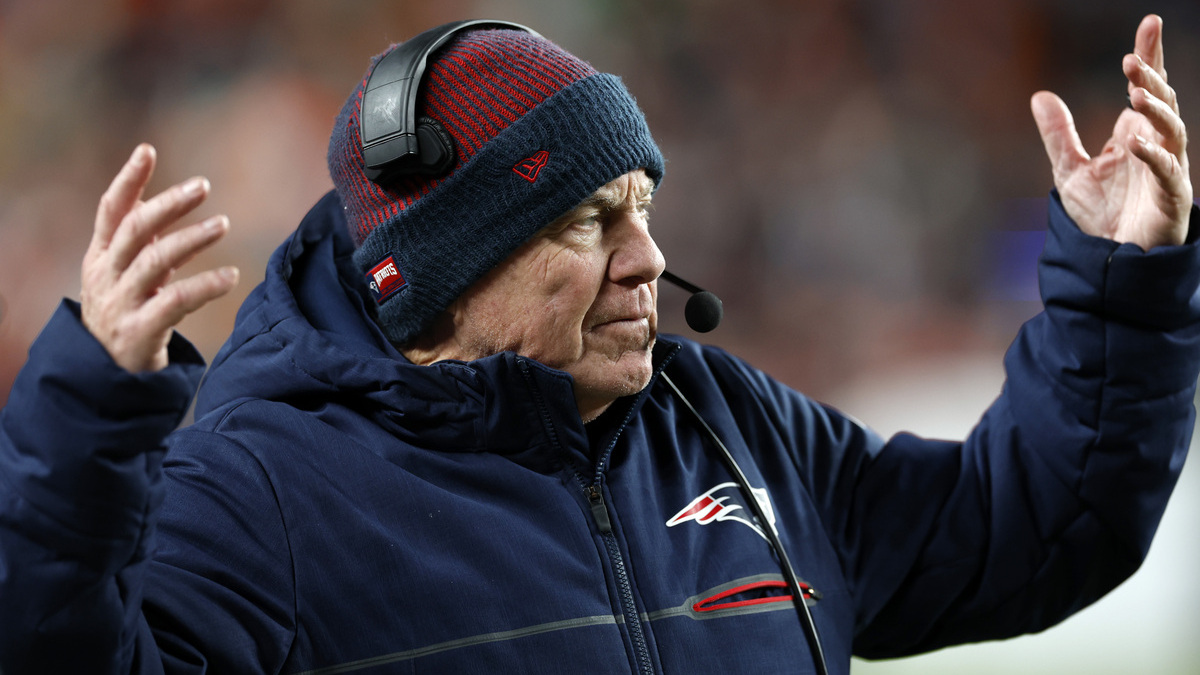
The buzz has been — and it’s the only plausible explanation — that Belichick is being punished by some voters for his role in the Patriots’ Spygate scandal.
Former Indianapolis Colts general manager and team president Bill Polian, who is on the Hall of Fame voting committee, denied reports that he was the one pushing that agenda — but couldn’t remember if he personally voted for Belichick.
Ironically, whoever decided or agreed Belichick needed to be penalized by being denied first-ballot induction only served to do the impossible and make the curmudgeonly legend the one thing he couldn’t pull off on his own — a sympathetic figure unifying the sports world.
Incredible.
“I don’t understand it,” said Tom Brady, Belichick’s quarterback for all six of those Super Bowl championships in New England. “I was with him every day. If he’s not a first-ballot Hall-of-Famer there’s really no coach that should ever be a first-ballot Hall-of-Famer, which is completely ridiculous because people deserve it. … We’ll all be there to celebrate him when it does happen.”
Hall of Fame coach Jimmie Johnson wasn’t so reserved in his own reaction, meanwhile.
“I think this tarnishes everything in the Hall of Fame — all of the inductees, everybody in the Hall of Fame just because of 10 or 11 or 12 ignorant, jealous ***holes who did not vote for him,” Johnson said on the Pat McAfee Show after going on a Twitter tirade about the matter.
Football stars past and present have shared in the outrage. Heck, even NBA legend LeBron James spoke out on it.
There are already rumblings that there could be fallout from this with the potential that the Pro Football Hall of Fame could remove voters if it deems any violated selection process bylaws.
As Brady noted, though, Belichick will get his Hall of Fame call eventually — almost assuredly next year after the backlash the voting committee has received.
In the meantime, with the official Hall of Fame class set to be announced Feb. 5, let’s look at a few other worthy candidates who haven’t yet gotten the call to Canton despite multiple years on the ballot (thus excluding first-ballot finalists like QB Drew Brees, WR Larry Fitzgerald and TE Jason Witten).
QB Eli Manning
Manning was one of 15 modern-era finalists for the second year in a row but did not get enough votes again, per reports.
Not only did Manning win two Super Bowls with the New York Giants — against those Belichick/Brady Patriots, no less — but he’s one of just six players to win two Super Bowl MVPs.
Of that list, Joe Montana, Terry Bradshaw and Bart Starr are in the Hall of Fame while Brady hasn’t yet come eligible and Patrick Mahomes is still playing, though both will surely be first-ballot selections (if any such thing can be sure at this point).
Manning also ranks 11th all-time with 57,023 passing yards and 366 passing touchdowns.
WR Torry Holt
Holt, who starred for the Rams from 1999-2008 before one year with the Jaguars, is also among the 15 modern-era finalists — for the seventh year in a row.
He ranks 17th all-time in receiving yards (13,382), but his elite consistency is what sets him apart. He is one of two wide receivers in league history with six straight 1,300-yard seasons (along with Julio Jones).
The only HOF-eligible receivers with more yards are Fitzgerald (in his first year of eligibility), Reggie Wayne, Anquan Boldin and Henry Ellard, who all played several years longer than Holt.
One of the stars of the Rams’ “Greatest Show on Turf” Super Bowl team, he averaged 83.6 receptions and 1,216.5 receiving yards per season for his career.
Holt finished with 920 receptions and 74 TDs. He ranks 10th all-time, 5th among non-active players and 1st among HOF-eligible receivers in averaging 77.4 receiving yards per game over the duration of his career.
WR Reggie Wayne
It would be hard to put one in and not the other when it comes to Holt and Wayne, who is also in his seventh year as a finalist.
The former Colts star is 10th all-time in receiving yards (14,345) and 11th in receptions (1,070), scored 82 TDs and also won a Super Bowl.
He played 14 years in the league from 2001-14, all with Indianapolis, and had a nine-year stretch from 2004-12 in which he averaged 91.6 receptions for 1,246 yards and 7.4 TDs per season.
RB Roger Craig
Craig, best known for his integral role on the Bill Walsh-coached San Francisco 49ers teams of the 1980s, retired after the 1993 season and has long been cited as one of the best players not in the Pro Football Hall of Fame.
But he has a shot to make it this year.
Aside from the 15 modern-era finalists, he is part of a group of five finalists this cycle voted on separately that includes one coach (Belichick, who we know didn’t get the vote), one contributor (Patriots owner Robert Kraft) and three “senior” players (Craig, former Bengals QB Ken Anderson and former Steelers DE L.C. Greenwood).
Craig is regarded as an influential pioneer in setting the standard for pass-catching running backs, as he was the first player in NFL history to have 1,000 rushing yards and 1,000 receiving yards in the same season — in 1985 when he rushed for 1,050 yards and 9 TDs and caught a league-high 92 passes for 1,016 yards and 6 TDs.
Only two players since have matched that feat — Hall-of-Famer Marshall Faulk and current 49ers star Christian McCaffrey.
Craig was a key part of three 49ers Super Bowl championship teams (for the 1984, 1988 and 1989 seasons), made four Pro Bowls (when that still meant something) and was named the NFL’s Offensive Player of the Year while finishing third in MVP voting in 1988. That season, he rushed for a career-high 1,502 yards and 9 TDs and caught 76 passes for 534 yards and a TD.
He only played 11 seasons, including one with the Raiders and two with the Vikings, and his overall career stats — 8,189 rushing yards, 566 receptions for 4,911 yards and 73 combined TDs — won’t top any individual all-time lists. Even together, he only ranks 49th in all-time yards from scrimmage (28th among running backs).
But as a central figure for one of the NFL’s dynasty runs and a game-changing weapon who inspired Hall-of-Famers to follow in his mold, Craig belongs in Canton.
Coach Mike Holmgren
Since the spotlight this week is on a legendary coach getting snubbed from the Hall of Fame, let’s spotlight the next most-deserving coach not yet in Canton.
How’s this for a stat? Among HOF-eligible-but-not-yet-enshrined Super Bowl-winning coaches with at least 150 regular-season wins not named Belichick (are you still with us?), Holmgren has the highest career winning percentage at .592 (161-111).
The only other two who fit that bill are Mike Shanahan at .552 (170-138) and Tom Coughlin at .531 (170-150), and a compelling case can be made for those two as well as they each won two Super Bowl titles as head coach.
(Bear with us and we’ll get back to Holmgren momentarily)
Shanahan won back-to-back Super Bowls with QB John Elway and the Broncos in the 1997-98 seasons and got Denver back to another AFC championship game seven years later with QB Jake Plummer. He also won a Super Bowl as offensive coordinator of the 1994 49ers.
Coughlin won two Super Bowls with Eli Manning and the Giants after the 2007 and 2011 seasons (and one as the team’s WRs coach in 1990). Before breaking through in New York, he also led the Jaguars to two AFC championship games during the 1996 and 1999 seasons (two of the three AFC title game appearances in franchise history).
Shanahan and Coughlin are among five coaches with multiple Super Bowl wins not in the Hall of Fame, along with Belichick (6), current Chiefs coach Andy Reid (3) and former 49ers coach George Seifert.
So why are we giving the nod to Holmgren?
Holmgren is one of just three HOF-eligible head coaches not in Canton to get to at least three Super Bowls, along with Belichick (9 — seriously, put this guy in yesterday) and Dan Reeves, who went 0-4 with the Broncos and Falcons.
Holmgren is one of just seven coaches to lead two different franchises to the Super Bowl — along with Hall of Fame inductees Don Shula, Bill Parcells, Dick Vermeil, future inductee Reid (who got his first NFL job under Holmgren in Green Bay) and then Reeves and John Fox.
Holmgren won it all with QB Brett Favre and the 1996 Packers and then got back to the Big Game the next year, losing to Shanahan’s Broncos. He then led the Seahawks to their first-ever Super Bowl appearance after the 2005 season, losing to the Steelers.
Building two separate franchises up and his overall consistency are what elevates Holmgren above Shanahan and Coughlin for us.
It’s easy to forget now after the last three decades, but the Packers had made the playoffs just once in 20 years from 1973-92 (getting to the divisional round during the strike-shortened 1982 season) before Holmgren led them to six straight appearances starting in 1993, his second season. More to the point, Green Bay had just three winning records in the 19 seasons before his arrival.
Holmgren revived one of the NFL’s most storied franchises immediately, going 9-7 his first year on the way to posting a winning record in all seven seasons there with a 75-37 overall mark (67%), plus a 9-5 record in those six playoff appearances with three conference championship game berths, the two Super Bowls and the one championship.
He then resigned to take over the Seahawks, who were willing to give him total control over personnel decisions and the largest contract for a head coach in NFL history at the time (eight years and $32 million).
Again, Holmgren took on a major turnaround challenge as Seattle had missed the playoffs 10 straight years and hadn’t posted a winning record in eight straight seasons (albeit with a few 8-8s).
And yet, he elevated that franchise immediately as well, going 9-7 with a division title and playoff breakthrough in his first season in 1999. After missing the postseason the next three years, Holmgren then led Seattle to five straight playoff berths and the franchise’s first Super Bowl appearance.
Overall, he had just three losing seasons in 17 years as a head coach.
Holmgren also won two Super Bowls as an assistant coach in San Francisco, one as QBs coach and one as OC, where he was hailed for helping Joe Montana to his two MVP seasons in 1989-90 while also developing future MVP Steve Young, before developing Favre into a three-time MVP during their time together in Green Bay.
And then there’s his coaching tree.
Coughlin also built winners in two cities, though the Giants had been in a Super Bowl four seasons before he took the reins. But he also had just 10 winning seasons (plus an 8-8 team that made the postseason) and nine playoff appearances in 20 years.
And Shanahan took over an already thriving Broncos franchise that had been to three Super Bowls in the prior decade with just two losing seasons in the previous 12 years. Shanahan got the franchise and its Hall of Fame QB to new heights and deserves his own HOF consideration one day because of it, but he also didn’t match Holmgren’s consistency.
Including 1-plus season as head coach of the Raiders and four with the Washington franchise (now Commanders), Shanahan posted 10 winning seasons and 8 playoff appearances in 20 years.
Holmgren was a Hall of Fame finalist in 2020 when eight coaches were among 38 candidates considered in a special Centennial Class vote to honor the NFL’s 100th season. He was a finalist against last year as the lone coach on the ballot, but it’s hard to say when or if he’ll get another shot.
The HOF selection process has continually changed regarding coaches, contributors and players outside the modern-era window. For the last two years, committee members could vote for a maximum of three candidates from a pool of one coach finalist, one contributor and three senior players.
Belichick replaced Holmgren as the coach finalist this year, from a pool of semifinalists that included both along with Coughlin, Shanahan, Reeves, Seifert, Chuck Knox, Buddy Parker and Marty Schottenheimer.
Unless the process changes further, it’s almost a certainty Belichick will be the one coach finalist again next year.
But once that wrong is righted and Belichick gets his day in Canton, Holmgren deserves another look in 2027.
Editor's Pick
 2026 NFL Postseason: Playoff Schedule & Draft Order