With Super Bowl week in full effect, it is a good time to look back at those who previously played on the biggest stage. There are a ton of players who have put up amazing performances. Some of these players would go on to win Super Bowl MVP.
This award is one of the most prestigious individual honors in football. However, history shows that the award doesn’t always go to the player who had the best performance on the field.
Some players delivered legendary performances and rightfully took home MVP. Others were just as extraordinary, but left without the trophy.
Here are our picks for 10 of the greatest Super Bowl performances, split into two categories — those who won MVP and those who probably should have.
Players Who Won Super Bowl MVP
Tom Brady (Super Bowl LI)
The most memorable Super Bowl in the history books, where Tom Brady led the New England Patriots down 28-3. At the time, Brady eclipsed Kurt Warner’s record for most passing yards, his own record for most completions, and Jim Kelly’s for pass attempts. This was a legacy defining game for Brady, which is what propels it as one of best performances. Many consider this to be Brady’s best Super Bowl performance as well.
Brady would go on to break the passing record with 466 yards (which he would break the following year). However, being down 28-3 with 8:31 left in the third quarter, Brady ended up throwing for 284 passing yards (including overtime), and two passing touchdowns. One play people do forget was Brady’s only rushing attempt. On third-and-8 on the Falcons 35-yard line, a 15-yard scramble would extend the drive that started the comeback.
Brady has been to multiple Super Bowls, won them, won MVP. However, his performance as the quarterback, the leader of the team, when all odds were against the Patriots, cemented his status as the Greatest of All Time (G.O.A.T).
Jerry Rice (Super Bowl XXIII)
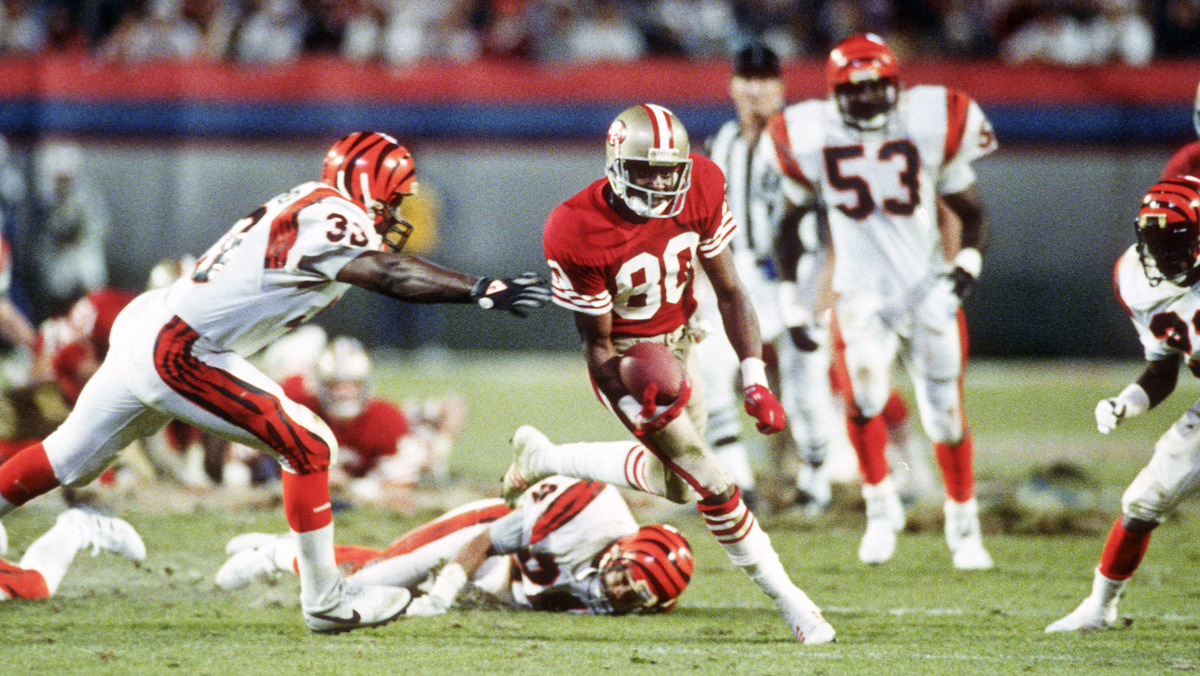
When talking about the best wide receiver performance in Super Bowl history, you have to start with Jerry Rice in Super Bowl XXIII. Rice put on a performance that still stands alone in the record books, 11 receptions for 215 yards and a touchdown. To this day this is still a Super Bowl record that has never been broken.
Rice would end the game with only one receiving touchdown, a 14-yard reception from Joe Montana, which would wind up tying the game. This touchdown gave momentum to the San Francisco 49ers at a much needed time. Rice’s showing wasn’t just about yards, it was about impact. Rice consistently got open and punished a staggering Bengals secondary. For Cincinnati, you just couldn’t leave Rice one-on-one, but Montana would take advantage when they did.
This performance left a lasting legacy for Rice, as he is considered the greatest wide receiver to ever play the game.
Nick Foles (Super Bowl LII)
Super Bowl LII will forever be remembered for the “Philly Special.” However, it is also remembered for the quarterback who faced all odds. Despite facing a heavily favored New England Patriots defense, Foles had one of the most efficient and gutsy Super Bowl performances by a quarterback in recent memory.
Not only did Foles defeat the Patriots, but he would wind up reshaping how teams look at backup quarterbacks. The impact of Foles winning this Super Bowl is more than just the box score. It’s the fact that he came off the bench and won Philadelphia their first Super Bowl championship when all odds were against the Eagles.
Foles would end the night with 373 passing yards, 3 passing touchdowns, as well a receiving touchdown from the trick play the, “Philly Special.” That night, nobody expected to see the upset led by a backup quarterback. However, Foles showed up time after time that night to cement a long lasting memory in the history books.
Joe Montana (Super Bowl XXIV)
Joe Montana’s Super Bowl XXIV performance was about surgical dominance. In the 49ers’ 55–10 demolition of the Denver Broncos, Montana simply owned the field. He completed 22 of 29 passes for 297 yards and at the time, a Super Bowl-record of five touchdown passes in a game that remains the most lopsided in Super Bowl history.
This wasn’t just piling up stats, every throw was precise, every drive methodical, every read perfect. Montana carved up Denver’s defense and the result was one of the most complete offensive performances you’ll ever see on football’s biggest stage.
Where others rise to the moment by grinding out a win, Montana erased the moment entirely. For Montana, he has always had his unique style in winning Super Bowls or having a clutch game winning drive. However, his Super Bowl XXIV line wasn’t just great, it was historic in its dominance.
Doug Williams (Super Bowl XXII)
Super Bowl XXII wasn’t just a blowout, it was a cultural milestone. Doug Williams became the first black quarterback to start, win, and earn Super Bowl MVP honors. Facing the Denver Broncos, Williams threw for 340 yards and four touchdowns, leading Washington to a commanding 42–10 victory. This game started with Washington trailing 10-0, with odds against it and John Elway on the other side.
However, Williams would end up coming back into the second quarter, after twisting his leg, which is when everything started to click for the team.
What makes Williams’ performance resonate beyond just numbers is the historical context. In a league that had long undervalued black quarterbacks, he didn’t just succeed, he excelled. His performance wasn’t just efficient, it was explosive, with Williams systematically dismantling Denver’s defense while paving the way for future generations of signal-callers.
This wasn’t just a Super Bowl MVP moment, it was a statement that changed the narrative of what a champion quarterback could look like.
Players Who Didn’t Win Super Bowl MVP
Thurman Thomas (Super Bowl XXV)
In a game that came down to eight seconds and a missed field goal, Thurman Thomas delivered one of the most impressive Super Bowl performances ever. In Super Bowl XXV, Thomas rushed for 135 yards and a touchdown while adding 55 receiving yards. Thomas did more than just move the ball, he controlled the pace of the game for the Buffalo Bills.
Yet even with that level of production, the MVP went to Giants running back Ottis Anderson due to the Bills losing on a last-second kick that missed wide right. The narrative unfairly buried what Thomas did: a dominant ground and receiving performance that kept Buffalo in the game. Many analysts and fans alike have argued that if the Bills had won, Thomas would’ve been the rightful Super Bowl MVP. Besides Chuck Howley, there is nobody in Super Bowl history where a player was clearly the best on the field and on the losing side.
Thomas’ Super Bowl XXV night is a classic example of an MVP performance overshadowed by a game result.
James White (Super Bowl LI)
In the story of Super Bowl LI, James White was the true engine behind the Patriots’ comeback. White was everywhere in the game. Finishing the contest with 14 catches for 110 yards, a Super Bowl record for receptions by any player. On top of that, he rushed six times for 29 yards and two crucial rushing touchdowns. White had the game-tying score with under a minute left and the overtime walk-off touchdown that sealed the 34–28 victory.
White also converted the 2-point attempt that cut the deficit to 8, helping set up the final drive. In total, he accounted for 20 of the Patriots’ 34 points, another Super Bowl record.
What makes White’s night so remarkable is how many roles he filled. White was the leading receiver, red-zone scorer and a clutch runner. Running backs don’t often lead teams in receiving or put up MVP-caliber numbers, but White did all of that on the sport’s biggest stage.
Even Tom Brady himself publicly stated after the game that White deserved the MVP over him. In a game full of unforgettable moments, White’s performance stands out not just for the stats. His performance was decisive, historic, and for many, arguably more deserving of a Super Bowl MVP than anyone else on the field that night.
Matt Snell (Super Bowl III)
One of the most underrated performances in Super Bowl history came from Matt Snell in Super Bowl III. However, he didn’t get Super Bowl MVP despite arguably deserving it. Snell was the workhorse of the New York Jets’ offense in their historic upset over the Baltimore Colts. He would end up carrying the ball 30 times for 121 yards, a then-Super Bowl rushing record.
Snell would end up scoring the only touchdown for the Jets on a 4-yard run that gave New York a 7-0 lead. He also chipped in 4 receptions for 40 yards, making him a centerpiece of the Jets’ ball-control attack that day.
What makes Snell’s performance so compelling is not just the volume of production, but the context of it. He consistently moved the chains and kept the Colts defense off balance. His 121 rushing yards came against what was one of the league’s most respected defenses, and his touchdown put the first AFL-champion Jets on the scoreboard in a massive upset.
Yet despite this level of contribution, arguably the most impactful offensive effort in that game, the MVP went to Joe Namath. This was largely due to his guarantee and leadership in managing the game rather than having flashy stats. Many analysts and historians still argue that Snell should’ve been MVP. His physical dominance and key score were indispensable to the Jets winning their first Super Bowl. During this time period, this kind of production meant a whole lot more than it would in today’s world, which makes it even more impressive.
Snell’s Super Bowl III night stands as one of the throwback examples where production and impact arguably outshined the official MVP choice.
Jalen Hurts (Super Bowl LVII)
A great Super Bowl performance that is overshadowed due to being on the losing team. Jalen Hurts had a dominant performance for the Philadelphia Eagles. Hurts tied the rushing touchdown record, but he was the first quarterback to rush for 3 touchdowns. For Hurts, his performance consisted of 304 passing yards, 1 passing touchdown on top of 3 rushing ones, and 70 rushing yards. Although Hurts had a costly fumble that was returned by Nick Bolton for a touchdown, there is no doubt Hurts wins MVP if the Eagles won the game.
Besides the fumble, statistically, Hurts played perfectly. He carried the team and accounted for 20 points, individually. Not only did Hurts use his legs to extend plays, but he also punished the Kansas City Chiefs’ defense with his arm.
What Hurts did with his legs that night had never been done before by a quarterback. He outplayed Mahomes, and did it just his third season.
Due to the performance shown on the field, it is widely considered that Hurts should have won the Super Bowl MVP despite the Eagles losing.
James Washington (Super Bowl XXVIII)
Super Bowl XXVIII was defined by the Dallas Cowboys finally ending the Buffalo Bills’ Super Bowl appearance streak. And right in the middle of that turning point was James Washington. In the second half of the game, Leon Lett would force a fumble on Thurman Thomas that Washington returned for a touchdown that swung momentum decisively in Dallas’ favor. The fumble-turned-touchdown would essentially deflate any chance Buffalo had at a comeback.
As a defensive player, it was already highly unlikely Washington would end up winning MVP, however it wasn’t just about the points, it was the timing. That one play broke the Bills’ rhythm, snapped their confidence, and allowed the Cowboys to pull away to a 30–13 victory. On the Buffalo Bills 30 for 30 documentary, multiple Bills players would end up speaking highly about the fumble returned for a touchdown, and how it was basically the gut punch for the game.
Washington didn’t win MVP, but the multiple turnovers and return for a score was the game’s biggest moment. In a different world, Washington gets that MVP hardware.